
Key points
- The glossary has 78 terms in five groups: financial statements, books and entries, assets and inventory, analysis and control, and Egyptian tax terms.
- Each term is given in English and in the Arabic that Egyptian accountants use at work, such as ميزان المراجعة for trial balance and العهدة for petty cash.
- The definitions of asset, liability, equity, income and expenses follow the IASB Conceptual Framework revised in March 2018.
- The tax terms name the law or system behind them, such as VAT Law No. 67 of 2016, and give no rates, because rates change.
This glossary gives 78 accounting terms in English and Arabic, each with a definition of one or two sentences. It is written for two readers: a company owner who hears these words from an accountant or a bank, and a new graduate who studied in one language and now works in both. The terms are grouped the way the work runs, from the financial statements down to the entries behind them, then assets, analysis and the Egyptian tax terms you meet in the first month on the job.
How do the terms fit together?
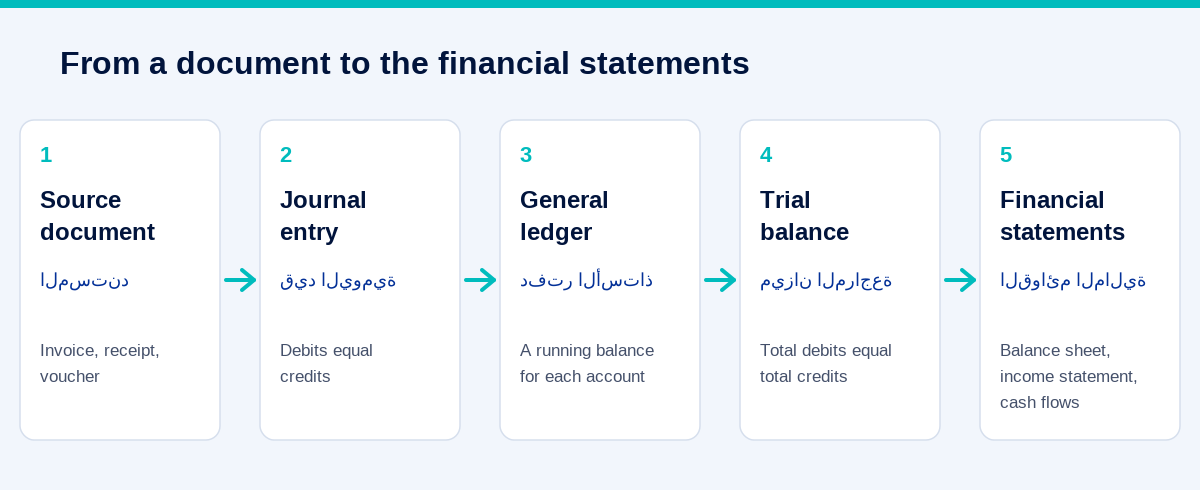
Most of these terms sit somewhere on one path. A source document, such as an invoice, becomes a journal entry; entries are posted to the general ledger; the ledger balances are listed in a trial balance; and the trial balance is the base for the financial statements. If you know where a term sits on that path, you know who in the company deals with it and when.
What do the financial statement terms mean?
The financial statements are the reports a company produces at the end of a period: what it owns and owes, what it earned, and how its cash moved. The five elements below (asset, liability, equity, income, expenses) follow the wording of the IASB Conceptual Framework, revised in March 2018, which also underlies the Egyptian standards.
- Statement of financial position, balance sheet (الميزانية، قائمة المركز المالي)
- A list of what the company owns and owes on one date. Assets always equal liabilities plus equity.
- Income statement, profit and loss (قائمة الدخل)
- Revenue less expenses for a period, ending in a profit or a loss. It covers a month, a quarter or a year, never a single day.
- Statement of cash flows (قائمة التدفقات النقدية)
- Cash in and cash out for the period, split into operating, investing and financing activities. It explains why profit and the bank balance differ.
- Statement of changes in equity (قائمة التغير في حقوق الملكية)
- How capital, reserves and retained earnings moved during the period. Profit, dividends and new capital all appear here.
- Notes to the financial statements (الإيضاحات المتممة)
- The pages after the statements that explain the policies used and break down the main figures. They are part of the statements.
- Asset (الأصل)
- A present economic resource controlled by the company as a result of past events. Cash, stock, machines and amounts customers owe are all assets.
- Liability (الالتزام، الخصم)
- A present obligation of the company to transfer an economic resource as a result of past events. Supplier balances, loans and taxes due are liabilities.
- Equity (حقوق الملكية)
- The residual interest in the assets after deducting all liabilities. In practice: capital, reserves and retained earnings.
- Income, revenue (الدخل، الإيراد)
- Increases in assets, or decreases in liabilities, that increase equity, other than money put in by owners. Revenue is the part that comes from the company’s ordinary activities, such as sales.
- Expenses (المصروفات)
- Decreases in assets, or increases in liabilities, that reduce equity, other than distributions to owners. Rent, salaries and depreciation are expenses.
- Retained earnings (الأرباح المحتجزة)
- Profits from past years that were kept in the company instead of being distributed. They sit inside equity.
- Going concern (الاستمرارية)
- The assumption that the company will keep operating for the foreseeable future. Statements are normally prepared on this basis unless there is reason to doubt it.
- Accrual basis (أساس الاستحقاق)
- Recording income when it is earned and expenses when they are incurred, whatever the date of payment. The opposite is the cash basis.
- Financial year, fiscal year (السنة المالية)
- The twelve months a company closes its books for. It does not have to match the calendar year.
What do the books and entries terms mean?
These are the words of daily bookkeeping, the work that turns documents into balances. A graduate will use most of them in the first week. An owner who knows them can ask better questions at the month end, such as whether the bank reconciliation is done and what is still in the suspense account.
- Double entry (القيد المزدوج)
- Every transaction is recorded in at least two accounts, with total debits equal to total credits. This is what lets the books be checked.
- Debit and credit (مدين ودائن)
- The two sides of every entry. A debit increases an asset or an expense; a credit increases a liability, equity or income.
- Journal entry (قيد اليومية)
- The record of one transaction: date, accounts, amounts and an explanation. It should point to the document it came from.
- Journal, day book (دفتر اليومية)
- Entries in date order, as they happen. In an accounting system it is the list of posted entries.
- General ledger (دفتر الأستاذ العام)
- The same entries sorted by account, with a running balance for each. Posting is moving an entry from the journal to the ledger.
- Subsidiary ledger (دفتر الأستاذ المساعد)
- A detailed ledger behind one control account, such as one account per customer behind total receivables. Its total must agree with the control account.
- Chart of accounts (دليل الحسابات)
- The numbered list of every account the company uses, grouped by type. A good one decides what reports the business can get later.
- Trial balance (ميزان المراجعة)
- A list of every ledger account with its debit or credit balance on one date. The two totals must agree, though agreement alone does not prove the entries are right.
- Source document (المستند)
- The paper or electronic evidence behind an entry: invoice, receipt, payment voucher, delivery note. No document, no entry.
- Documentary cycle (الدورة المستندية)
- The agreed route a document takes, who issues it, who approves it, who records it. Purchases, sales, stock and cash each have their own cycle.
- Adjusting entry (قيد التسوية)
- An entry at the period end that puts income and expenses in the right period, such as accruals, prepayments and depreciation.
- Closing entry (قيد الإقفال)
- The year-end entry that clears income and expense accounts into profit or loss and then into retained earnings. Most systems do it automatically.
- Reversing entry (القيد العكسي)
- An entry that cancels an earlier one, line for line, on the first day of the next period. It is used for accruals and to correct mistakes without deleting history.
- Accrued expense, accruals (المصروف المستحق)
- An expense already incurred but not yet invoiced or paid, such as electricity used in November and billed in December. It is recorded as a liability.
- Accrued income (الإيراد المستحق)
- Income earned in the period but not yet invoiced. It is recorded as an asset until the invoice is issued.
- Prepaid expense, prepayment (المصروف المقدم)
- An amount paid now for a later period, such as a year’s rent paid in advance. It is an asset, released to expense month by month.
- Deferred revenue, income received in advance (الإيراد المقدم)
- Money received before the work is done or the goods delivered. It is a liability until the company delivers.
- Bank reconciliation (مذكرة تسوية البنك)
- A monthly statement that explains each difference between the bank account in the books and the bank statement. Typical items are cheques not yet cleared and bank charges not yet recorded.
- Suspense account (الحساب المعلّق)
- A temporary account for amounts whose correct account is not yet known. It should be cleared to zero at each month end.
- Petty cash, cash advance (العهدة، النثرية)
- A small sum given to an employee for minor expenses, settled later against receipts. An unsettled advance stays a receivable from that employee.
- Month-end close (الإقفال الشهري)
- The set of checks and entries that finish a month: reconciliations, accruals, depreciation, review. After it, the month is locked against new entries.
What do the asset and inventory terms mean?
This group covers what the company owns and how its value is measured over time: machines that wear out, stock that is bought and sold, customers who may not pay. For inventory, IAS 2 and Egyptian Accounting Standard No. 2 allow FIFO or weighted average cost for interchangeable items, and IAS 2 does not permit LIFO.
- Fixed assets, property, plant and equipment (الأصول الثابتة)
- Physical assets used in the business for more than one year, such as buildings, machines, vehicles and computers. They are recorded at cost and depreciated.
- Depreciation (الإهلاك)
- Spreading the cost of a fixed asset, less its residual value, over its useful life. It is an expense that involves no cash payment.
- Straight-line method (طريقة القسط الثابت)
- Equal depreciation each year. A machine costing EGP 120,000 with a five-year life and no residual value is depreciated by EGP 24,000 a year.
- Useful life (العمر الإنتاجي)
- The period the company expects to use an asset. It is an estimate, reviewed if circumstances change.
- Residual value (القيمة المتبقية، القيمة التخريدية)
- What the company expects to get for an asset at the end of its useful life. It is not depreciated.
- Accumulated depreciation (مجمع الإهلاك)
- All the depreciation charged on an asset so far. Cost less accumulated depreciation is the net book value.
- Intangible asset and amortisation (الأصل غير الملموس والاستهلاك)
- An asset without physical form, such as software licences. Amortisation is its equivalent of depreciation.
- Impairment (الاضمحلال)
- A write-down when an asset is worth less than its book value, for example a machine left idle. The loss goes to the income statement.
- Capital and revenue expenditure (المصروف الرأسمالي والمصروف الإيرادي)
- Capital expenditure buys or improves an asset and is added to its cost. Revenue expenditure keeps things running and is expensed at once.
- Inventory, stock (المخزون)
- Goods held for sale, in production, or as materials to be used in production. It is measured at the lower of cost and net realisable value.
- Stock count, stocktake (الجرد)
- Counting what is physically in the store and comparing it with the books. The differences show shortages, errors or missing documents.
- FIFO, first in first out (الوارد أولاً يصرف أولاً)
- A cost formula that assumes the oldest units are sold first, so closing stock is valued at the latest prices. It is allowed under IAS 2 and EAS 2.
- Weighted average cost (المتوسط المرجح)
- A cost formula that values every unit at the average cost of the units available. The average can be worked out periodically or after each delivery.
- Net realisable value (صافي القيمة البيعية)
- The expected selling price less the costs still needed to finish and sell the item. If it falls below cost, stock is written down to it.
- Accounts receivable, debtors (العملاء، المدينون)
- Amounts customers owe for sales already made. An ageing report shows how long each balance has been unpaid.
- Allowance for doubtful debts (مخصص الديون المشكوك في تحصيلها)
- An estimate of the receivables that will not be collected, deducted from the receivables balance. It is booked before a debt is finally written off.
- Accounts payable, creditors (الموردون، الدائنون)
- Amounts the company owes suppliers for goods and services received. They should agree with the suppliers’ own statements.
What do the analysis and control terms mean?
These terms are about reading the numbers and protecting them. An owner meets them in a bank meeting or a monthly report; a graduate meets them in an interview. Working capital and the current ratio describe whether the company can pay its bills. Segregation of duties and cut-off describe whether the numbers can be trusted.
- Working capital (رأس المال العامل)
- Current assets less current liabilities. It is the money tied up in running the business day to day: stock, customer balances, cash.
- Current assets and current liabilities (الأصول والالتزامات المتداولة)
- Items expected to turn into cash, or to be paid, within twelve months or one operating cycle. Everything else is non-current.
- Current ratio (نسبة التداول)
- Current assets divided by current liabilities. Banks read it as a first test of whether short-term debts are covered.
- Liquidity (السيولة)
- The ability to pay obligations when they fall due. A profitable company can still run out of cash.
- Gross profit (مجمل الربح)
- Sales less cost of sales. Divided by sales, it gives the gross margin, the first line to watch in a trading company.
- Cost of goods sold (تكلفة المبيعات)
- The cost of the stock sold in the period: opening stock plus purchases less closing stock. The stock count feeds it directly.
- Net profit (صافي الربح)
- What is left after all expenses, including interest and tax. It is the bottom line of the income statement.
- EBITDA (الأرباح قبل الفوائد والضرائب والإهلاك والاستهلاك)
- Earnings before interest, tax, depreciation and amortisation. Lenders use it as a rough measure of operating cash generation.
- Budget (الموازنة التقديرية)
- The plan for the coming period in numbers: expected sales, costs and cash. Comparing actual results with it each month is budget control.
- Variance (الانحراف)
- The difference between actual and budget. A variance is useful only when someone explains why it happened.
- Cost centre (مركز التكلفة)
- A part of the business that costs are collected for, such as a branch, a department or a production line. It is set up in the chart of accounts or the ERP.
- Break-even point (نقطة التعادل)
- The level of sales at which total revenue equals total cost, with no profit and no loss. Fixed costs divided by the contribution margin per unit gives it in units.
- Materiality (الأهمية النسبية)
- Information is material if leaving it out or misstating it could change a reader’s decision. It depends on size and nature, not on a fixed percentage.
- Cut-off (الفصل بين الفترات)
- Making sure each transaction is recorded in the period it belongs to. Goods delivered on 31 December belong to December, even if the invoice is dated January.
- Internal control (الرقابة الداخلية)
- The approvals, checks and limits that protect assets and keep records reliable. Approval authorities and stock counts are examples.
- Segregation of duties (الفصل بين المهام)
- Not letting one person both handle an asset and record it. The storekeeper should not also post the stock entries.
- External audit (المراجعة الخارجية)
- An independent examination of the financial statements by a licensed auditor, who gives an opinion on them. It is separate from the bookkeeping.
Which Egyptian standards and tax terms should you know?
These terms come from Egyptian law and from the Egyptian Tax Authority’s own systems, so each entry names its source. They are general definitions as of November 2026, with no rates or deadlines. For a specific case, read the current law or the Tax Authority’s site. Kayan Finance does not represent clients before the Tax Authority.
- Egyptian Accounting Standards, EAS (معايير المحاسبة المصرية)
- The accounting standards issued with Minister of Investment Decree No. 110 of 2015 and amended by later decrees. The Financial Regulatory Authority publishes them and their amendments.
- Value added tax, VAT (الضريبة على القيمة المضافة)
- A tax on the sale of goods and services, governed by Law No. 67 of 2016, which replaced the General Sales Tax Law of 1991. Registered businesses collect it on sales and deduct what they paid on purchases.
- Input tax (ضريبة المدخلات)
- In the VAT Law’s words, tax paid on purchases and imports related to taxable sales. It is deducted from the tax collected on sales.
- Registrant (المسجل)
- A taxable person registered with the Egyptian Tax Authority under the VAT Law. Registration brings the duty to invoice, collect the tax and file returns.
- Tax period (الفترة الضريبية)
- Under the VAT Law, one calendar month. A registrant files a VAT return for each month.
- Tax invoice (الفاتورة الضريبية)
- An invoice prepared on the form set by ministerial decree under the VAT Law. For companies required to join the e-invoice system, the invoice is issued through that system.
- E-invoice system (منظومة الفاتورة الإلكترونية)
- The Egyptian Tax Authority’s system through which companies issue invoices to other businesses electronically. The Authority publishes which taxpayers are required to join.
- E-receipt system (منظومة الإيصال الإلكتروني)
- The Tax Authority’s parallel system for receipts issued to individual consumers, usually from a point of sale. It too has published lists of businesses required to join.
- Withholding and collection, WHT (الخصم والتحصيل تحت حساب الضريبة)
- A system under the Income Tax Law No. 91 of 2005 in which a payer deducts part of a payment and remits it to the Tax Authority on the payee’s account. The Authority publishes the return forms on its site.
Tax laws are amended often. The entries above say what a term means, not how much is due or when. Check the law in force and the Tax Authority’s site for any figure.
Common questions
- Is الميزانية the same as a budget?
- No. In Egyptian usage الميزانية usually means the balance sheet, a statement of the past. A budget, الموازنة التقديرية, is a plan for the future. When a bank asks for one, check which it means.
- Why do Egyptian accountants say الخصوم and الالتزامات for the same thing?
- Both translate liabilities. الخصوم is the older word, still common in practice; الالتزامات is closer to the wording of the current standards. Either is understood.
- Should a graduate learn the terms in English or in Arabic?
- Both. Most accounting systems and certifications use English, while documents, the Tax Authority and many managers use Arabic. Learning each term as a pair, as in this glossary, saves translating in your head during an interview.
- Is LIFO allowed in Egypt?
- Egyptian Accounting Standard No. 2 names FIFO and weighted average for interchangeable items, plus specific identification for items that are not interchangeable. It does not provide for LIFO, and IAS 2 does not permit it.
Sources
The pages the figures and rules in this article were checked against, read in November 2026.
- ifrs.org/issued-standards/list-of-standards/conceptual-framework
- accaglobal.com/gb/en/student/exam-support-resources/fundamentals-ex...
- accaglobal.com/gb/en/student/exam-support-resources/professional-ex...
- ifrs.org/issued-standards/list-of-standards/ias-2-inventories
- aasb.gov.au/admin/file/content105/c9/IAS2_BC_1-22.pdf
- tarekmansour.com/wp-content/uploads/2021/06/02-المخزون.pdf
- fra.gov.eg/wp-content/uploads/2025/05/معاييرالمحاسبةالمصرية110لسنة2...
- fra.gov.eg/تشريعات-معايير-المحاسبة-ومراقبي-الحس-2
- eta.gov.eg/sites/default/files/2024-02/Law-english-no.67-2016.pdf.pdf
- eta.gov.eg/ar/content/e-invoice-services
- eta.gov.eg/ar/content/e-receipt-services
- eta.gov.eg/ar/content/nmadhj-aqrarat-alkhsm-walthsyl
- eta.gov.eg/ar/content/qwanyn-aldrybt-ly-aldkhl