
Key points
- The balance sheet is a picture on one date. The income statement covers a period; the balance sheet shows where things stand at its end.
- Assets are what the company owns or is owed. Liabilities are what it owes to others. Equity is what is left for the owners.
- Assets always equal liabilities plus equity, because every transaction is recorded on two sides.
- Current items are expected to turn into cash or be paid within twelve months or the normal operating cycle. Comparing the two current totals shows whether the company can meet its near-term bills.
- A balance sheet is only as true as its balances: count the stock, age the customer balances and reconcile the bank before you rely on it.
A balance sheet shows, on one date, everything a company owns (its assets) and who has a claim on those assets: outsiders such as banks and suppliers (its liabilities), and the owners (its equity). The two sides are always equal, because the owners’ share is simply whatever is left after everyone else has been counted. Egyptian standards call it the statement of financial position; most owners and accountants in Egypt still say الميزانية.
What are assets, liabilities and equity?
Assets are what the company controls and expects to benefit from: cash, stock, money customers owe, vehicles, equipment. Liabilities are what the company owes: suppliers’ invoices, bank loans, tax due, salaries not yet paid. Equity is the owners’ stake: the capital they put in plus the profits kept in the business, less any losses and withdrawals.
Here is the example wholesaler used across this series, at the end of 2025. It owns EGP 2,944,000 of assets. Of that, EGP 1,285,000 is owed to the bank, suppliers and the tax authority, and the remaining EGP 1,659,000 belongs to the owners.
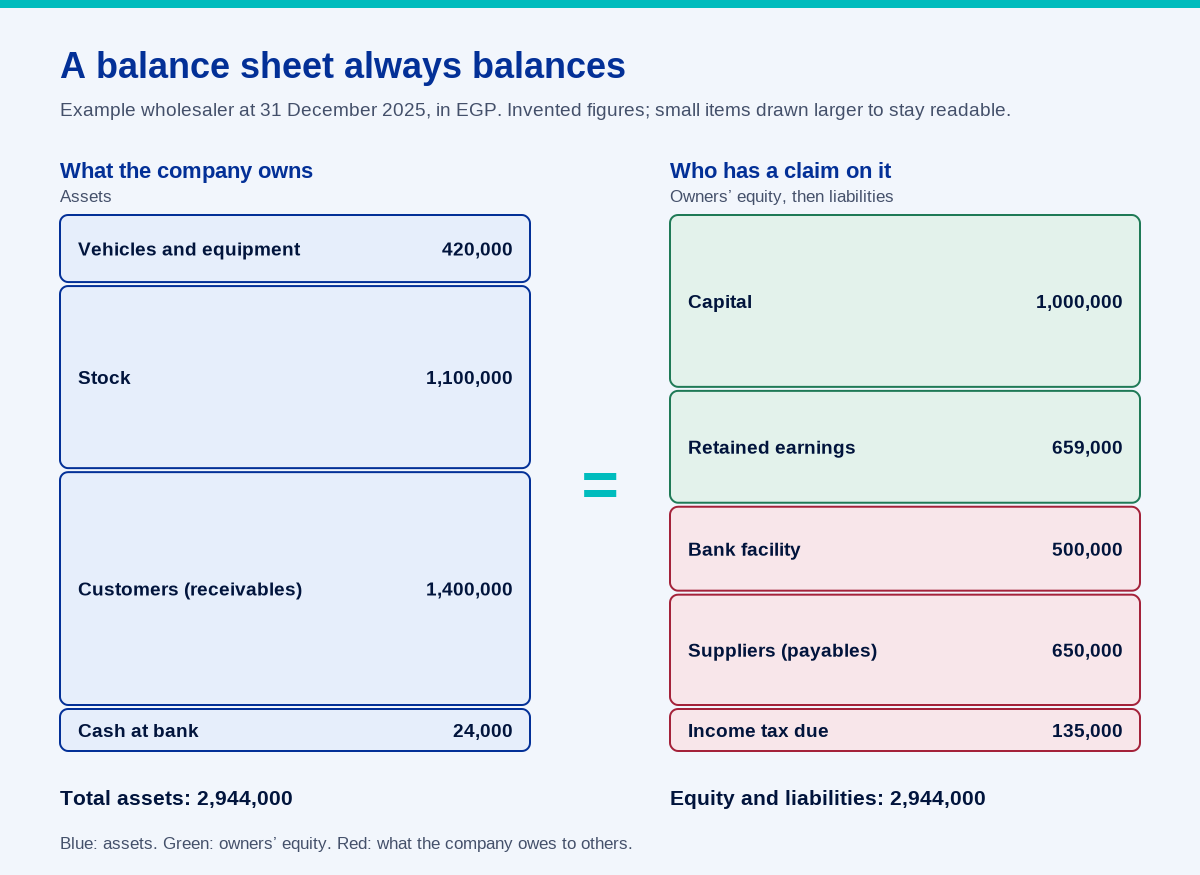
| Item | 2025 | 2024 |
|---|---|---|
| Vehicles and equipment, after depreciation | 420,000 | 360,000 |
| Total non-current assets | 420,000 | 360,000 |
| Stock | 1,100,000 | 700,000 |
| Customers (trade receivables) | 1,400,000 | 900,000 |
| Cash at bank | 24,000 | 400,000 |
| Total current assets | 2,524,000 | 2,000,000 |
| Total assets | 2,944,000 | 2,360,000 |
| Suppliers (trade payables) | 650,000 | 500,000 |
| Income tax due | 135,000 | 126,000 |
| Short-term bank loan (facility) | 500,000 | 400,000 |
| Total current liabilities | 1,285,000 | 1,026,000 |
| Capital | 1,000,000 | 1,000,000 |
| Retained earnings | 659,000 | 334,000 |
| Total equity | 1,659,000 | 1,334,000 |
| Total equity and liabilities | 2,944,000 | 2,360,000 |
Why does a balance sheet always balance?
Because every transaction is recorded twice, once on each side, so the totals move together. Buy stock on credit for EGP 50,000 and stock rises by 50,000 while the amount owed to suppliers rises by the same 50,000. Pay the supplier and cash falls by 50,000 while the supplier balance falls by 50,000. Sell the stock at a profit and the customer balance rises by the sale price, stock falls by its cost, and the difference is profit, which belongs to the owners and lands in equity.
That last step is the link between the two main statements. The example company started 2025 with retained earnings of EGP 334,000, made EGP 465,000 of net profit during the year, and the owner withdrew EGP 140,000. Retained earnings at the end of the year are 334,000 plus 465,000 minus 140,000, which is EGP 659,000. If your accountant cannot show you this roll-forward, the books have a gap.
A balance sheet that balances is not proof that it is right. A missing supplier invoice leaves out both the stock and the debt, and the totals still agree. The checks below catch what the arithmetic cannot.
What do current and non-current mean?
Current means expected to turn into cash, or to be paid, soon. Egyptian Accounting Standard No. 1 requires current and non-current assets and liabilities to be shown separately, unless ordering them by liquidity gives more reliable and relevant information. The test is twelve months from the balance sheet date or the company’s normal operating cycle. Stock and customer balances count as current even when they will take longer than twelve months to turn into cash, as long as that is within the normal operating cycle.
The split matters because it answers the question owners care about most: can the company pay what falls due soon from what will come in soon? The example company has EGP 2,524,000 of current assets against EGP 1,285,000 of current liabilities, almost two to one. That looks comfortable, but only EGP 24,000 of it is cash. The rest is stock still to be sold and customer balances still to be collected. And its bank loan falls due within the year. The balance sheet is healthy only if those customers pay and that stock sells.
What should an owner check on the balance sheet?
Check that each large balance is real and that you understand it. An owner does not need to audit the balance sheet, but five questions put to the accountant every quarter will catch most of the problems we see in small companies.
- Cash: does the cash at bank figure agree with the bank statement, after a written reconciliation for that date?
- Customers: is there an ageing list behind the customer total, and how much of it is more than 90 days old? An invoice nobody expects to collect is not an asset.
- Stock: was the stock counted on or near the balance sheet date, and were damaged and slow items written down?
- Suppliers and other payables: do the large supplier balances agree with the suppliers’ own statements, and are unpaid bills for the period included?
- Owners’ accounts: is there a partner’s current account (جاري الشريك) or a loan from the owner, and does it agree with what the owners think they put in and took out?
If several of these get a vague answer, the balance sheet is probably carrying old errors forward from year to year. That is common in companies whose earlier years were never closed properly, and it is fixed by going back and reconciling each balance to evidence, one account at a time.
Does the balance sheet show what my company is worth?
Not usually. In a small company most items are recorded at what they cost, less depreciation for equipment and vehicles, and not at what they would sell for today. A customer list, a good location or a trusted brand built over years does not appear at all. Equity of EGP 1,659,000 in the example is the owners’ accounting stake, which is a starting point for a valuation and rarely the answer to one.
Common questions
- Is the balance sheet the same as the statement of financial position?
- Yes. Statement of financial position is the name the standards use; balance sheet is the older name most people still use. Both mean the same document.
- Retained earnings are EGP 659,000. Why can’t I find that money?
- Retained earnings are a claim, not a pile of cash. The profit that built them has been spent on the assets on the other side: stock, customer balances, the vehicle. The cash at bank figure is the only line that tells you how much money there is.
- Can equity be negative?
- Yes, when accumulated losses and withdrawals are larger than the capital and profits put in. It means the company owes more than it owns, and the owners should take advice on what that means for the company’s legal position.
- How often should I look at the balance sheet?
- At least every quarter, alongside the income statement. The balance sheet shows problems the income statement hides, such as customer balances growing faster than sales or a stock figure that never seems to fall.
Sources
The pages the figures and rules in this article were checked against, read in November 2026.