
Key points
- Every later entry builds on the opening balances, so an error in them shows up months later as a report that does not make sense.
- Pick one cut-off date, usually the first day of a month or of the financial year, and prove every balance at that same date.
- Prove balances from outside the old books: a cash and stock count, bank, customer, supplier and lender statements, and a fixed asset register.
- Bring in customers and suppliers invoice by invoice, not as one total each, so later payments can be matched to what they settle.
- The difference left after proving everything goes to equity only once it has been investigated, listed and approved by the owner.
Opening balances are the position a new set of books starts from: the cash and bank you hold, what customers owe you, the stock on your shelves, your fixed assets, what you owe suppliers and lenders, and the owners’ equity that balances the rest. The step is hard because each figure has to be proved from outside the old books, all at the same date, while the business keeps trading. Every entry posted afterwards builds on those figures, so a mistake here keeps resurfacing for months.
Why is this the hardest step?
Because a wrong opening balance does not fail on the day it is entered. It fails later, when a customer pays an invoice that was never in the opening list and their account goes into credit, or when the first stock count in the new system shows a shortage that was already there on day one. By then nobody remembers whether the problem is new or inherited.
There is also a practical difficulty. Counting stock, getting statements from customers and suppliers, and listing fixed assets take days or weeks, and during that time goods are sold and invoices are paid. Each balance has to be brought back to the same cut-off date, or the opening position mixes two different moments.
Which date should the opening balances be at?
Choose one cut-off date and prove every balance at that date. The first day of the financial year is the cleanest choice, because the old year closes at the same point and the year-end stock count serves both. Failing that, use the first day of a month. Avoid a date in the middle of a month, because bank and supplier statements are usually issued by month.
If you start at a year end, the stock count you make serves the old books as well. Egypt’s Commercial Law (Law 17 of 1999, Article 23) has the trader record in the inventory book the details of goods held at the end of the financial year, together with a copy of the balance sheet.
How do you prove each opening balance?
Prove each balance from something outside the old books: a count for cash and stock, a statement for bank, loans, customers and suppliers, and a register backed by invoices for fixed assets. A balance copied from the old system is only as reliable as the way the old system was kept.
| Account | Prove it with | Common mistake |
|---|---|---|
| Cash and petty cash | A count at the cut-off, signed by two people | Using the cash balance from the old books |
| Bank | The statement balance plus a list of uncleared cheques and deposits | Entering the statement balance and forgetting cheques already issued |
| Customers | A list of unpaid invoices per customer, agreed to their statements | One total per customer, which later payments cannot be matched against |
| Stock | A count at the cut-off, valued at cost | Taking quantities from the old system without counting |
| Fixed assets | A register: each asset’s cost, purchase date and accumulated depreciation | One net figure with no list behind it |
| Suppliers | A list of unpaid invoices per supplier, agreed to their statements | Missing invoices received but not yet entered |
| Loans | The lender’s statement of principal and accrued interest | Using the original loan amount |
| Taxes payable | The last returns filed and the payments made since | Leaving out amounts due for the last open period |
| Capital | The company’s contract and commercial registration | Mixing capital with owner’s current account |
Why bring in customers invoice by invoice?
Because the system needs to know which invoice a payment settles. If a customer’s opening balance is one figure of EGP 85,000 and they pay EGP 30,000 against a specific invoice, the system cannot tell you which invoices are still open or how old the debt is. Brought in as three invoices with dates, the same balance gives you an aged list from the first day, and payments clear the right invoice.
The same applies to suppliers and, where your system tracks them, to advances paid to staff and cash held by employees. Each open item should be something a person could find the document for.
What does an opening trial balance look like?
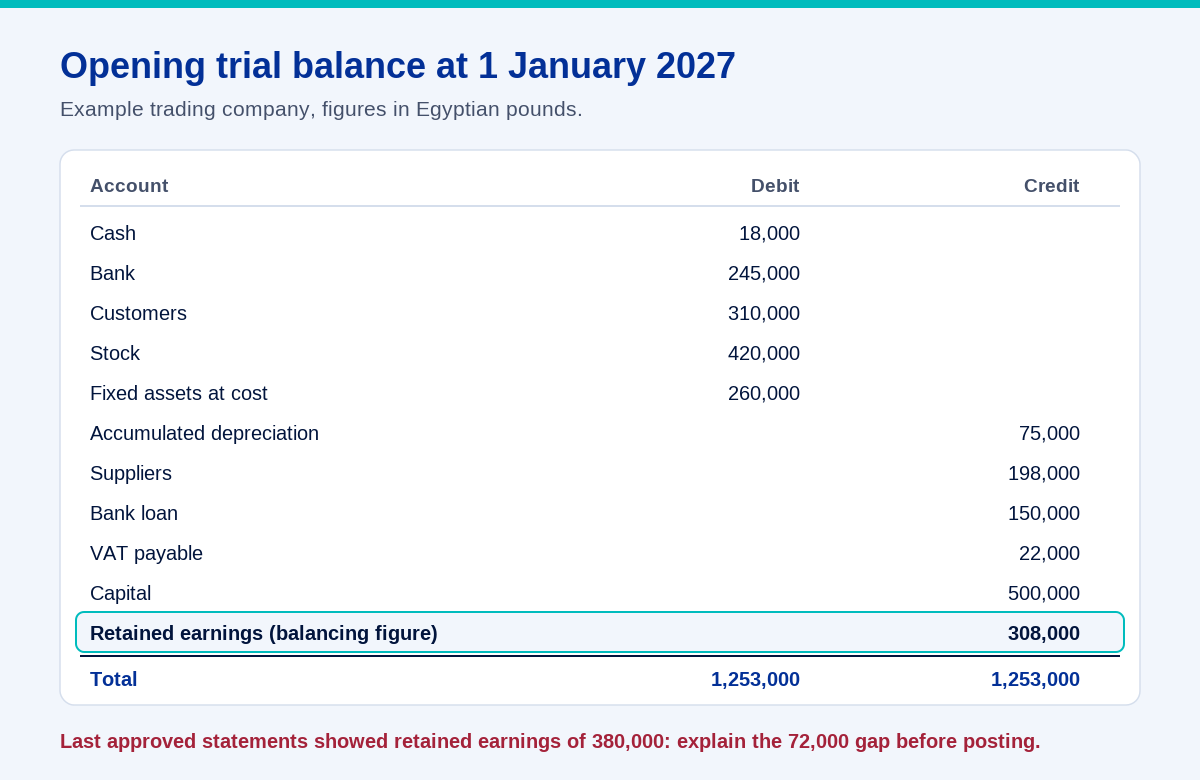
It lists every proven balance as a debit or a credit, and the two sides must be equal. In practice one figure is left to balance them: retained earnings, the profits kept in the business over past years. That figure is a test of the whole exercise. Compare it with the retained earnings in the last approved financial statements. A large gap means something was missed or the old books were wrong.
What do you do with the difference?
Break it down before you accept it. In the example, the 72,000 gap might turn out to be a stock shortage found in the count, two customer invoices that were paid but still sat in the old books, and a bank charge never recorded. Each part is written down with its amount and cause, and the owner signs the list. What cannot be explained is shown as unexplained, with its amount, so the owner approves it knowingly.
Do not park the difference in a suspense account to clear later. A suspense balance on day one tends to be there at the end of the year too, and by then the new accountant has started posting other unexplained amounts beside it.
What are the steps, in order?
The sequence below takes a typical small company from choosing a date to a signed, posted opening entry. Counting and collecting statements take the most time, so start them as close to the cut-off as you can.
- Choose the cut-off date, usually the first day of the financial year or of a month.
- Count cash, petty cash and stock at the cut-off, with stock movement frozen during the count, and sign the count sheets.
- Collect bank, lender, customer and supplier statements at the cut-off date, and reconcile each bank account.
- List every unpaid customer and supplier invoice with number, date and amount, and agree the totals to the statements.
- Prepare the fixed asset register with cost, purchase date and accumulated depreciation.
- Put everything into an opening trial balance, compare retained earnings with the last approved statements, and explain the gap.
- Have the owner sign the trial balance and the explanation, post one opening entry, and lock every date before the cut-off.
Common questions
- Can we just copy the closing balances from the old system?
- Only if the old year was closed properly: bank reconciled, customers and suppliers agreed, stock counted, statements approved. If it was, its closing balances are your opening balances. If not, prove each balance as described here, or close the old year first.
- The stock count takes three days and we cannot stop selling. What do we do?
- Count section by section, record every receipt and issue during the count with its document, and adjust each counted quantity back to the cut-off date. It is more work than a frozen count, so keep the counting period as short as you can.
- We are a new company. Do we have opening balances?
- Yes, but they are simple: the capital paid in, the bank account it sits in, and any costs paid before the company started trading. Record them from the bank statement and the receipts on day one.
- Who should sign the opening balances?
- The owner, or whoever has authority to approve the company’s financial statements, together with the accountant who prepared them. The signature is on the trial balance and on the list that explains the difference.
Sources
The pages the figures and rules in this article were checked against, read in November 2026.