
Key points
- Record cash given to an employee as owed by that employee, not as an expense. It becomes an expense only when the receipts arrive.
- Run petty cash as a fixed float: at any moment, the cash in the box plus the receipts must equal the float.
- Give a task advance for a stated purpose and a settlement date, and do not give a second one until the first is settled.
- Keep personal loans to staff separate from work advances, with a signed repayment schedule.
- Once a month, list every open advance by employee and age, and ask about anything that has been open too long.
Treat every amount of cash given to an employee as money that employee owes the company until they bring back either the cash or a receipt for what they spent. In practice that means three habits: petty cash is a fixed float that is topped up only against receipts, any other advance is given for a stated purpose with a date to settle it, and once a month someone reviews a list of every open advance by name and age. Money in small companies is rarely lost in one large theft. It usually goes in small advances that were never settled and then forgotten.
What is the difference between petty cash, an advance and a staff loan?
Petty cash is a standing float for small daily spending. A task advance is cash given for one job, such as a purchase or a trip, and settled when the job is done. A staff loan is money lent to an employee for personal use and repaid from salary. They are settled differently, so record them in separate accounts.
| Item | Petty cash float | Task advance | Staff loan |
|---|---|---|---|
| Used for | Small daily spending: transport, cleaning supplies, courier fees | One stated job: buying materials, a site visit, a trip | The employee’s personal needs |
| Settled by | Receipts, then the float is topped up by the same amount | Receipts plus any unspent cash returned, by an agreed date | Deductions from salary on a signed schedule |
| Recorded as | A cash account in the custodian’s name | Owed by the employee until settled | A loan receivable from the employee |
| Becomes an expense | When receipts are recorded | When receipts are recorded | Never: it is repaid |
How does a fixed petty cash float work?
You hand one person a fixed amount, say EGP 10,000. They pay small expenses from it and keep every receipt. When the cash runs low, they bring the receipts, the accountant records them as expenses, and the company pays back exactly the amount of the receipts, so the float returns to EGP 10,000. At any moment, cash plus receipts must equal the float.
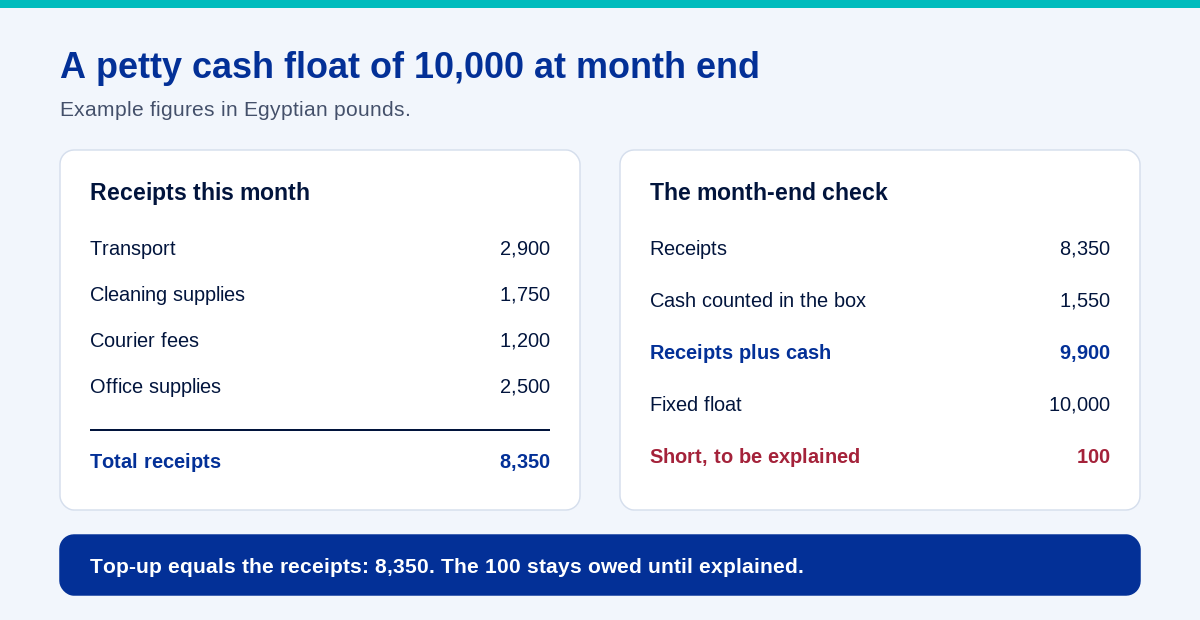
The top-up always equals the receipts, never the amount needed to bring the cash back to EGP 10,000. If you topped up by 8,450 to cover the missing 100, the shortage would disappear into the next month and the float would look correct. Record the 100 as owed by the custodian until it is explained, or as a loss the owner approves.
How should advances be recorded so they do not disappear?
When the cash leaves the safe, record it as owed by the named employee, in an account for staff advances with a line for each person. When the receipts come back, move the amount from that employee to the right expense accounts. The common mistake is to record the payment straight as an expense. The books then show nothing owed, and nobody can tell later whether the job was done or the money was spent at all.
A worked example: on 3 March, a site supervisor takes EGP 15,000 to buy materials. The books show EGP 15,000 owed by the supervisor. On 10 March he returns receipts for EGP 13,600 and EGP 1,400 in cash. The books move 13,600 to materials, 1,400 back to the cash box, and his balance returns to zero. If he had brought receipts for 12,000 only, his balance would stay at 1,600 until he settled it.
Which rules keep petty cash and advances under control?
A few written rules do most of the work. Agree them once, put them on one page, and have everyone who holds cash sign it. They matter most in a company where the owner cannot see every payment.
- One custodian per float. Two people sharing one cash box means nobody is responsible for a shortage.
- A written ceiling for a single petty cash payment. Anything above it goes through the normal payment cycle.
- Every receipt shows a date, an amount and who was paid. Where no receipt exists, the custodian fills in a payment voucher and a manager signs it.
- No new advance until the last one is settled, whatever the reason.
- A settlement date for each task advance, written on the advance request.
- A count of the petty cash box by someone other than the custodian at least once a month, without warning.
What should the owner look at each month?
Ask for one list: every open advance and staff loan, with the employee’s name, the amount, the date given and how many days it has been open. Anything older than its settlement date needs an answer. The list takes the accountant a few minutes if advances are recorded per person, and it is impossible to produce if they were booked straight to expenses.
| Employee | Type | Amount | Given on | Days open | Action |
|---|---|---|---|---|---|
| Office administrator | Petty cash float | 10,000 | Standing | n/a | Surprise count this month |
| Site supervisor | Task advance | 1,600 | 3 March | 27 | Settle or explain this week |
| Sales representative | Task advance | 4,000 | 25 March | 5 | Within its settlement date |
| Storekeeper | Staff loan | 6,000 | 1 February | 57 | Deduct per signed schedule |
How should personal loans to staff be handled?
Put every staff loan in writing: the amount, the monthly deduction, the first deduction date, and the employee’s signature. Keep these loans in their own account, apart from work advances. As of November 2026, WageIndicator’s summary of Egypt’s Labour Law (Law 14 of 2025) says the deduction to repay an employer loan may not exceed 10% of the worker’s wage. Check the current text of the law with whoever runs your payroll before you agree a schedule.
When an employee who holds a float or an open advance leaves, settle it before the final payment: count the float with them, collect the receipts, and get a signed statement of what, if anything, is still owed.
Common questions
- How big should the petty cash float be?
- Big enough for two to four weeks of normal small spending, so it is topped up a few times a month at most. Look at the last three months of small cash payments and set the float from that. A float that keeps running out is too small; one that sits untouched for months is too large.
- What if there is no receipt, for example for a taxi?
- The custodian fills in an internal payment voucher with the date, amount and purpose, and a manager signs it. Keep these for genuinely small items. Whether such a payment is deductible for tax is a separate question for your tax adviser.
- Can the owner take money from petty cash?
- Better not. If it happens, the custodian records it as a withdrawal by the owner with a signed slip, and the accountant posts it to the owner’s current account, not to an expense. Otherwise the float shows a shortage that is really an owner withdrawal.
- Should petty cash pay salaries or supplier invoices?
- No. Salaries and supplier invoices go through the normal payment cycle with its approvals. Petty cash is for small items below the written ceiling.
Sources
The pages the figures and rules in this article were checked against, read in November 2026.