
Key points
- Every company receipt and payment should pass through a bank account in the company’s name, never through the owner’s own account.
- Mixed money makes sales, costs, profit and cash wrong at once, and the errors can cancel so that profit still looks plausible.
- The owner takes money out by one agreed route: a fixed salary or recorded drawings, each with a document.
- When money does cross the line, record it in the owner’s current account the same day, with a receipt.
Give the company its own bank account, run every company receipt and payment through it, take money out for yourself by one agreed route, and record every amount that crosses between you and the company in an owner’s current account. Mixing the two breaks every number because the books then record only part of what the company earned and spent, and include some of what you spent at home. Sales, costs, profit, cash and what you owe the company are all wrong at the same time, and nobody can say by how much.
Why does mixing personal and company money break the numbers?
Because each crossing hides a transaction from the books or adds one that does not belong there. A customer who pays into your personal account is a sale the company never records. A supplier you pay from your pocket is a cost that never reaches the income statement. School fees paid from the company account appear as a company expense. Each error is small, and they pile up month after month.
The damage reaches beyond profit. The bank balance in the books stops matching the bank statement, so the bank cannot be reconciled. Supplier balances look higher than they are, because payments you made personally were never recorded against them. Customer balances look unpaid when the customer has paid you. And if you have partners, nobody can show what each of you has put in or taken out.
What does it look like in one month?
Take a small trading company whose true sales for the month are EGP 400,000 and true costs 350,000, so the true profit is 50,000. During the month a customer pays 20,000 into the owner’s personal account, the owner pays a supplier 50,000 from his own account, and the company account pays 35,000 of the owner’s personal bills.
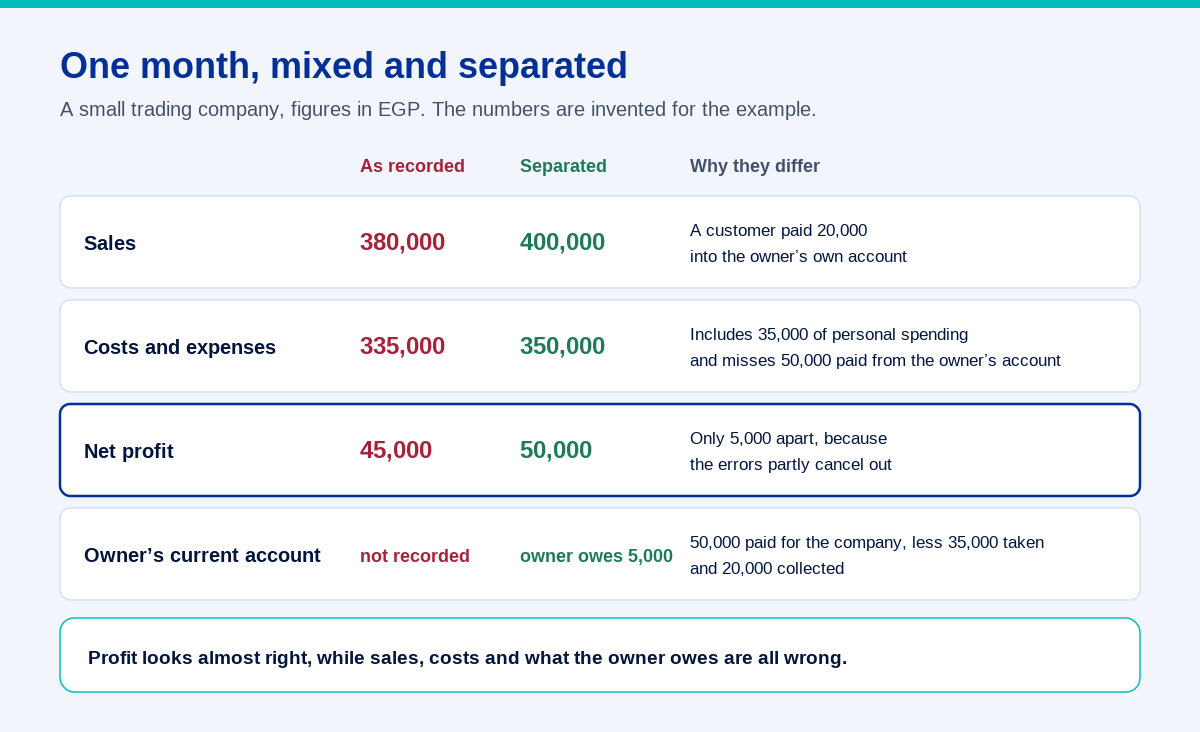
The books show sales of 380,000 and costs of 335,000: the 50,000 supplier payment is missing and the 35,000 of personal bills is included. Recorded profit is 45,000, close enough to 50,000 that nobody asks a question. Yet the owner put 50,000 into the company and took out 55,000 (35,000 in bills and 20,000 from the customer), so he owes the company 5,000. A month like this is easy to fix. A year of them usually is not, because nobody remembers which transfer was which.
How do you separate the two, starting this month?
Separation comes down to a few habits. The company needs its own account, customers need to know where to pay, and the owner needs one way to take money out. These steps are in the order most owners can manage them.
- Open a bank account in the company’s name, if it does not have one, and use it for every company receipt and payment.
- Tell customers in writing which account to pay into, and print it on every invoice. Stop accepting company payments into personal accounts or wallets.
- Pay suppliers, salaries and rent only from the company account. If the company cannot afford a payment, lend it the money first through the owner’s current account, then pay from the company account.
- Decide how you take money out: a fixed monthly salary, recorded drawings, or both. Move it by transfer to your personal account, never by paying personal bills directly from the company.
- Keep company cards and cheque books for company spending only. If a personal purchase slips through, record it as a drawing the same day and keep the receipt.
- Ask your accountant to reconcile the company account monthly and show you the owner’s current account balance on the same page.
What is the owner’s current account, and what goes in it?
It is the account in the books that records everything between the owner and the company that is neither capital nor salary. Money the owner puts in or pays on the company’s behalf goes on one side. Drawings, personal bills paid by the company and company money the owner collected go on the other. Its balance says, at any date, who owes whom.
| What happened | Record it as | Effect on the owner’s current account |
|---|---|---|
| You paid a supplier from your own account | A purchase, owed by the company to you | Company owes you more |
| A customer paid into your personal account | A collection from the customer, held by you | You owe the company more |
| The company paid a personal bill | A drawing, not an expense | You owe the company more |
| You transferred money in to cover a shortfall | A loan or contribution from you, as you decide in writing | Company owes you more, unless you record it as capital |
How you pay yourself, and whether money you put in is a loan or capital, can have legal and tax consequences that depend on the company’s legal form. Ask a tax adviser before you choose. Kayan does not represent clients before the tax authority. The accounting rule is the same in every case: each amount is recorded as what it is, on the day it happens.
What if the money has been mixed for years?
Separate from today first, then deal with the past as a separate job. Fixing old years means going through the statements of every account that carried company money, personal ones included, and classifying each line as company, personal or a crossing. That is slow, and it gets slower the longer it waits, but it is the only way to reach a true opening balance for the owner’s current account.
At Kayan, the Foundation Package sets up the company’s cycle, chart of accounts and written policies, including how cash is handled, from a clean starting point. Where earlier years were never closed properly, the Past Years Cleanup package reconciles, corrects and closes them, with every correction documented and approved before it is posted.
Frequently asked questions
- The company is mine alone. Does separation still matter?
- Yes. Whatever the legal form, the books of the business should show only the business, or the profit, the cash and the balances with customers and suppliers cannot be trusted. A bank reading your statements for a facility will ask the same questions.
- Can I just settle the owner’s current account at the end of the year?
- You can settle the balance then, but record each movement when it happens. A year-end figure built from memory is the problem you were trying to remove.
- How much salary should I pay myself?
- There is no standard figure. Pick an amount the company can pay every month without borrowing, keep it fixed, and take anything beyond it as recorded drawings once the monthly figures show the profit is there.
- What about partners who each take money differently?
- Give each partner a separate current account and agree in writing what each may draw and when. Drawings that nobody recorded are very hard to agree on years later.
Sources
The pages the figures and rules in this article were checked against, read in November 2026.
- gafi.gov.eg/English/eServices/Pages/DepartmentService.aspx
- gafi.gov.eg/English/StartaBusiness/Laws-and-Regulations/Documents/C...
- gafi.gov.eg/en/contenttemplate/ca1b9d8b-76d1-46dc-a677-eb4ba5ccaae3