
Key points
- A customer balance you can rely on is a list of open invoices you can name, after receipts, returns and agreed discounts are applied to them.
- Balances usually go wrong through receipts posted to the wrong customer or never applied to invoices, returns with no credit note, and duplicated invoices.
- Send each important customer a statement and ask them to confirm it or list the differences. Their reply is the fastest check you have.
- Only after balances are right does an ageing report tell you what is likely to be collected and what needs chasing or an allowance.
You know who really owes you money when each customer’s balance can be broken down into open invoices you can name, after every receipt, return and agreed discount has been applied to them, and the customer agrees with the result. A balance with no list behind it may be right, but you cannot tell. Getting there means rebuilding each account from its documents, sending statements to customers to confirm, fixing the differences, and only then reading the ageing to decide what to chase.
Why do customer balances go wrong?
Most errors come from money and goods coming back. Sales invoices are usually recorded well, because someone wants them issued. Receipts, returns and discounts are recorded by different people at different times, often without a clear link to the invoice they settle, and that is where the balance starts to drift from reality.
| Cause | What it does to the balance | How it shows up |
|---|---|---|
| A receipt posted to the wrong customer | One customer looks paid up, another looks overdue | A customer who insists they paid |
| A receipt never applied to invoices | The total is right, the ageing is wrong | Old invoices that look unpaid next to an unexplained credit |
| A return with no credit note | The balance is too high | The customer deducts the amount from a later payment |
| A discount agreed by sales but never recorded | The balance is too high | Short payments that never get cleared |
| A returned cheque not reversed | The balance is too low | Found in the bank reconciliation |
| An invoice posted twice | The balance is too high | Two invoices with the same amount and date |
| Opening balances never confirmed | An old error carried into every year since | A balance nobody can explain |
Can the total be right while the customers are wrong?
Yes, and it is common. A receipt posted to the wrong customer leaves total receivables unchanged, so the balance sheet looks fine while one customer is chased for money already paid and another is never chased at all. The same is true of receipts left unapplied: the total is right, but the ageing shows old invoices as overdue when they were settled months ago.
How do you find out who actually owes you money?
Work customer by customer, largest balance first. For each one, rebuild the account from its documents, ask the customer what their records show, and explain every difference. A few large customers usually hold most of the money, so the first part of the list gives you most of the answer.
- Start from the last balance the customer confirmed, or the last year-end your auditor accepted, and print the customer’s statement of account since then.
- Match each receipt to the invoices it paid. Ask the sales team or the customer where it is unclear.
- List what will not match: receipts with no invoice, invoices partly paid, and credits nobody can explain.
- Check returns and discounts with the sales and warehouse teams. Issue the credit notes that should exist, after confirming the goods came back or the discount was agreed.
- Send the statement to the customer and ask them to confirm the balance or list the differences.
- Reconcile their reply to your account, item by item, and correct your books where the error is yours.
- Only then run the ageing report.
What happens when the customer’s figure differs from yours?
You reconcile the two the same way a bank is reconciled: list the items each side has recorded and the other has not, and adjust each balance until both reach the same figure. Items missing from your books need an entry. Items missing from the customer’s records are usually timing, such as an invoice issued on the last day, and clear by themselves.
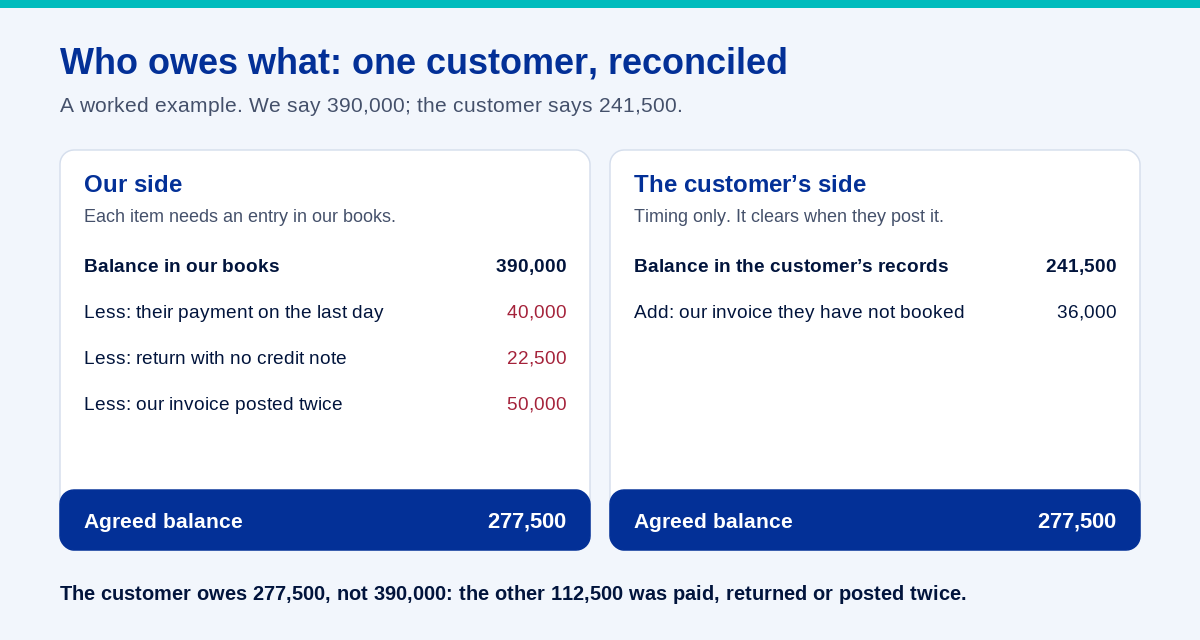
In the example, three of the four differences were on our side. Chasing the customer for 390,000 would have meant asking for money already paid, for goods already returned, and for an invoice that did not exist, which is a quick way to lose a good customer.
What does an ageing report tell you once the balances are right?
It splits each customer’s balance by how long the invoices have been overdue, so you can see which money is on its way and which is at risk. The older a debt, the more attention it needs. An ageing report built on unapplied receipts or missing credit notes overstates the old buckets, which is why it comes last.
| Customer | Not yet due | 1 to 60 days overdue | 61 to 180 days overdue | Over 180 days overdue | Total |
|---|---|---|---|---|---|
| Customer A | 120,000 | 97,500 | 60,000 | 0 | 277,500 |
| Customer B | 85,000 | 0 | 0 | 0 | 85,000 |
| Customer C | 0 | 0 | 42,000 | 133,000 | 175,000 |
| Customer D | 30,000 | 18,000 | 0 | 0 | 48,000 |
| Total | 235,000 | 115,500 | 102,000 | 133,000 | 585,500 |
Read across each row. Customer B pays on time. Customer A is large and slipping, so the 60,000 in the third column is the one to raise now. Customer C has not paid anything recent and most of the balance is more than six months overdue; that account needs a decision about collection, and possibly an allowance in the accounts.
What about customers who may never pay?
They are shown in the accounts through an allowance, so that receivables are not presented at more than you expect to collect. For companies reporting under the Egyptian Accounting Standards, the standard on financial instruments, EAS 47 (2019), is the one the Financial Regulatory Authority describes as aligned with IFRS 9, and it works with an allowance for expected credit losses. That looks at the likelihood of not being paid, not only at debts already known to be bad. Agree the method with your auditor.
Writing a debt off is a separate decision from providing for it, and it should be approved and documented: who decided, why, and what collection steps were taken first. Whether a bad debt is deductible for tax depends on the conditions in the tax rules, so ask your tax adviser. We do not represent clients before the Tax Authority.
How do you keep customer balances right from now on?
Apply every receipt to specific invoices on the day it is recorded, issue a credit note for every return and agreed discount, and send statements to your main customers every month. These three habits prevent most of the causes in the table above.
- Ask customers to quote their name and invoice numbers in every transfer.
- No returned goods go back on the shelf without a return note, and no return note stays without a credit note.
- Discounts agreed by the sales team are sent to accounts in writing before the invoice is issued.
- Review the ageing every month with whoever is responsible for collection, and note the action for each overdue customer.
If the balances are wrong across several years, the work belongs with closing those years properly, which is Past Years Cleanup. If you want the receipts applied and the statements sent every month from now on, that is part of bookkeeping.
Common questions
- A customer says they paid, but we can’t find it. What now?
- Ask for the transfer receipt or cheque details, then look in three places: your unidentified receipts, other customers with similar names, and the bank statement for that date. If the money is in your bank, it is somewhere in your books.
- Do I need to send statements to every customer?
- Start with the largest balances and the oldest, which carry most of the risk. Small, current accounts can follow once the process is routine.
- A customer is also our supplier. Can we net the two balances?
- Agree it with them in writing first, then record the offset as an entry on both accounts. A silent netting leaves two balances that neither side’s statement will match.
- How old does a debt have to be before it counts as bad?
- There is no single age. Age is one signal; the customer’s situation, the collection history and any security you hold matter as much. That is why the allowance is a judgement, agreed with your auditor.
Sources
The pages the figures and rules in this article were checked against, read in November 2026.