
Key points
- A bank reconciliation lists and explains every difference between the bank statement and the cash-at-bank account in your books on the same date.
- A small net difference can hide large errors that cancel each other out, so a total that looks close is not evidence that the books are right.
- Catch up one month at a time, starting from the last month the two agreed, and carry the open items forward.
- Record what the bank shows and the books lack, such as charges and unidentified transfers, from the bank’s own advices and in the month they happened.
- Leave an unexplained difference visible and approved, never buried in one adjusting entry.
If your bank has not matched your books for months, you catch up by going back to the last month the two balances agreed and reconciling every month after it in order, explaining each difference with a document before you correct anything. A bank reconciliation is that explanation: a short statement, prepared for one account on one date, showing why the balance on the bank statement differs from the cash-at-bank balance in your ledger. Done monthly, it takes little time. Left for a year, it turns into a project, though a finite one.
What is a bank reconciliation, in plain terms?
It is a comparison of two records of the same money. The bank keeps one record of your account, and your accountant keeps another in the books. On any given date the two should tell the same story once you allow for items one side has recorded and the other has not yet. The reconciliation lists those items and shows that, after them, the two balances are equal.
Some differences are only timing. A cheque you wrote on the 28th is already out of your books, but the supplier may not deposit it until next month. Others are gaps in the books: a bank commission nobody entered, or a customer transfer that arrived without a name and was never recorded. The reconciliation separates the two kinds, because timing clears itself and gaps do not.
Why does the bank stop matching the books?
It drifts because the bank records things the accountant never hears about, and the accountant records things the bank has not processed yet. Each month that goes unreconciled adds a few new items to the pile. After several months nobody remembers which transfer belonged to which customer, so the difference stops being a list and becomes one large number.
| Cause | What it looks like | What fixes it |
|---|---|---|
| Bank charges, commissions and interest | Small debits on the statement with no entry in the books | An entry in the books from the bank’s advice |
| Customer transfers without a clear name | Credits on the statement nobody has allocated to a customer | Identify the payer, then record the receipt against that customer |
| Cheques issued but not yet cashed | Payments in the books that are missing from the statement | Nothing, if recent; follow up with the payee if old |
| Customer cheques returned unpaid | A deposit and then a reversal on the statement; only the deposit in the books | Reverse the receipt and put the amount back on the customer |
| Entries in the wrong bank account | One account short and another over by the same amount | Move the entry to the right account |
| Duplicated or mistyped entries | An amount in the books twice, or with digits swapped | Correct the entry in the books |
Does it matter if the difference is small?
Yes, because the net figure tells you very little. A difference is the sum of items that push in opposite directions, so a few thousand pounds can hide a large unrecorded customer receipt on one side and a large uncashed cheque or a duplicated payment on the other. Each of those affects something else: a customer balance, a supplier balance, or the profit for the month.
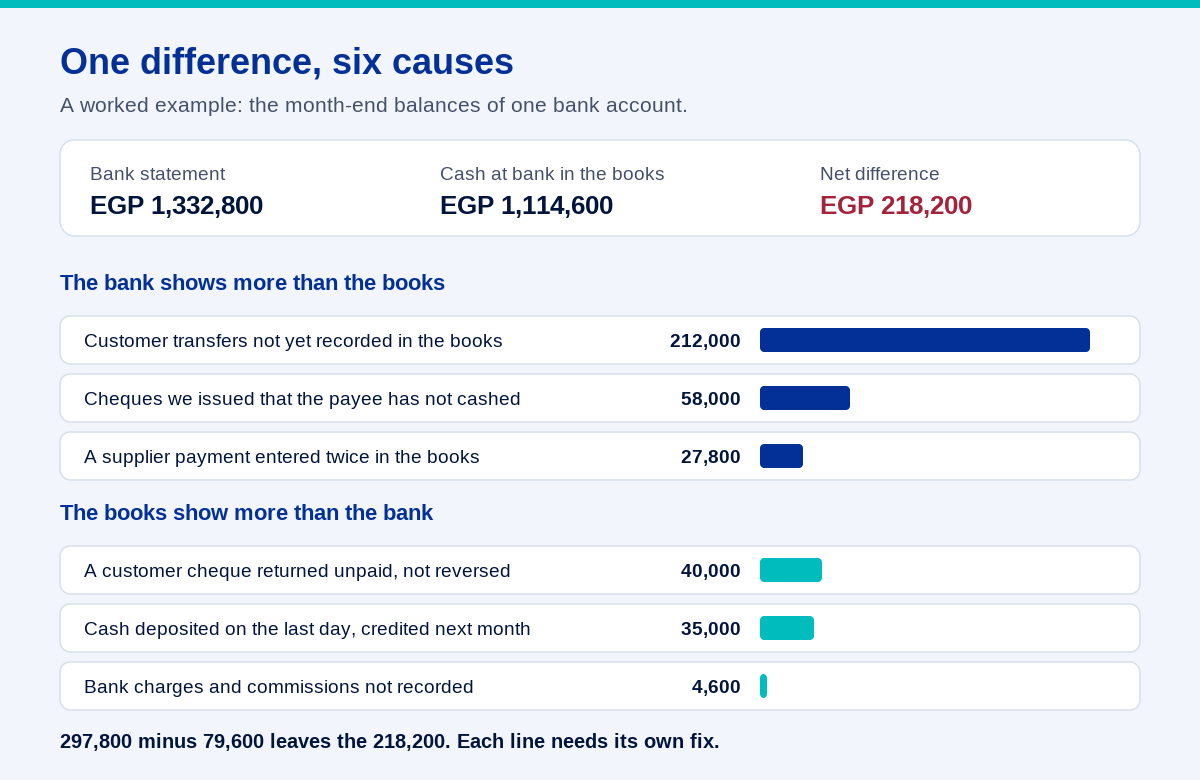
There is also a control reason. Unreconciled bank accounts are where a wrong payment, or a deliberate one, stays unnoticed longest. A bank that matches every month leaves very little room for that. And when you apply for a facility or close the year, the bank balance in your accounts needs to agree with the bank’s own figure.
How do you catch up on months of unreconciled bank?
Work forward one month at a time from a balance you trust, never backwards from today’s total. Each month’s reconciliation starts with the open items left from the month before, so the work gets faster as you go. The first months are the slowest, because they are the ones where the documents are hardest to find.
- Find the starting point: the last month-end where the bank statement and the ledger agreed, or a year-end balance your auditor accepted.
- Collect a complete statement for every month since then, for every account the company holds, including any foreign-currency and deposit accounts. Ask the bank for any month that is missing.
- Take the first month. Tick every line on the statement that matches an entry in the books, by amount and date.
- List what is left in two columns: items in the bank but not in the books, and items in the books but not in the bank.
- For items in the bank only, find the bank advice or transfer detail and record each one in the books, in the month it happened.
- For items in the books only, decide whether each is timing, such as a cheque not yet cashed, or an error, such as a duplicate. Correct the errors; carry the timing items forward.
- Confirm that the adjusted balances agree, then have someone other than the preparer review and sign the month before you start the next.
- Repeat until you reach the current month.
Unidentified receipts take most of the time. A transfer that arrived with only a reference number has to be traced through the bank, the sales team or the customer’s own statement. Record it as unidentified receipts while you look, so the cash is in the books and the open question stays visible.
What do you do with a difference you cannot explain?
Keep it on the reconciliation as a named, unexplained item, report it to the owner in writing, and decide together what happens to it. If the owner agrees to write a small, old amount off, the entry should say what it is, who approved it and why. A single entry that makes the bank agree, with no list behind it, removes the difference from the books and leaves its cause wherever it was.
Set the write-off limit before the work starts, in writing. Deciding it after you have seen the difference invites a limit that happens to fit.
How do you stop the bank drifting again?
Reconcile every bank account every month, soon after month-end, and have it reviewed by someone other than the person who records payments. A reconciliation of a quiet account takes very little time when the month is fresh, and the open items are few enough to remember.
- Give each reconciliation a fixed deadline in the closing calendar, for example within the first week of the next month.
- Record bank charges every month from the bank’s advices, even when they are small.
- Ask customers to put their name or invoice number in the transfer reference, and tell the accountant when a large payment is expected.
- Look at the list of cheques not yet cashed. One that has been outstanding for several months needs a call to the payee.
- As the owner, sign the reconciliation or read its unexplained items. Ten minutes a month is enough.
If the backlog covers more than one year, or other accounts are behind too, the bank is usually one symptom of books that need closing properly year by year. That is what Past Years Cleanup is for. If the books are current and you want someone to check the reconciliations each month, that is the monthly review.
Common questions
- Can the accountant post one entry to make the bank agree?
- Not without a list behind it. The entry would make the balance right and leave customer, supplier and expense accounts wrong. Approve a write-off only for named items you have chosen to stop chasing.
- Is the online banking screen enough, or do I need statements?
- Use the bank’s statement for the month, in whatever form your bank issues it, and keep a copy with the reconciliation. A screen view can change as pending items post; a statement for a closed period does not.
- We have three bank accounts. One reconciliation or three?
- Three, one per account and per currency. Reconciling them together lets an entry posted to the wrong account disappear inside the total.
- Who should prepare the reconciliation?
- The accountant who keeps the books can prepare it. Someone who does not make or record payments should review it: the owner, a finance manager, or an outside reviewer.