
Key points
- Take everything over in writing: your own login, the cash count, the custody list, bank statements and open balances.
- Count petty cash with the person who holds it before you sign for it, and record any difference on the spot.
- Ask how a document becomes an entry here: who approves, who records, and where the paper is filed.
- Do not delete, back-date or "fix" old entries in your first week. List what looks wrong and raise it in writing.
- End the week with a one-page note to your manager: what you took over, what is missing, and what is due this month.
In your first week as an accountant, take over four things in writing (your system access, the cash and custody, the bank statements and the open balances), and ask enough questions to know how a document becomes an entry in this company. Change nothing yet. The point of the week is to know exactly what you were handed, so that any problem found later is dated before or after your arrival. The plan below fits five working days in a typical Egyptian SME.
What should you take over in your first week?
Anything you will be held responsible for: system access in your own name, petty cash and custody, every bank account, customer and supplier balances, and the files where documents are kept. Ask for each one by name, check it, and get the handover recorded in an email or a signed sheet. What you did not check on day one becomes yours by default.
| Item | What to ask for | Why it matters |
|---|---|---|
| System access | A user in your own name, with the rights your job needs | Every entry carries the name of the user who made it |
| Chart of accounts | The full coded list, and any written posting rules | You cannot post correctly without knowing which code takes what |
| Petty cash | A count with the holder, compared with the book balance | A shortage found next month will be blamed on you |
| Custody and advances | A list of every open balance by person and date | Old advances are hard to recover once the person has forgotten them |
| Bank accounts | Latest statements, and the last month reconciled | Unreconciled months hide errors that grow |
| Open balances | Customer and supplier balances as at your start date | This is the line between what you inherited and what you did |
| Deadlines | What is due this month: VAT return, payroll, supplier payments, the close | Some fall due before you have settled in |
The cash count shows why writing matters. Say the book balance of petty cash is EGP 12,500 and you count EGP 11,900 with the cashier. The EGP 600 difference may be a receipt not yet recorded, or a real shortage. Either way, write the count on a sheet, list the notes and coins, have you and the cashier sign it, and give a copy to your manager the same day. If the 600 is explained later, good. If you had signed for 12,500 without counting, it would now be your shortage.
Which questions should you ask, and whom?
Ask about the path a document takes: who requests, who approves, who records, who pays and where the paper is filed. Your manager answers the questions about approvals and deadlines, the colleague you replace or sit beside answers the ones about the system, and the warehouse and sales staff answer the ones about where documents start. Write each answer down.
- Documents: what paper must exist before a purchase invoice is recorded? Before a payment is made?
- Approvals: up to what amount can the finance manager approve a payment, and above it who signs?
- The system: which entries does the system make by itself, and which are made by hand? Who can post to a closed month?
- Sales: are customers invoiced from the system as e-invoices, and who issues credit notes for returns?
- Cash: how often is petty cash topped up, and up to what amount?
- Deadlines: when does the month close here, and when is the VAT return filed?
- History: which old balances does everyone know are wrong, and has anyone written them down?
On VAT, the general rule as of November 2026 is a monthly return filed online by the last day of the following month, and e-invoicing has applied to all taxpayers since July 2023. Your company’s own calendar is what matters for your first month, so ask for it rather than assume.
What does a good first week look like, day by day?
Spend the first three days receiving, the fourth understanding, and the fifth writing. Access and people come first, because nothing else works without them. Cash and custody come second, because they move daily. Open balances come third. Then follow one real transaction through the system, and finish with a short written note.
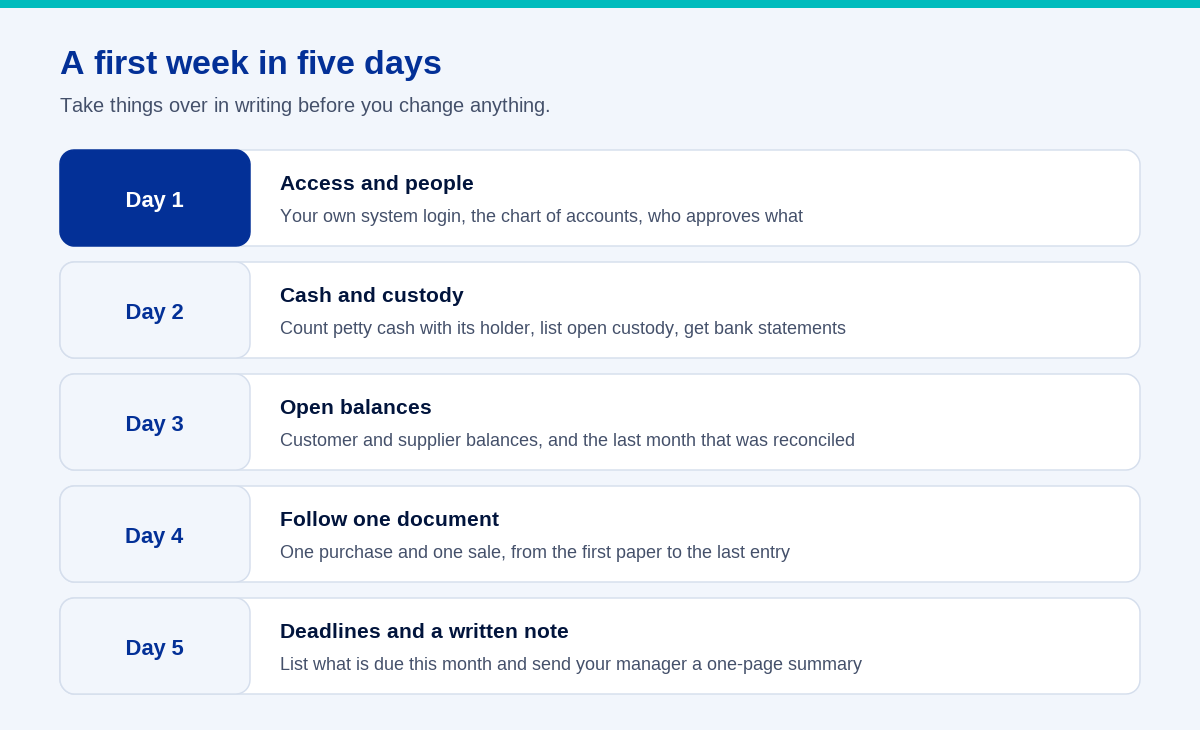
- Day 1, access and people. Get your own login, a copy of the chart of accounts and the list of who approves what. Meet the people whose documents you will record: the storekeeper, the sales coordinator, the person who handles payroll.
- Day 2, cash and custody. Count petty cash with the cashier and sign the count together. List every open custody balance by name, amount and date. Collect the latest statement for every bank account.
- Day 3, open balances. Print customer and supplier balances as at your start date and keep them. Find out the last month each bank account was reconciled; if the answer is “months ago”, write that down too.
- Day 4, follow one document. Take one recent purchase and one recent sale and trace each from the first paper to the final entry and payment. Note every step where you had to ask someone.
- Day 5, deadlines and a written note. List everything due this month with its date. Then send your manager one page: what you took over, what is missing, what looks wrong, and what you plan to do first.
What if nobody hands anything over to you?
Then build the handover yourself from sources outside the books. The bank statement shows what really went in and out. A cash count shows what is in the safe. Statements from the main suppliers show what the company owes. Compare each with the system, list the differences, and send the list to your manager as the starting position you inherited.
It happens when the previous accountant left suddenly, and it is usually a sign that the company has no written documentary cycle, which is worth mentioning politely in your note, because it will affect how fast you can work.
Which first-week mistakes are hard to undo?
The ones that blur the line between what you inherited and what you did. Working under someone else’s login, signing for cash or custody without counting it, and correcting old entries before anyone agrees they are wrong all make it impossible to show later what the books looked like when you arrived.
- Using a shared or borrowed login. Ask for your own, even if it takes a day.
- Deleting an entry instead of reversing it. A reversal leaves a trail; a deletion does not.
- Posting into a month that was already closed and reported, without approval.
- Promising a report by a date before you know where the data comes from.
- Taking copies of company files home. Ask what you may take before you take anything.
A good first-week note is short: four lines on what you took over, a list of what is missing, a list of what looks wrong, and the three things you will do next week.
Common questions
- Should I correct old errors I find in the first week?
- Not yet. List them with the evidence and send the list to your manager. Corrections to past periods need approval, and some will turn out not to be errors once you know the history.
- What if nobody has time to answer my questions?
- Collect them in one list and ask for twenty minutes at the end of the day. A written list is easier to answer than interruptions, and it shows what you have already worked out yourself.
- Is it all right to say “I don’t know” in my first week?
- Yes, followed by when you will know. “I don’t know yet, I will check the bank statement and tell you by tomorrow” is a good answer from a new accountant. A confident guess that turns out wrong is not.
- What if the company has no chart of accounts in writing?
- Export the list of accounts from the system and use it as your chart for now. Note which accounts look unused or duplicated, and mention it in your end-of-week note.
Sources
The pages the figures and rules in this article were checked against, read in November 2026.