
Key points
- In a real company every entry starts from a document: an invoice, a receipt or a signed request. Without the document there is no entry.
- Accounting software posts the debit and credit for you. Your work moves to checking what goes in and reading what comes out.
- Egyptian companies report under the Egyptian Accounting Standards, issued in July 2015, which the IFRS Foundation describes as close to IFRS but not identical.
- Monthly work fills most of the year: bank reconciliation, the month-end close, adjusting entries and the VAT return.
- The owner will ask about cash more often than profit, and explaining why the two differ is part of the job.
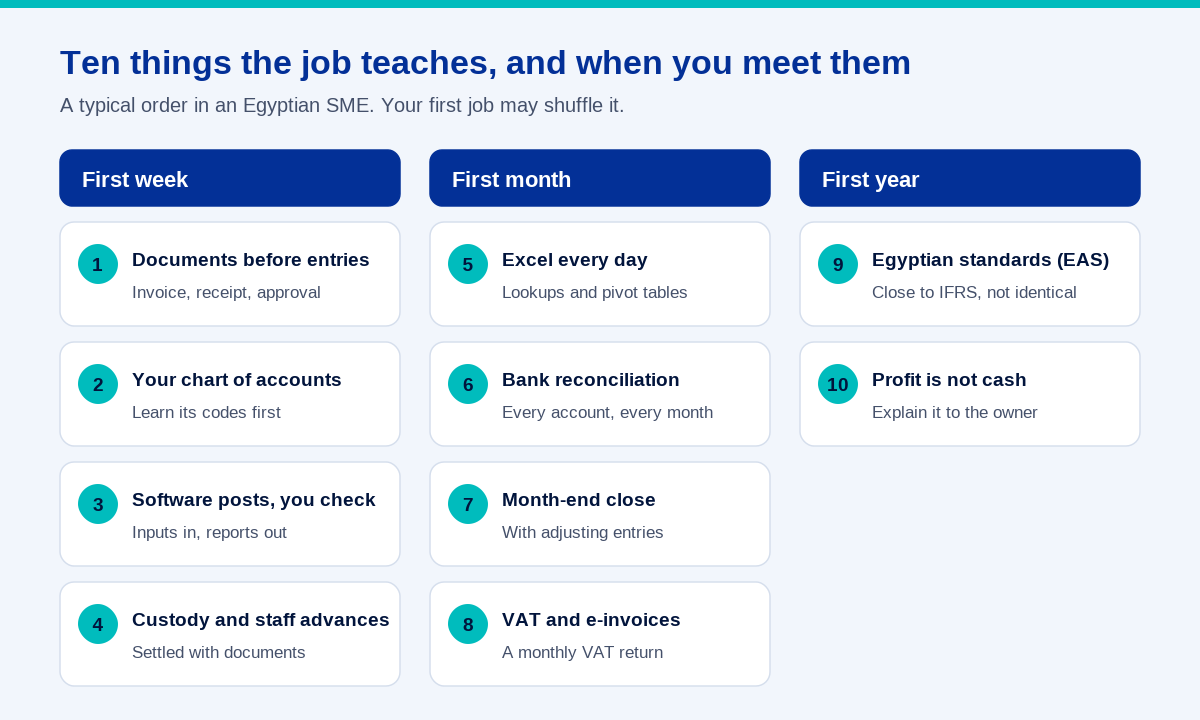
University teaches you the rules of accounting, and your first job teaches you where the numbers come from and what happens to them every month. In an Egyptian SME that means ten things most new accountants meet within a year: documents, the company’s own chart of accounts, accounting software, custody and staff advances, Excel, bank reconciliation, the month-end close, VAT and e-invoices, the Egyptian Accounting Standards, and the gap between profit and cash. Each one is learned by practice with real documents. This article explains what to expect from each and what to learn first.
What are the ten things a new accountant meets at work?
They fall into three groups by when they arrive. In the first week you meet documents, the chart of accounts, the software and custody. In the first month come Excel, the bank reconciliation, the close and VAT. Over the first year you learn how the Egyptian standards shape the statements and how to explain profit and cash to an owner.
| Subject | At university | At work |
|---|---|---|
| Entries | A transaction described in a sentence | An invoice, a receipt and a signature you must check first |
| Accounts | Generic names such as “Cash” and “Debtors” | A coded chart with hundreds of accounts built for one business |
| Posting | By hand, in a journal and a ledger | By the software, the moment an invoice is saved |
| Period end | Once, at the end of the exercise | Every month, against a deadline |
| Tax | A separate subject | Part of almost every sales and purchase invoice |
| Reporting | A balanced exam answer | A question from the owner about where the cash went |
Why does every entry start with a document?
Because an entry records something that already happened and was approved, and the document is the proof. A purchase is a purchase order, a goods received note and a supplier invoice. A payment is a signed request with a cheque or transfer. The owner, the auditor and the tax inspector will all ask for the paper behind a number, and an entry without one cannot be defended.
This chain of documents is the documentary cycle, and in your first weeks most of your questions will be about it. Take a supplier invoice for 200 cartons of detergent at EGP 230 each: EGP 46,000 plus 14% VAT of EGP 6,440, a total of EGP 52,440. Before you record it, check the quantity against the goods received note, the price against the purchase order, and that someone with authority approved the order. If the warehouse received 190 cartons, the invoice is wrong, and recording it would make the books wrong too.
What does a real chart of accounts look like?
It is a coded list of every account the company uses, sometimes several hundred, grouped under assets, liabilities, equity, revenue and expenses. Each company builds its own, so the textbook account “Debtors” becomes one account per customer, and “Expenses” becomes dozens of lines. Learning which code takes which transaction is the first real skill of the job.
Ask for the chart on your first day and read it with a senior colleague. The hard choices are the ones the textbook never posed: does a delivery charge on a sale go to selling and distribution expenses or to cost of sales? Does a new air conditioner for the office go to fixed assets or to maintenance? The company should have an answer written down. If it does not, write down the answer you are given, so the same cost goes to the same account next month.
How much of the job is software and Excel?
Most of it. The accounting software, or the company’s ERP, posts the debit and credit when you save a sales invoice or a payment, so the double entry you practised by hand happens out of sight. Your work moves to the inputs: the right account, customer, date and tax code. Excel then fills the gaps the software leaves, from reconciling a customer’s statement to preparing reports the system cannot produce.
Understanding the double entry is how you find mistakes: an entry the software made from a wrong input is balanced and still wrong. In Excel, start with what your team uses daily, which is usually lookup functions to match two lists and pivot tables to total by customer, supplier or month.
What is custody (العهدة), and why does it matter?
Custody is money or property handed to an employee who must later account for it: a petty cash float, a travel advance, a laptop. The amount is recorded as owed by that person, and it becomes an expense only when receipts come back. An advance that nobody settles overstates what staff owe the company and understates its expenses.
An example: a sales representative takes EGP 5,000 for a trip to Alexandria. On the day, you debit his custody account and credit cash. He returns with receipts for EGP 4,350 of fuel, tolls and a hotel, and hands back EGP 650. You debit the expenses (4,350) and cash (650), and credit his custody (5,000), which is now zero. If he had brought no receipts, the 5,000 would stay as his balance until he did, and it would not be your decision to call it an expense.
What happens every month that the course covered in one chapter?
Three jobs repeat every month. The bank reconciliation matches the company’s bank account in the books to the bank statement, line by line. The month-end close brings all the month’s documents in, checks the balances and produces the trial balance. Adjusting entries record what belongs to the month but has no invoice yet, such as accrued electricity, prepaid rent and depreciation.
At work you gather the facts yourself, by a deadline, while next month’s invoices are already arriving. Each of the three has its own article on this site.
Where does tax show up in a junior accountant’s day?
Mostly through VAT and e-invoices. As of November 2026 the general VAT rate under Law No. 67 of 2016 is 14%, so almost every sales and purchase invoice carries tax you must record correctly. Registered companies file a monthly VAT return online, due by the last day of the following month, and invoices pass through the Egyptian Tax Authority’s e-invoicing system.
E-invoicing has applied to all taxpayers since July 2023, and PwC’s Egypt tax summary notes that the Tax Authority recognises only e-invoices as valid support for deductible costs and expenses. In practice, a junior accountant checks that each supplier invoice is a valid e-invoice before booking it, and raises a question when a registered supplier sends paper. This is a general picture as of November 2026, not advice on any particular case. Rules change, so check the Tax Authority’s own site, and note that Kayan Finance does not represent clients before the tax authority.
Which accounting standards do Egyptian companies follow?
The Egyptian Accounting Standards (EAS), issued in July 2015 and amended in 2019 and 2023. The IFRS Foundation describes them as close to IFRS but not identical, and where an Egyptian standard is silent, companies look to IFRS for guidance. So the principles you studied apply, but the numbering, some treatments and the audit report’s wording are Egyptian.
Two examples. Fixed assets are covered by EAS 10, where IFRS uses IAS 16, so a colleague who says “standard 10” means fixed assets. And the IFRS Foundation’s profile of Egypt notes that employees’ share of profit is treated as a distribution from equity, not as an expense in profit or loss. EAS also includes requirements for small and medium-sized entities, in force since 1 January 2016.
Why does the owner ask about cash when the books show a profit?
Because salaries and suppliers are paid in cash, and profit is not cash. Profit counts a sale when it is made, even if the customer pays in sixty days, and it ignores money spent on stock still in the warehouse or on repaying a loan. A new accountant who can explain this in two sentences, with the month’s own numbers, becomes the person the owner turns to.
Suppose a distributor made a profit of EGP 90,000 in October. During the month, the amount customers owe rose by EGP 250,000, and the amount it owes suppliers rose by EGP 120,000. Cash moved by 90,000 less 250,000 plus 120,000: it fell by EGP 40,000. The owner sees a profitable month and a lower bank balance, and both are right.
How do you close the gap in your first year?
By working through real transactions on purpose. The steps below take a few hours a week on top of normal work, cover all ten items, and need little more than a senior colleague who will answer questions once a week.
- In week one, get the chart of accounts and the list of documents each cycle needs: sales, purchases, payments, payroll.
- Follow one purchase from order to payment, and one sale from quotation to collection, through every document and every entry.
- Prepare one bank reconciliation yourself each month, even if a senior signs it.
- Keep a written list of questions and ask them together once a week, so you are not interrupting all day.
- Learn the Excel functions your team actually uses before anything more advanced.
- Read your company’s last audited financial statements and find which accounts make up each line.
- Ask to sit in on the month-end close, and by the third month take one part of it yourself.
If your company has no written chart of accounts or documentary cycle, you will learn less, because every answer depends on who you ask. That is worth raising early, politely, with whoever you report to.
Common questions
- Do I need a professional certificate before my first accounting job?
- Nothing in this list needs one. A certificate can help later, when you want to move into analysis or management accounting, but the first year’s skills come from handling real documents.
- Which accounting software should I learn?
- The one your employer uses, once you are hired. Before that, learn what every system shares: master data, documents, posting and reports. Someone who understands those moves between programs in weeks.
- Is it normal to feel lost in the first month?
- Yes. You are learning one company’s documents, codes and people at the same time. Following a few transactions end to end, as described above, is the quickest way to make sense of it.
- What should I ask in an interview to know whether I will learn?
- Ask whether there is a written chart of accounts, who reviews your entries, and when the month is closed. Clear answers to all three usually mean someone will check your work and teach you from it.
Sources
The pages the figures and rules in this article were checked against, read in November 2026.
- ifrs.org/use-around-the-world/use-of-ifrs-standards-by-jurisdiction...
- fra.gov.eg/en
- accaglobal.com/us/en/student/exam-support-resources/fundamentals-ex...
- taxsummaries.pwc.com/egypt/corporate/other-taxes