
Key points
- Egyptian companies, including listed ones, report under Egyptian Accounting Standards (EAS). The IFRS Foundation describes EAS as close to IFRS but not identical or as comprehensive.
- Where EAS do not cover a transaction, the decree issuing them tells preparers to use guidance from IFRS.
- The difference you will meet most: employees’ share of profit is treated as a distribution of equity under EAS, and as an expense under IFRS.
- EAS also differ on foreign-exchange losses from the 2016 and 2022 devaluations, on the revaluation model (allowed only from January 2023), and on the presentation of comprehensive income.
- If your company reports to a foreign parent, you will often prepare a second set of figures under IFRS, so learn where the two part.
Egypt has not adopted IFRS. Companies in Egypt prepare their financial statements under Egyptian Accounting Standards (EAS), which the IFRS Foundation describes as close to IFRS but not identical or as comprehensive. For a new accountant this means most of what you studied from IFRS-based textbooks still applies, but a handful of treatments differ, and one of them, the employees’ share of profit, appears in almost every Egyptian company’s accounts.
Who in Egypt uses EAS, and who uses IFRS?
Domestic companies use EAS, and that includes companies listed on the Egyptian Exchange: the IFRS Foundation’s profile says IFRS are neither required nor permitted for them and that there are no plans to change this. Foreign companies listed in Egypt may use IFRS with the FRA’s approval. Banks follow an accounting framework issued by the Central Bank of Egypt in 2008 and amended in 2019. The IFRS for SMEs standard is not used.
The auditor’s report on an Egyptian company states that the financial statements conform with EAS, and the profile notes that a dual statement of conformity with both EAS and IFRS is not allowed. So a company that needs IFRS figures, usually for a foreign parent, prepares them as a separate reporting package.
Where do Egyptian Accounting Standards come from?
The current set was issued by Minister of Investment Decree 110 of 2015: 39 standards plus a framework for preparing and presenting financial statements, applied from 1 January 2016. The standards were written in Arabic from the start. Decree 69 of 2019 added three standards based on IFRS: EAS 47 Financial Instruments, EAS 48 Revenue from Contracts with Customers, which replaced EAS 11 on revenue, and EAS 49 Leases, which replaced EAS 20 on finance leasing. A standard similar to IFRS 17, EAS 50 on insurance contracts, applies to periods beginning on or after 1 July 2024.
Changes keep coming. FRA’s legislation page lists Prime Ministerial decrees amending EAS in 2022, 2023 and 2024, including Decree 636 of 2024, which added an Egyptian interpretation on carbon emission reduction certificates. A standard-setting committee chaired by the head of the FRA, formed under Prime Ministerial Decree 2115 of 2023, reviews the standards. Check FRA’s page for the latest decree before you rely on a paragraph.
When EAS are silent on a transaction, the decree issuing them requires you to use guidance from IFRS. That is why IFRS knowledge is useful even in a purely Egyptian company.
What are the main differences between EAS and IFRS?
The IFRS Foundation’s profile names two major differences and several IFRS options that EAS do not allow. The table lists them as the profile states them. It is a summary of the main points, not a full reconciliation of the two frameworks.
| Item | Egyptian Accounting Standards | IFRS |
|---|---|---|
| Employees’ share of profit | Treated as a distribution of equity | Recognised as an expense in profit or loss |
| Exchange differences from the 2016 and 2022 devaluations | A different, one-time model, extended to the end of 2023, with effects on later depreciation of remeasured assets | The standard IFRS treatment |
| Revaluation model for property, plant and equipment, intangibles and investment property | Not permitted until January 2023 | Permitted |
| Comprehensive income | Profit or loss is a separate statement; one combined statement is not an option | One statement or two |
| Equity method in separate financial statements | Not an option | Permitted |
How does the employees’ profit share change the numbers?
Under EAS the employees’ share of profit does not reduce the reported profit for the year; it is deducted from equity when the profit is distributed. Under IFRS the same amount is an expense, so reported profit is lower by that amount. The example below uses invented figures to show the effect, ignoring tax.
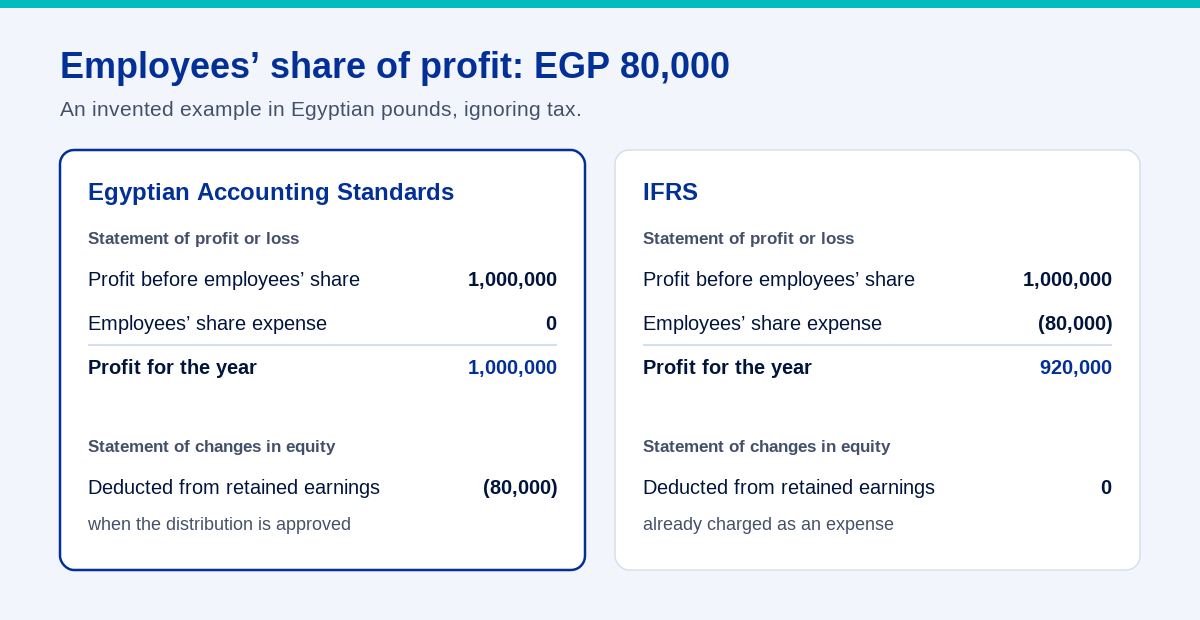
This matters most when someone compares ratios. A net margin calculated from Egyptian statements will look higher than the same company’s margin under IFRS. If you prepare an IFRS package for a parent company, this is usually the first adjustment you post.
Why do FX and revaluation keep coming up?
Because both are tied to the devaluations of the Egyptian pound. EAS 13 covers the effects of changes in exchange rates, and special treatments have been issued for the moves against the pound, including Ministerial Decree 16 of 2017, which added an annex to EAS 13, and FRA Decree 843 of 2022. Under these, some companies remeasured assets once, which still affects their depreciation. Separately, EAS did not allow the revaluation model until January 2023, so older fixed-asset registers are normally kept at cost.
In practice, when you join a company, ask two questions in your first month: did it apply any of the special FX treatments, and does it use cost or revaluation for its fixed assets? The answers explain many entries in the fixed-asset register that would otherwise look wrong.
How should a new accountant learn the two?
- Download the Egyptian standards from FRA’s accounting standards page, in Arabic, and keep them beside you rather than relying on a summary.
- Start with the standards you will touch in your first year: presentation of financial statements, inventories, fixed assets, revenue (EAS 48), leases (EAS 49) and foreign exchange (EAS 13).
- For each one, read the matching IFRS and note only the differences. The list is short, which is the point.
- Check FRA’s legislation page for amending decrees issued after the edition you downloaded.
- If your company reports to a foreign parent, ask for last year’s reconciliation between the local and IFRS figures. It is the fastest map of the differences that matter to that company.
Common questions
- Are Egyptian Accounting Standards just a translation of IFRS?
- No. The IFRS Foundation says they were prepared in Arabic from the start, are based on IFRS, and are close to them but not identical or as comprehensive. Separately, the IFRS Foundation publishes an Arabic translation of IFRS itself.
- Can a small Egyptian company use IFRS for SMEs?
- The IFRS Foundation’s profile says Egypt has not adopted the IFRS for SMEs standard and is not considering it.
- Do banks use EAS?
- Banks follow the accounting framework issued by the Central Bank of Egypt in 2008 and amended in 2019, in addition to EAS, according to the IFRS Foundation’s profile. If you join a bank, learn the CBE rules first.
Sources
The pages the figures and rules in this article were checked against, read in November 2026.
- ifrs.org/use-around-the-world/use-of-ifrs-standards-by-jurisdiction...
- fra.gov.eg/en/معايير-المحاسبة-المصرية
- fra.gov.eg/تشريعات-معايير-المحاسبة-ومراقبي-الحس-2/page/2
- fra.gov.eg/wp-content/uploads/2024/03/معيار-المحاسبة-المصري-رقم-48-...
- fra.gov.eg/wp-content/uploads/2024/03/معيار-المحاسبة-المصري-رقم-49-...
- accaglobal.com/gb/en/qualifications/glance/acca/how.html
- esaa.org.eg/trainees/المنهج