
Key points
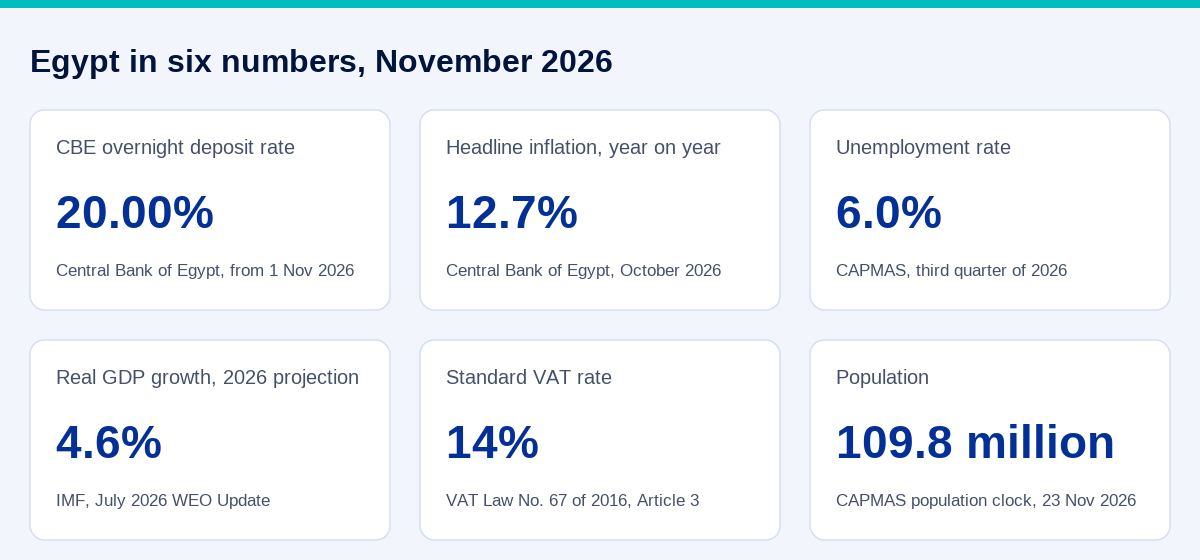
- The Central Bank of Egypt’s overnight deposit rate is 20.00% and its lending rate 21.00%, effective 1 November 2026.
- Annual headline inflation was 12.7% in October 2026 and core inflation 13.1%, according to the Central Bank.
- CAPMAS put unemployment at 6.0% in the third quarter of 2026; 44.6% of the unemployed hold a university degree or higher.
- The standard VAT rate is 14%, and a business must register once its sales over twelve months reach EGP 500,000.
- Every figure here is dated. The page is reviewed each quarter; the next review is due in February 2027.
As of November 2026, the Central Bank of Egypt’s overnight deposit rate stands at 20.00%, annual headline inflation at 12.7%, unemployment at 6.0% and the standard VAT rate at 14%. This page collects twenty-five such figures that an accountant or a business owner in Egypt needs when pricing, budgeting, borrowing or job hunting. Each comes from the body that publishes it, with the date we read it, and the page is refreshed every quarter.
What are interest rates, inflation and the exchange rate in Egypt now?
With effect from 1 November 2026 the Central Bank’s overnight deposit rate is 20.00% and its overnight lending rate 21.00%, one percentage point above the 19.0% and 20.0% its Monetary Policy Committee kept at its 9 July 2026 meeting. Annual headline inflation was 12.7% in October 2026 and core inflation 13.1%. The Central Bank’s average market rate for the US dollar on 22 November 2026 was EGP 54.37 to buy.
| Indicator | Figure | Source and date |
|---|---|---|
| Overnight deposit rate | 20.00% | Central Bank of Egypt, effective 1 Nov 2026 |
| Overnight lending rate | 21.00% | Central Bank of Egypt, effective 1 Nov 2026 |
| Main operation rate and discount rate | 20.50% | Central Bank of Egypt, effective 1 Nov 2026 |
| Headline inflation, year on year | 12.7% | Central Bank of Egypt, October 2026 (page updated 9 Nov 2026) |
| Core inflation, year on year | 13.1% | Central Bank of Egypt, October 2026 |
| Headline inflation, month on month | 0.7% | Central Bank of Egypt, October 2026 |
| US dollar, average market rate | EGP 54.3743 buy, 54.4743 sell | Central Bank of Egypt, 22 Nov 2026 |
The Central Bank’s rates are not the rate a company pays on a bank loan. Banks price loans above them, and the gap differs by bank and borrower. They do set the direction that loan and overdraft pricing tends to follow.
How fast is Egypt’s economy expected to grow?
The IMF’s page on Egypt shows a projected real GDP growth of 4.6% for 2026, taken from its July 2026 World Economic Outlook Update, and projected consumer price inflation of 13.2% for the year. CAPMAS’s population clock read 109,798,956 people in the early hours of 23 November 2026. These are the background numbers for any sales forecast.
| Indicator | Figure | Source and date |
|---|---|---|
| Real GDP growth, 2026 projection | 4.6% | IMF Egypt page, from the July 2026 WEO Update |
| Consumer prices, 2026 projection | 13.2% | IMF Egypt page, read 23 Nov 2026 |
| Population | 109,798,956 | CAPMAS population clock, 23 Nov 2026 |
Two inflation figures appear on this page, and they measure different things. The Central Bank’s 12.7% is what prices did over the twelve months to October 2026. The IMF’s 13.2% is a projection for the year as a whole. Use the first to explain last year’s costs and the second, with care, in a budget.
What does the job market look like for accounting graduates?
CAPMAS reported on 18 November 2026 that unemployment was 6.0% in the third quarter of 2026, up 0.2 points on the quarter before. University graduates make up a large share of those without work: 44.6% of the unemployed hold a university degree or higher. CAPMAS does not publish a separate figure for accounting graduates.
| Indicator | Figure | Source and date |
|---|---|---|
| Unemployment rate | 6.0% (5.8% in Q2) | CAPMAS labour force survey, 18 Nov 2026 |
| Unemployed holding a university degree or higher | 44.6% of the unemployed | CAPMAS, 18 Nov 2026 |
| Female unemployment rate | 14.9% | CAPMAS, 18 Nov 2026 |
| Labour force | 35.757 million | CAPMAS, 18 Nov 2026 |
| Employed | 33.595 million | CAPMAS, 18 Nov 2026 |
| Employed people paid a cash wage | 71.1% of the employed | CAPMAS, 18 Nov 2026 |
| Unemployment rate, full year 2025 | 6.3% | CAPMAS selected indicators, read 23 Nov 2026 |
For finance staff worldwide, ACCA’s Global Talent Trends 2026 survey, published in May 2026 with more than 11,000 respondents in 160 countries, found that 82% were confident they could build AI-related skills and 51% were worried about AI’s effect on their jobs. It also found 55% dissatisfied with their pay and 52% expecting their next move to be outside their current employer. These are global figures, not Egyptian ones.
| Finding | Figure | Source and date |
|---|---|---|
| Confident they can develop AI-related skills | 82% | ACCA, May 2026 |
| Worried about AI’s impact on their jobs | 51% | ACCA, May 2026 |
| Dissatisfied with current pay | 55% | ACCA, May 2026 |
| Expect their next move to be outside their current employer | 52% | ACCA, May 2026 |
Which VAT figures does every accountant in Egypt use?
Three numbers from VAT Law No. 67 of 2016 come up every month: the standard rate of 14%, the registration threshold of EGP 500,000 in sales over twelve months, and an additional tax of 1.5% a month on VAT paid late. They are taken from the Egyptian Tax Authority’s English translation of the law, updated to January 2023. Kayan Finance does not represent clients before the Tax Authority.
| Item | Figure | Source and date |
|---|---|---|
| Standard VAT rate | 14% (since fiscal year 2017/2018) | VAT Law, Article 3; ETA translation updated Jan 2023 |
| Registration threshold | EGP 500,000 of sales in the past 12 months | VAT Law, Article 16; ETA translation updated Jan 2023 |
| Time to apply once the threshold is reached | 30 days | VAT Law, Article 16 |
| Additional tax on unpaid VAT | 1.5% for each month or part of a month | VAT Law, Article 1 (definitions) |
Tax law is amended often. Before applying any of these figures to a real return, check the law in force on the Egyptian Tax Authority’s site.
What is changing in financial reporting?
On 30 August 2026 the Financial Regulatory Authority held a workshop with the EU and UNDP on a draft roadmap for applying the IFRS Sustainability Disclosure Standards in the non-bank financial markets it supervises. The draft has three phases: simplified climate disclosures, initial application of the standards, then full compliance. It was still under review when we read it.
How should a small company use these numbers?
Use them as reference points, not forecasts of your own costs. Inflation tells you whether a price increase from a supplier is above or below the general trend. The Central Bank’s rates tell you which way borrowing costs are moving. The VAT threshold tells you whether a growing business has to register.
- Compare supplier increases with inflation. A trading company whose main supplier raises prices by 20% in a year when headline inflation was 12.7% has a reason to ask for an explanation or a second quote.
- Test the budget against the Central Bank’s direction. A company with an overdraft of EGP 2,000,000 whose bank passes on the full one-point rise pays about EGP 20,000 more interest a year.
- Watch the VAT threshold monthly. Add up sales for the last twelve months at each month end; once the total reaches EGP 500,000, the law gives 30 days to apply for registration.
- Date every number you quote. A budget that says "inflation 12.7% (CBE, October 2026)" can be checked and updated; one that says "inflation about 13%" cannot.
How is this page kept up to date?
We re-read every source each quarter and change a figure only when its publisher has changed it. The date at the top of the page is the date of the last full check. A figure we cannot confirm from its publisher’s own page is removed, not estimated. The next review is due in February 2027, after the Central Bank’s next decisions and CAPMAS’s fourth-quarter labour survey.
Common questions
- Why does CAPMAS show a different inflation figure from the Central Bank?
- CAPMAS’s home page showed an annual inflation rate of 12% for October 2026 without saying which index it was; the Central Bank’s headline figure for the same month was 12.7%. We have not confirmed which index each body shows, so this page uses the Central Bank’s headline figure throughout so comparisons stay consistent.
- Is there a figure for how many accountants work in Egypt?
- We did not find one published by CAPMAS or a professional body that we could confirm, so this page gives none. If you see such a figure, ask for its source and date.
- Can I quote these figures in a report?
- Yes, but cite the original publisher and date shown in the tables, not this page. The publisher’s figure is the one that will be revised.
- What is the corporate income tax rate?
- We left it out of this edition because we could not confirm it from an official Egyptian source on the day we checked. Read it from the current Income Tax Law on the Tax Authority’s site.
Sources
The pages the figures and rules in this article were checked against, read in November 2026.
- cbe.org.eg/en/economic-research/statistics/overnight-deposit-and-le...
- cbe.org.eg/en/monetary-policy/mpc-meetings-schedule
- cbe.org.eg/-/media/project/cbe/listing/publication/monetary-policy-...
- cbe.org.eg/en/economic-research/statistics/inflation-rates
- cbe.org.eg/en/economic-research/statistics/exchange-rates
- capmas.gov.eg/mediaLanding/news/13566
- capmas.gov.eg
- imf.org/en/Countries/EGY
- eta.gov.eg/sites/default/files/2024-02/Law-english-no.67-2016.pdf.pdf
- accaglobal.com/gb/en/news/2026/May/GTT-2026.html
- fra.gov.eg/en