
Key points
- Gross profit margin = gross profit ÷ sales × 100. Net profit margin = net profit ÷ sales × 100.
- Gross margin is the one to watch monthly: prices, discounts and purchase costs move it, and you control all three.
- Margin and markup are different. A 30% markup on cost gives a margin of about 23%, not 30%.
- In our example, a two-point fall in gross margin on EGP 6 million of sales cost EGP 120,000, about a quarter of the year’s net profit.
- Compare margins with your own history first. Industry averages only help when the other businesses sell the same way you do.
Gross profit margin is gross profit divided by sales, and net profit margin is net profit divided by sales, both shown as a percentage. Gross margin tells you whether your prices cover what you pay for the goods you sell, with enough left to run the business. Net margin tells you what is left from each EGP 100 of sales after every cost, interest and tax. As an owner you need both, but you will act on the gross margin far more often, because it moves with decisions you make every week.
How do you calculate gross profit margin?
Take sales, subtract the cost of the goods you sold to get gross profit, then divide gross profit by sales and multiply by 100. Both figures come from the income statement. The example wholesaler used across this series had sales of EGP 6,000,000 in 2025 and cost of goods sold of EGP 4,200,000, so gross profit was EGP 1,800,000 and the gross margin 30%.
Cost of goods sold means the cost of what was sold, not everything bought. It is opening stock plus purchases minus closing stock. That is why the gross margin is only as reliable as the stock count behind it: overstate closing stock by EGP 100,000 and gross profit is overstated by the same amount.
How do you calculate net profit margin?
Divide net profit, the last line of the income statement, by sales and multiply by 100. The example company’s net profit in 2025 was EGP 465,000 on sales of EGP 6,000,000, a net margin of 7.75%. Between the two sits a third margin worth knowing: operating profit margin, operating profit divided by sales. It was 11% (EGP 660,000 on EGP 6 million). Because it comes before interest and tax, it is the fairest way to compare one year’s trading with another when borrowing has changed.
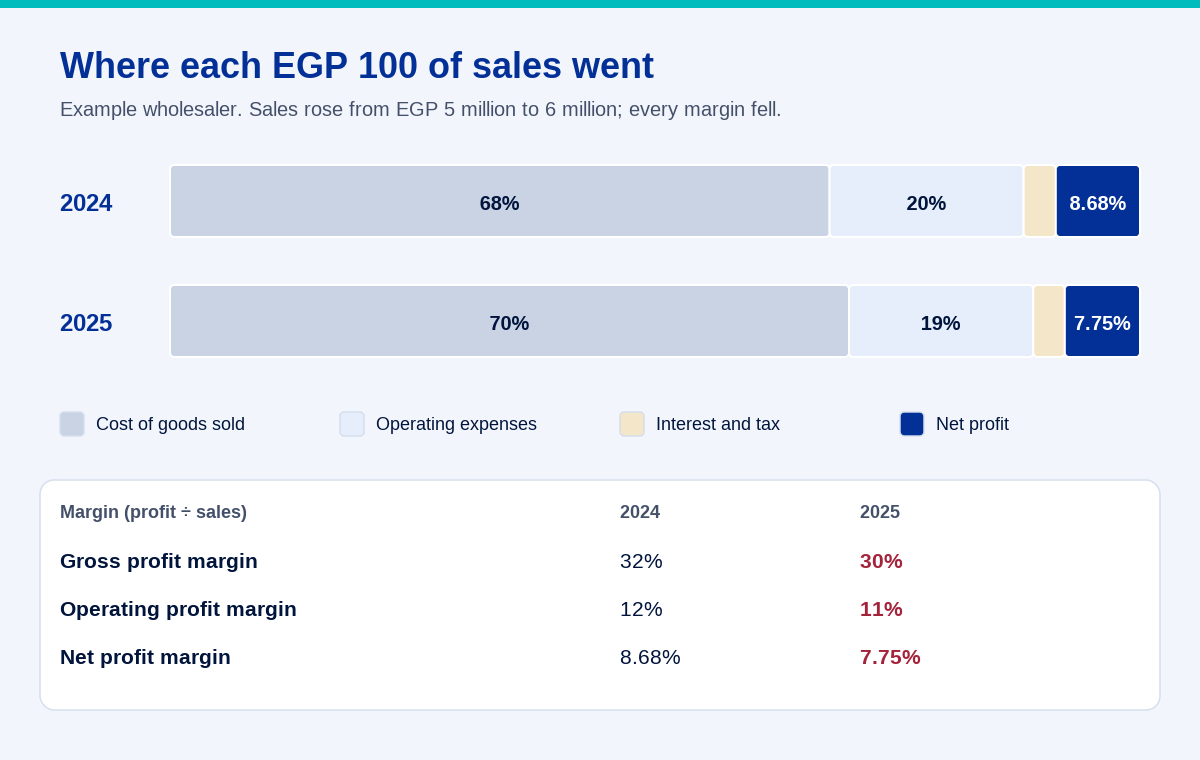
| Item | 2024 | 2025 |
|---|---|---|
| Sales | 5,000,000 | 6,000,000 |
| Gross profit | 1,600,000 | 1,800,000 |
| Gross profit margin | 32% | 30% |
| Operating profit | 600,000 | 660,000 |
| Operating profit margin | 12% | 11% |
| Net profit | 434,000 | 465,000 |
| Net profit margin | 8.68% | 7.75% |
What is the difference between margin and markup?
Margin divides profit by the selling price; markup divides the same profit by the cost. An item that costs EGP 100 and sells for EGP 130 has a markup of 30% and a margin of 23.1% (30 divided by 130). The two are often confused when prices are set, and the confusion always runs the same way: an owner who adds 30% to cost and expects a 30% margin earns less than planned. In the example company, gross profit of EGP 1.8 million on goods costing EGP 4.2 million is a markup of 42.9% and a margin of 30%.
| Markup on cost | Selling price for a cost of EGP 100 | Gross margin |
|---|---|---|
| 20% | 120 | 16.7% |
| 25% | 125 | 20% |
| 30% | 130 | 23.1% |
| 50% | 150 | 33.3% |
| 100% | 200 | 50% |
Which margin matters more to an owner?
Gross margin for running the business week to week; net margin for judging whether the business is worth running. Gross margin responds within days to a price change, a new discount, a supplier’s increase or a shift in what you sell, so it is the one to review every month, by product group if your system allows. Net margin moves more slowly and includes costs such as rent and salaries that you change once or twice a year. Review it quarterly and at the year end.
What does a two-point fall in gross margin cost?
Multiply the fall by sales. The example company’s gross margin fell from 32% to 30%. On sales of EGP 6 million, two points is EGP 120,000 of gross profit, about a quarter of the year’s net profit of EGP 465,000. The owner saw sales up 20% and profit up, and had no reason to look closer. The margin showed what the totals hid: each sale was earning less than the year before.
When gross margin falls, the cause is almost always one of a short list. Ask about each in turn before you decide anything.
- Purchase prices rose and selling prices did not follow, or followed late.
- Discounts grew: more customers getting them, larger percentages, or discounts given without anyone approving them.
- The mix changed: more of the sales came from lower-margin products or customers.
- Stock went missing or was damaged, and the loss sits inside cost of goods sold.
- The stock count was wrong, in this period or the one before, which moves cost of goods sold between the two.
Agree in writing who may give a discount and up to what percentage. In many small companies the gross margin falls because salespeople have the authority to cut prices and nobody sees the total.
What is a good profit margin?
There is no single answer, and be wary of anyone who gives one. A wholesaler that moves large volumes can run well on a gross margin that would sink a specialist retailer, and a service company has almost no cost of goods sold at all. The useful comparisons are, in order: your own margin last month and last year, your margin by product group and by customer, and then other businesses that sell similar goods to similar customers on similar terms. A falling trend in your own numbers matters more than any average.
Common questions
- Can net margin be higher than gross margin?
- Only if the company has large income outside its trading, such as a gain on selling an asset. In a normal year net margin is always lower, because operating expenses, interest and tax all come after gross profit.
- Why does my gross margin jump around from month to month?
- Usually because cost of goods sold is not worked out properly each month. If purchases are expensed as they arrive and stock is counted only at the year end, monthly margins rise and fall with the timing of deliveries. Ask for a monthly cost of sales based on a perpetual stock record or a monthly count.
- Should I calculate margin per product?
- Yes, if your system records cost per item. The company-wide margin is an average, and an average can hide a product that sells well and earns almost nothing. Start with your ten largest products or product groups.
- Is a falling margin bad if profit is still rising?
- It deserves an explanation. Sometimes it is a deliberate choice, such as lower prices to win a large customer. If nobody chose it, the margin is telling you about a cost or a discount that nobody is watching.