
Key points
- Start from a bill of materials for one unit, at current purchase prices, including normal waste.
- Charge labour by the hours one unit takes, at the full hourly cost of the worker, not only the wage.
- Spread rent, power, supervision and machine depreciation over your normal monthly output, not over whatever was produced this month.
- Add a share of selling and admin costs before you set a price. The price has to cover them even though stock is valued without them.
- Recalculate whenever a main material price changes, and check the costing against the books every quarter.
To calculate a product’s cost correctly, add up four things per unit: the materials it uses, the direct labour it takes, its share of production overhead spread over your normal output, and its share of selling and admin costs. The first three are the cost of making it; all four are what the price has to cover before you earn anything. Most small manufacturers count only the first two, and so believe each unit earns more than it does.
What goes into the cost of one product?
For valuing stock, the international standard on inventories, IAS 2, says cost includes the costs of purchase, the costs of conversion (direct labour and production overhead), and other costs of bringing the goods to their present location and condition. For pricing you need one more layer: the selling and admin costs the business carries whether or not the factory runs.
| Layer | What it includes | How to measure it per unit |
|---|---|---|
| Materials | Raw materials, components, packaging, normal waste | Bill of materials at current purchase prices |
| Direct labour | Workers who make the product | Hours per unit times full hourly cost |
| Production overhead | Workshop rent, power, supervision, machine depreciation, maintenance | Monthly total divided by normal monthly output |
| Selling and admin | Office, sales staff, delivery, accounting | Monthly total divided by normal monthly sales volume |
How do you work out the materials in one unit?
Write a bill of materials: every material and component in one unit, with its quantity. Price each line at what you would pay today, because that is what the next batch will cost you. Then add normal waste. If one chair needs 0.05 cubic metres of finished wood but cutting loses a tenth of every plank, the chair consumes about 0.055. Waste that is normal for the process belongs in the unit cost; a spoiled batch does not, and should be recorded and looked into separately.
How do you charge labour to a product?
Time how long one unit takes at each stage, and multiply by the full hourly cost of the workers who do it. The full cost is more than the wage: add the employer’s share of social insurance, paid leave, and any regular bonuses, then divide by the hours actually worked in a year. A worker paid EGP 9,000 a month who costs the company EGP 12,000 in total is charged at the 12,000 rate.
How do you spread overhead across units?
Divide the monthly production overhead by your normal monthly output: the volume you produce in an ordinary month, not your best month and not your worst. Using normal output keeps the unit cost steady. If you divided by each month’s actual output, a quiet month would make every unit look more expensive, and you might raise prices exactly when customers are scarce.
Here is a worked example. A furniture workshop makes dining chairs. Each chair uses EGP 600 of materials, including normal waste, and four hours of labour at a full cost of EGP 75 an hour, so EGP 300. Production overhead (workshop rent, power, a supervisor and machine depreciation) totals EGP 60,000 a month, and the workshop normally makes 400 chairs a month, so each chair carries EGP 150. Selling and admin costs of EGP 40,000 a month add EGP 100 a chair. The full cost is EGP 1,150.
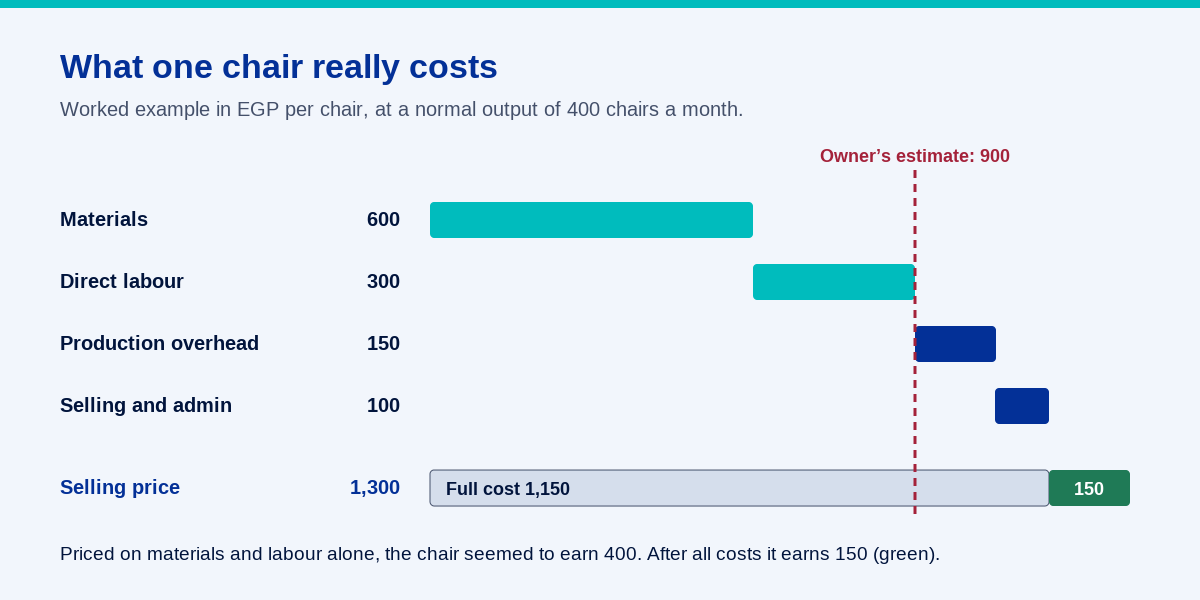
Now suppose a slow month in which the workshop makes only 250 chairs. Dividing EGP 60,000 by 250 would put overhead at EGP 240 a chair. Keep it at EGP 150, the normal-output rate. The EGP 22,500 of overhead that the 250 chairs do not absorb is the cost of the idle capacity that month. Show it as its own line in the management accounts, where you can see it and act on it, instead of hiding it inside the unit cost.
How do you set a price from the cost?
Start from full cost and add the profit you need, then compare the result with what the market pays. If the market price is below your full cost, the costing shows that something has to change: you need cheaper materials, fewer hours per unit, more volume over the same overhead, or a different product. Without the costing you would only see the problem at year end, as a smaller profit than expected.
There is one case for pricing below full cost: an extra order when the workshop has spare capacity. Overhead is already paid, so any price above the costs that rise with each extra chair (here materials, and labour if you pay overtime or extra workers) adds to profit. Keep such orders separate and limited, or the lower price becomes your normal price.
What are the steps to cost a product?
- Write the bill of materials for one unit and price it at current purchase prices, adding normal waste.
- Time each stage of production and multiply by the full hourly cost of the workers involved.
- Total the monthly production overhead and divide it by normal monthly output.
- Total the monthly selling and admin costs and divide them by normal monthly sales volume.
- Add the four layers to get full cost, then add the margin you need and compare with the market price.
- Each quarter, multiply unit costs by units sold and compare the total with the costs in your books. A large gap means a layer is missing or wrong.
Common questions
- How do I share overhead between products made in the same workshop?
- Use whatever drives the overhead. If machines are the main cost, share it by machine hours; if people are, by labour hours. A product that takes twice the hours carries twice the overhead. Dividing by the number of units treats a small stool like a large wardrobe.
- How often should I update the costing?
- Whenever the price of a main material changes, when wages change, and at least once a year for overhead. A price set once and left alone while costs move is how a profitable product quietly stops earning.
- Does this work for a restaurant or a service business?
- Yes. In a restaurant the bill of materials is the recipe, and overhead is the kitchen. In a service business materials are small and labour hours dominate, so the hourly cost and the share of overhead per hour matter most.
- Is the cost I use for pricing the same as the stock value in my books?
- Not quite. Stock in the books is valued at the cost of making the product, which excludes selling and admin costs. The pricing cost adds them back. Both should start from the same materials, labour and overhead figures.
Sources
The pages the figures and rules in this article were checked against, read in November 2026.