
Key points
- An hourly session buys an answer to one defined question. A monthly contract buys a set of outputs delivered on fixed dates.
- If the work recurs every month, such as entries, bank reconciliations and month-end reports, a monthly arrangement usually fits better.
- A session is only as good as its preparation: one clear question and the statements or records it concerns.
- Many small companies combine the two: monthly bookkeeping or review, plus a session when a specific decision comes up.
Pay an accounting firm by the hour when you have a defined question or a one-off piece of work, and use a monthly contract when the work comes back every month. An hourly session suits “what is my balance sheet telling me?” or “is my chart of accounts set up properly?”. A monthly arrangement suits recording the month’s transactions, reconciling the banks and producing reports on a fixed date. Most of the confusion comes from buying one to do the job of the other: monthly fees for a question that needed an afternoon, or hourly sessions to keep books that need someone every week.
What do you actually get from an hourly session?
You get an accountant’s attention on one question, using your own figures, and an answer you can act on. A good session is prepared in advance from the statements and records you send, held with you, and closed with a written summary: what the figures mean, what is wrong, and what to do about each point. The work that follows is usually yours or your accountant’s.
A session also tells you something about your records. If the books cannot support a reliable answer, an honest session says so, and that finding is often worth more than the answer you came for. It is also the cheapest way to try a firm before you commit to anything longer.
What does a monthly contract cover?
A monthly contract covers an agreed scope of recurring work and a list of outputs with dates. Typical scopes are bookkeeping (recording the month’s documents, reconciling the banks and closing the month) or oversight (reviewing the work of an in-house accountant and reporting to the owner). The same work is done and delivered on the same dates every month.
Part of that calendar is set by tax rules. A company registered for VAT files a return for each calendar month, within the following month, together with the data of its sales and purchase invoices, as of November 2026. Books that are closed every month make that return a routine; books that are caught up every quarter make it a scramble. Projects in the simplified regime under Law 6 of 2025 file VAT every three months instead.
| Question | Hourly session | Monthly contract |
|---|---|---|
| What you buy | An answer to one defined question | Recurring work and dated outputs |
| Best for | Understanding statements, reviewing a chart of accounts or document cycle, a decision you are about to make | Bookkeeping, bank reconciliations, month-end close, monthly review of an in-house team |
| Who does the work afterwards | You or your accountant | The firm, within the agreed scope |
| How the cost behaves | You pay when you use it | A fixed fee for a fixed scope, reviewed when volume changes |
| What it needs from you | One clear question and the related records | Documents on time every month, and someone who answers questions |
| Main risk | Using sessions to keep books, so nothing is ever closed | Paying every month for a scope you no longer need |
How do you decide which one you need?
Ask two questions. Does the need come back every month? If it does, you are looking at a monthly arrangement, whatever you call it. If it does not, can you write the need as one question? If you can, book a session. If you cannot, because you only know that “the numbers feel wrong”, a session is still the right start, used to find the real question and the scope.
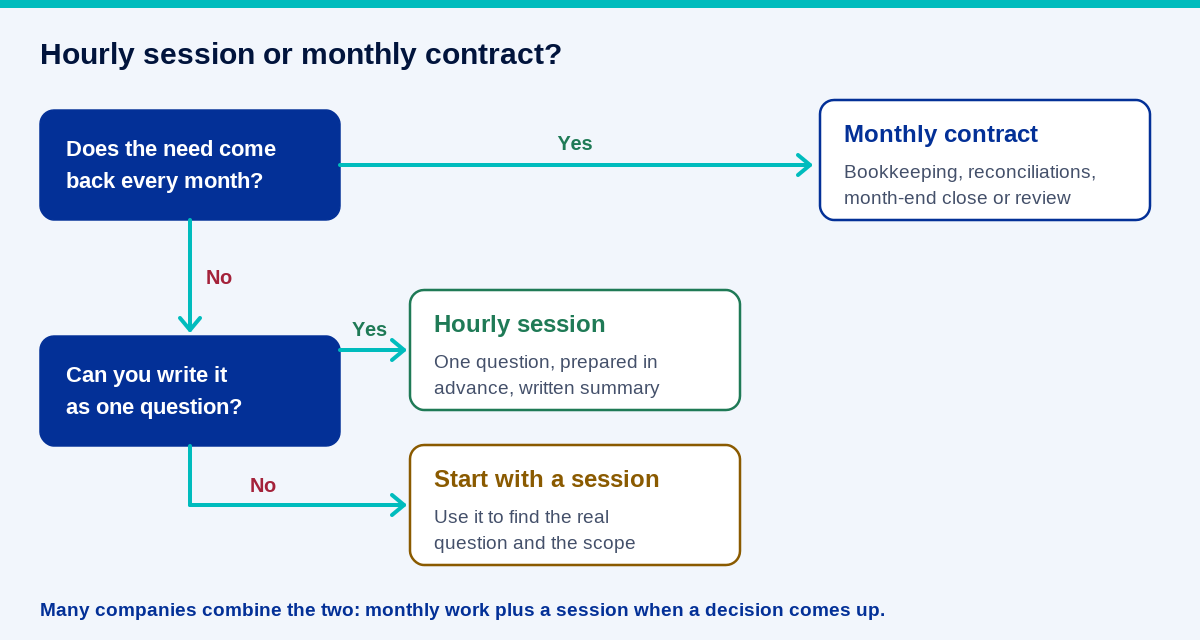
- Signs you need a monthly arrangement: transactions every day, no monthly profit figure by the middle of the following month, bank balances that nobody has reconciled, a monthly VAT return, or an in-house accountant whose work nobody reviews.
- Signs a session is enough: the books are kept and closed, and you want to understand them; you are about to take a loan or open a branch and want the figures read first; or your accountant wants a second opinion on one treatment.
How do you get real value from an hourly session?
- Write the question in one sentence. “Why does my balance sheet show a supplier balance I already paid?” is a session; “review my accounts” is a project.
- Send the material in advance: the financial statements, the trial balance, the chart of accounts or the documents the question concerns, even if they are incomplete.
- Bring the person who keeps the books, if you have one, so the answer reaches whoever will act on it.
- Ask for the summary in writing, with what to do and who does it.
- Decide afterwards, with the summary in hand, whether the fix is a one-off task or a sign that you need recurring help.
What should a monthly proposal spell out?
A monthly fee is only comparable between firms when the scope behind it is written down. Before you compare two proposals, make sure each one states the same things, otherwise the cheaper one may simply cover less.
- The volume the fee assumes, such as documents or bank accounts per month, and what happens when it changes.
- The outputs and their dates: which reports, by which day of the following month.
- What is excluded. Some accounting firms, Kayan Finance among them, do not represent clients before the Tax Authority or carry out statutory audits, so you may need a separate adviser for those.
- How one-off work outside the scope is charged, for example a session on a new question.
- How the records are handed back if the contract ends.
Can you combine the two?
Yes, and for many small companies that is the most sensible arrangement. A company with an in-house accountant might buy a monthly review and book a session when a bank asks for a credit file. A company without one might outsource the bookkeeping and book a session once a quarter to go through the statements with the owner. Kayan Finance works both ways: consulting sessions for one question, and monthly bookkeeping or oversight for recurring work. Many clients start with a session, because it shows what the records need before anyone signs a monthly contract.
Common questions
- Is a monthly contract always more expensive?
- Not over a year, if the work really recurs. Repeated sessions to deal with the same monthly backlog usually cost more and still leave the books unclosed. Compare the cost of a year of each against the outputs you need.
- Can one session fix messy books?
- No. A session can show what is wrong and what the fix involves. Cleaning up past years or setting up a chart of accounts and a document cycle is a project with its own scope.
- Should my in-house accountant attend the session?
- Yes, if the question concerns the books they keep. They know where the figures came from, and they are the person who will carry out the fix.
- How do I move from sessions to a monthly contract?
- Use the session summaries to write the scope: what recurs, how many documents, which reports you need and by when. Then ask for a proposal against that scope, starting at the beginning of a month.
Sources
The pages the figures and rules in this article were checked against, read in November 2026.
- eta.gov.eg/sites/default/files/2024-03/law_no.286-2021.pdf
- eta.gov.eg/sites/default/files/2024-02/Law-english-no.67-2016.pdf.pdf
- eta.gov.eg/sites/default/files/2025-02/law_no.6.of_.2025.pdf