
Key points
- As of November 2026 the general VAT rate is 14%, restated by Law 149 of 2026; some goods and services are exempt or treated differently.
- The tax period is the calendar month. The return is filed, and the tax paid, within the month after the period ends.
- Tax due is the tax on sales less the tax you may deduct: tax on purchases and inputs for taxable sales, and tax on sales returned to you.
- You can deduct only with a tax invoice in hand. A deduction larger than the month’s tax is carried forward to the following months.
- Projects in the simplified regime under Law 6 of 2025 file their VAT return every three months instead of monthly.
A VAT return in Egypt is worked out by taking the tax charged on the month’s taxable sales and subtracting the tax the company is allowed to deduct, mainly the tax on its purchases and on sales returned to it; the difference is paid with the return within the following month, or carried forward if it is negative. This article walks a new accountant through that calculation with a worked example. The rules are as of November 2026, the numbers in the example are invented, and the article is general explanation. Kayan Finance does not represent clients before the Tax Authority, so check your own company’s position with the Authority or a tax adviser.
Who has to register and file VAT returns?
Under Article 16 of the VAT Law (Law 67 of 2016), a person who sells taxable goods or services must register once total sales of taxable and exempt goods and services over 12 months reach EGP 500,000, and must apply within 30 days of reaching that threshold. Importers for trade, exporters and distribution agents register whatever their sales.
These figures come from the Tax Authority’s English translation of the law, updated in January 2023. The law allows the threshold to be changed by ministerial decree, so confirm the current figure on eta.gov.eg. A business below the threshold may also register voluntarily, and once registered it files returns like any other registrant.
What rate applies, and what period does a return cover?
The general rate is 14%. Law 149 of 2026, published on 28 July 2026, restated Article 3 of the VAT Law with that figure, and set a 5% rate for machinery and equipment used to produce goods or provide services (buses and passenger cars excluded). The tax period is the calendar month, and the return covers one month.
Not every sale is at 14%. The law has a list of exempt goods and services and a separate table of goods and services that carry a table tax, which has its own rules. A new accountant should check each product line against the current law before assuming the general rate.
What tax can you deduct?
Article 22 of the law and Article 26 of its Executive Regulation allow a registrant to deduct tax previously charged on inputs, on goods bought for resale and on imports, and tax on sales returned by customers. The tax invoice must be in your possession. When deductible tax exceeds the month’s output tax, the excess is carried forward to the following months.
| Item | Deductible? | Condition or note |
|---|---|---|
| Tax on inputs for taxable sales | Yes | Tax invoice in hand |
| Tax on goods bought for resale | Yes | Tax invoice in hand |
| Tax on imports | Yes | Per the customs certificate and payment receipt |
| Tax on sales returned to you | Yes | Goods back in the same condition, recorded, refunded or credited, with a dated note |
| Inputs used for both taxable and exempt sales | In part | In proportion of taxable sales to total sales |
| Inputs used only for exempt sales | No | Not deductible |
| Table tax, and input tax included in cost | No | Unless the law provides otherwise for table tax |
How does the calculation work in a real month?
Take an invented trading company whose sales are all taxable at 14%. In October 2026 it sold goods worth EGP 500,000 before tax, accepted returns of EGP 20,000, bought goods for resale worth EGP 300,000 and paid EGP 40,000 for taxable services such as maintenance and advertising, all with tax invoices. It has no credit carried from September.
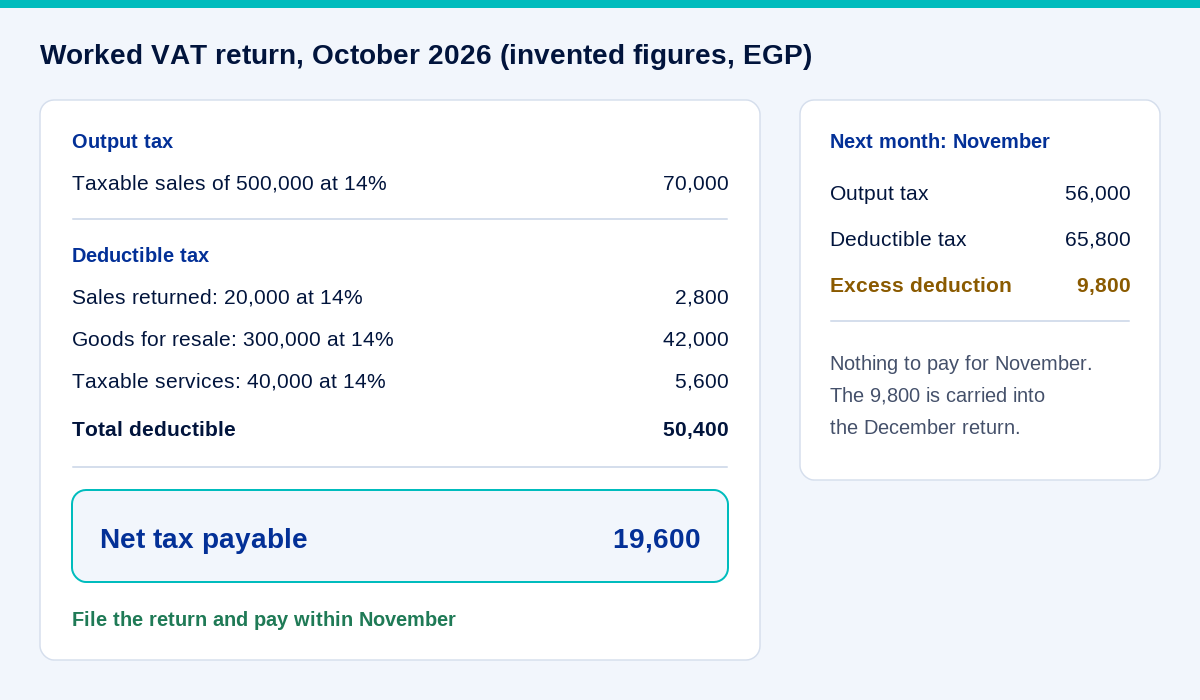
| Line | Value before tax | Tax at 14% |
|---|---|---|
| Taxable sales (output tax) | 500,000 | 70,000 |
| Less: sales returned by customers | 20,000 | (2,800) |
| Less: goods bought for resale | 300,000 | (42,000) |
| Less: taxable services bought | 40,000 | (5,600) |
| Net tax payable for October | 70,000 less 50,400 | 19,600 |
Now suppose that in November the same company sells EGP 400,000 (output tax EGP 56,000) but stocks up for the season and buys EGP 470,000 of goods (tax EGP 65,800). Deductible tax is EGP 9,800 more than output tax. Nothing is paid for November, and the EGP 9,800 is carried into the December return, where it is deducted before anything is paid.
Article 30 of the law lists the cases in which tax can be refunded rather than carried forward. Law 149 of 2026 rewrote one of them: a credit balance that has lasted more than four consecutive tax periods, or more than three months for projects under Law 6 of 2025. A refund has its own conditions and documents, so treat that as a separate procedure.
When and how is the return filed?
The Executive Regulation of the Unified Tax Procedures Law requires the return within the month following the end of each tax period, together with payment of the tax by a non-cash method. So the October return and its payment are due during November. The data of the month’s sales and purchase invoices must accompany the electronic return, or the return cannot be relied on.
Projects that opted into the simplified regime of Law 6 of 2025 (annual turnover up to EGP 20 million) are an exception: their VAT return is filed every three months, within the month after each quarter, with payment.
- Close the month’s sales: agree sales and credit notes in the ledger to the e-invoices and e-receipts on the Tax Authority’s system, and split them into taxable and exempt.
- Work out output tax on taxable sales and check it against the VAT output account.
- List deductible tax from the purchase invoices you hold, plus tax on sales returned to you. Leave out anything without a tax invoice.
- Subtract deductible tax and any credit carried from last month. A positive result is payable; a negative one is carried forward.
- File on the Authority’s portal with the month’s invoice data and pay by a non-cash method, within the following month.
Which mistakes do new accountants make most often?
- Deducting tax on a purchase with no tax invoice, or on an invoice in another company’s name.
- Treating every product at 14% without checking the exempt list and the table.
- Deducting the full input tax when part of the sales are exempt, instead of the taxable proportion.
- Booking a sales return without the credit note that the regulation requires.
- Forgetting the credit carried from last month, or carrying it twice.
- Filing figures that do not match the e-invoices on the Authority’s system, which is the data the return is filed with.
Most of these are caught by one habit: reconcile the VAT accounts in the ledger with the Tax Authority’s system before you start the return, and keep that reconciliation with the return. A worked file like the example above, kept month after month, also makes the next accountant’s job much easier.
Common questions
- What counts as a tax invoice for deduction?
- The law defines a tax invoice as one prepared on the form set by the Minister of Finance. When your supplier is on the e-invoice system, check that the invoice shows as valid there before you deduct it.
- Is the 14% charged on the price before or after discount?
- Article 11 of the Executive Regulation takes the value actually paid as the base and accepts ordinary trade discounts between a registered seller and an independent buyer. A discount that is not shown on the tax invoice is not accepted, so put it on the invoice.
- Can I deduct VAT on a car the company bought?
- Cars are a special case. The 5% rate for machinery and equipment excludes buses and passenger cars, and the regulation has specific refund conditions for them. Check before you deduct.
- Where can I read the law itself?
- The Tax Authority publishes the VAT Law, its Executive Regulation and every amendment, including Law 149 of 2026, on the VAT laws page of eta.gov.eg, with English translations of the law and regulation.
Sources
The pages the figures and rules in this article were checked against, read in November 2026.
- eta.gov.eg/sites/default/files/2026-08/law.no_.149.of_.2026.pdf
- eta.gov.eg/sites/default/files/2024-02/Law-english-no.67-2016.pdf.pdf
- eta.gov.eg/sites/default/files/2024-02/VAT-Executive-Regulations-En...
- eta.gov.eg/ar/content/qwanyn-aldrybt-ly-alqymt-almdaft
- eta.gov.eg/sites/default/files/2024-03/law_no.286-2021.pdf
- eta.gov.eg/sites/default/files/2025-02/law_no.6.of_.2025.pdf