
Key points
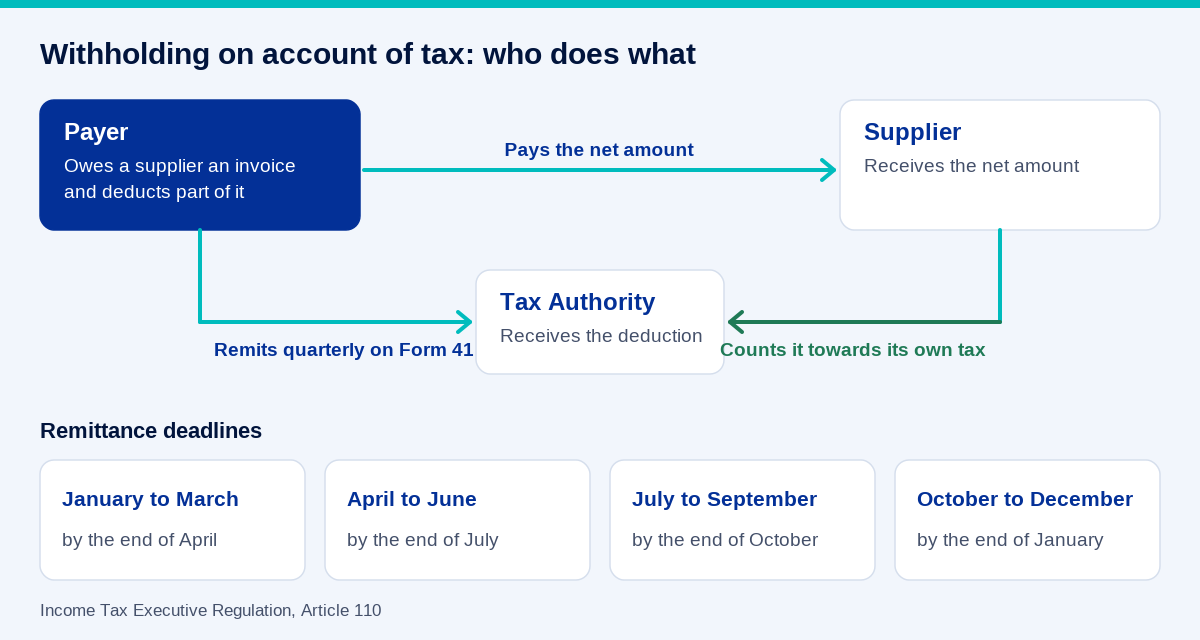
- Withholding on account of tax means the payer deducts part of a payment to a supplier and remits it to the Tax Authority; the supplier later counts it towards its own income tax.
- The Income Tax Regulation sets remittance on Form 41 by the end of April, July, October and January. The percentage depends on the type of transaction; check the current table with the Tax Authority.
- Projects in the simplified regime under Law 6 of 2025 are outside withholding in both directions: nobody deducts from them and they deduct from nobody.
- Employers file a quarterly payroll tax return and an annual settlement through the Tax Authority’s portal.
- From 1 January 2026 the insurable wage runs from EGP 2,700 to EGP 16,700 a month, and the law requires the actual wage to be insured.
In your first job you will meet two deductions that the company makes from money it pays out and then hands over to the state: withholding on account of income tax, taken from payments to suppliers, and social insurance contributions, calculated on employees’ wages. Payroll income tax sits between the two. This article explains how each one works, which forms and dates apply, and what was current in November 2026. It is general explanation for a new accountant. Kayan Finance does not represent clients before the Tax Authority or the National Social Insurance Authority, so confirm any specific case with them or with an adviser.
What is withholding on account of tax?
It is a way of collecting income tax early. Entities named in Article 59 of the Income Tax Law (Law 91 of 2005) deduct a percentage from what they pay the businesses they deal with, and remit it to the Tax Authority. The amount is “on account”: the supplier later counts it towards the income tax due on its own return.
So the same transaction looks different from each side. For the payer, the amount deducted is a liability owed to the Tax Authority until it is remitted. For the supplier, it is a tax credit, and the Tax Authority’s services guide shows that a certificate from the entity that deducted the tax, stating the amount and the date of the transaction, is among the documents used to support a claim for it.
How and when is the deducted tax remitted?
The Income Tax Law’s Executive Regulation, Article 110, requires the entities in clauses (1) and (2) of Article 59 to remit the amounts deducted by the end of April, July, October and January each year, one date for each quarter. The Tax Authority publishes Form 41 as an Excel template among its withholding and collection return forms, and Article 111 of the regulation requires two registers: one of the parties dealt with and one of the amounts remitted.
The template shows what you need to collect for every payment: the supplier’s tax registration number (or national ID and name for an individual), the transaction date, the nature of the transaction as a code, the total value, the type of deduction as a code, the net value, the percentage and the amount deducted. If your purchase records do not hold these fields, the form will take days to prepare each quarter.
The withholding percentage depends on the type of transaction, which is why Form 41 codes both the nature of the transaction and the type of deduction. This article does not list the percentages; take them from the Tax Authority’s current instructions for each type of payment.
Who is outside the withholding system?
Two groups. Projects that joined the simplified regime of Law 6 of 2025 (annual turnover up to EGP 20 million) are not subject to withholding or advance payments. The Tax Authority’s guide explains that this works both ways: the parties they deal with do not deduct from payments to them, and they have no duty to deduct from what they pay others.
The second group is taxpayers approved for the advance-payments system, which the Income Tax Law offers as an alternative to deduction at source. The taxpayer applies, and the Authority answers within 60 days at most. A first application must be made at least 60 days before the start of the tax period, and the payments are made in three equal instalments: the first within six months of the start of the period, and each of the others within three months of the one before.
When you pay a supplier who claims either status, ask for evidence and keep it on file, because the duty to deduct sits with the payer. Law 7 of 2025 shows what is at stake: to settle the offence of not deducting, or of deducting and not remitting, the law requires compensation of 12.5% of the amounts involved, in addition to the amounts themselves and the late-payment charge.
What does the employer file for payroll tax?
The employer deducts income tax from salaries and reports it. The Executive Regulation of the Unified Tax Procedures Law requires a quarterly return through the Tax Authority’s portal showing the number of employees and their details, total salaries for the previous three months, the amounts deducted and paid, and any change in headcount, with proof of payment. An annual settlement return follows.
The Tax Authority runs a payroll system for calculating salary tax on unified rules, and its services guide explains how to create an account on it. Projects in the Law 6 simplified regime have a lighter duty here as well: they file only the annual settlement, with payment.
How does social insurance work for a new employee?
Social insurance in Egypt is governed by the Social Insurance and Pensions Law, Law 148 of 2019. The National Social Insurance Authority states that the law obliges employers to insure the worker’s actual wage. Contributions are made of a worker’s share and an employer’s share, calculated on the wage earned each month, within a minimum and a maximum insurable wage.
Those limits are raised each January. The Authority announced that from 1 January 2026 the minimum insurable wage rose from EGP 2,300 to EGP 2,700 a month and the maximum from EGP 14,500 to EGP 16,700. It explains that the minimum mainly serves workers whose pay is hard to determine, such as irregular, construction and agricultural workers.
| Actual monthly wage | Insurable wage | Why |
|---|---|---|
| 9,000 | 9,000 | Between the limits, so the actual wage is insured |
| 16,700 | 16,700 | Exactly at the maximum |
| 25,000 | 16,700 | Above the maximum, so contributions stop at the ceiling |
The paperwork starts on the first day. The Authority’s questions-and-answers page names Form 1 as the application to register an insured person, and Form 2 as the form filed when a law or decision changes wages during the year. For employers with more than 100 insured workers, the Authority accepts wage-change forms on electronic media delivered to the insurance office. This article does not list the contribution percentages: take the current rates for each insurance branch from the Authority before you build them into a payroll.
What should a new accountant check every month?
- For every supplier payment, decide whether withholding applies: is your company an obliged entity, and is the supplier in the simplified regime or on advance payments?
- Record the Form 41 fields at the time of payment, and keep a running register of parties and remittances.
- Reconcile the withholding liability account to the register before each quarterly deadline, and remit the full balance.
- Issue the supplier the details of what was deducted, so it can count the amount towards its own tax.
- Run payroll on the actual wage, apply the current insurable-wage limits, and file the registration or wage-change forms when someone joins or a wage changes.
- Keep each quarter’s payroll return, payment proof and settlement working papers together.
Common questions
- Is withholding an extra tax on the supplier?
- No. It is collected on account of the supplier’s income tax, which is why the supplier counts it towards the tax on its own return.
- Where do I find the current withholding percentages?
- From the Tax Authority. We left them out because we could not confirm the current table from an official text this month, and a wrong percentage repeated every quarter is an expensive mistake.
- Does the minimum insurable wage mean I can insure someone at EGP 2,700 when they earn more?
- No. The Authority states that the law requires the actual wage to be insured. The minimum is a floor, used mainly where pay is hard to determine.
- Do the limits change every year?
- Yes. The Authority describes an annual mechanism in Law 148 of 2019 for raising both limits, and it announces the new figures ahead of January; the 2026 figures were announced in November 2025. Check its news page each December.
Sources
The pages the figures and rules in this article were checked against, read in November 2026.
- wipo.int/wipolex/ar/legislation/details/19951
- eta.gov.eg/sites/default/files/2024-03/law_no.286-2021.pdf
- eta.gov.eg/ar/content/nmadhj-aqrarat-alkhsm-walthsyl
- eta.gov.eg/sites/default/files/2025-02/law_no.6.of_.2025.pdf
- portal.eta.gov.eg/sites/default/files/2025-08/guide.of_.the_.egypti...
- eta.gov.eg/sites/default/files/2025-02/law_no.7.of_.2025.pdf
- eta.gov.eg/ar/periodic-books-instruction/periodical-books
- nosi.gov.eg/ar/news/Pages/2025-11-30.aspx
- nosi.gov.eg/ar/News/Pages/4-1-2022.aspx
- nosi.gov.eg/ar/About/Pages/FAQ.aspx