
Key points
- Start by fixing the cut-off: the last invoice, receipt note and payment that belong to the month.
- Reconcile before you adjust: banks, cash, customers, suppliers and stock, each against evidence from outside the books.
- Post adjusting entries for what belongs to the month without an invoice yet, such as accrued electricity and depreciation.
- Review the trial balance against last month and explain every large change before anyone sees the reports.
- Lock the month in the system once it is reported, and put any later correction into the next open month.
The month-end close is the set of steps that make a month’s books complete and correct before any report goes out: fix the cut-off, record every document, reconcile the bank, cash, customers, suppliers and stock, post adjusting entries, review the trial balance and lock the period. In an SME one accountant can usually do it in a few working days once the routine is set. The checklist below has ten steps over five days, which is our suggested pace, not a rule.
Why close every month instead of once a year?
Because errors are cheap to fix a month old and expensive a year old. A missing supplier invoice found in the next month takes one phone call. Found at the year end, it means searching twelve months of statements while the auditor waits. A monthly close also gives the owner monthly numbers to run the business with, and the VAT return, which is monthly, is built on the same accounts.
As of November 2026 the VAT return is filed electronically each month, by the last day of the following month. A close finished in the first week leaves time to check the VAT accounts before the return is due.
What are the ten steps of the month-end close?
In order: set the cut-off, record every document, reconcile the banks, count cash and settle custody, reconcile customers and suppliers, check inventory, post adjusting entries, check the VAT accounts, review the trial balance, then lock the month and report. The order matters, because each step relies on the ones before it being finished.
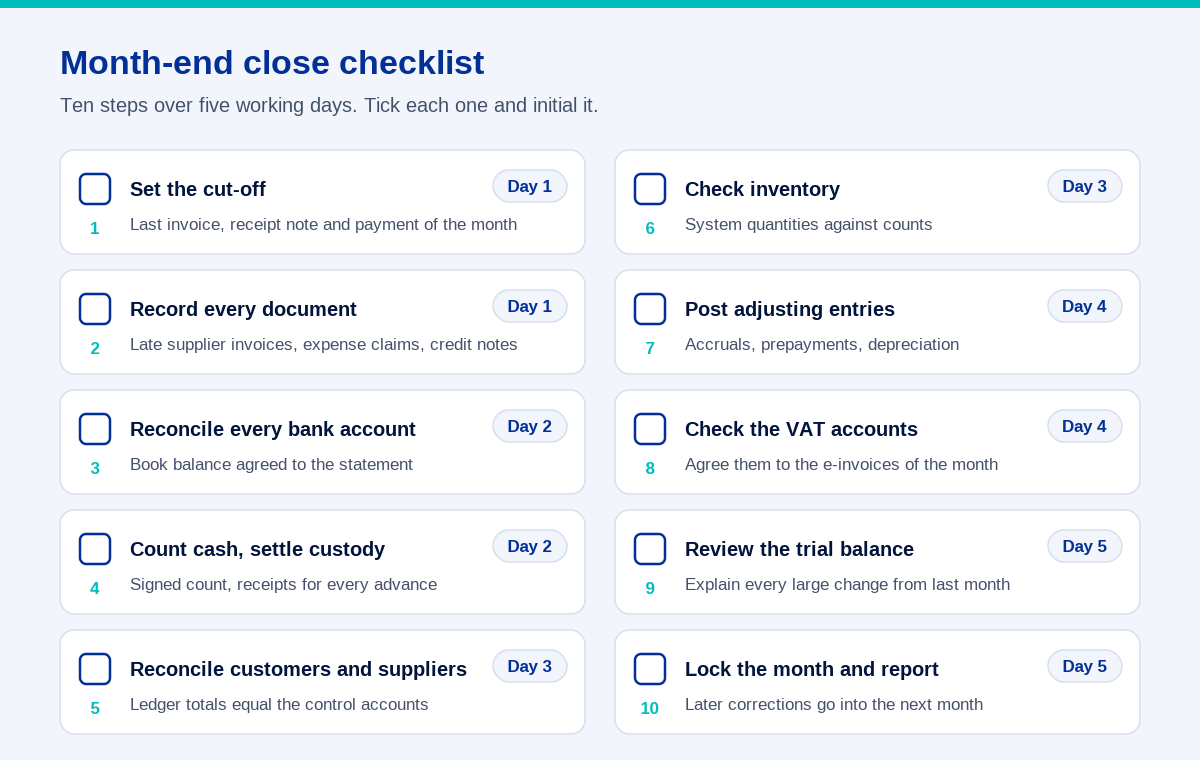
- Set the cut-off. Write down the number of the last sales invoice, the last goods received note and the last payment dated in the month. Anything after those numbers belongs to next month.
- Record every document. Chase supplier invoices for goods already received, staff expense claims, credit notes for returns, and custody settlements. Ask the warehouse and sales teams for anything still on their desks.
- Reconcile every bank account. Match the books to the statement line by line, and record bank charges, interest and direct debits that appear only on the statement.
- Count cash and settle custody. Count petty cash with its holder and both sign the count. Clear every custody advance that has its receipts, and list those that do not.
- Reconcile customers and suppliers. The total of the individual customer accounts must equal the customers control account; the same for suppliers. Agree your largest suppliers’ balances to their own statements.
- Check inventory. Compare the system quantities with any counts done in the month, and record goods received but not yet invoiced.
- Post adjusting entries. Accrue expenses incurred but not yet invoiced, release the month’s share of prepaid costs, and post depreciation.
- Check the VAT accounts. Agree VAT on sales and on purchases to the month’s e-invoices, so the return and the books tell the same story.
- Review the trial balance. Compare each balance with last month, explain every large change, and make sure suspense and clearing accounts are empty.
- Lock the month and report. Close the period in the system so nothing more can be posted to it, then send the reports.
Why does the cut-off matter so much?
Because a transaction recorded in the wrong month makes both months wrong. Sales, purchases and stock must be cut at the same point: if goods left the warehouse on the 30th, the sale belongs to this month even if the invoice was printed on the 1st. The goods received note and the delivery note, not the invoice date, show when goods actually moved.
Example: on the 30th the warehouse receives 80 cartons at EGP 230, but the supplier’s invoice arrives on the 4th of next month. The stock is already counted in the warehouse, so it must be in the books: debit Inventory 18,400; credit Goods received not invoiced 18,400. When the invoice arrives, with VAT of EGP 2,576, you debit Goods received not invoiced 18,400 and VAT on purchases 2,576, and credit the Supplier 20,976. Without the first entry, this month’s stock count would show 80 more cartons than the books.
Which balances need reconciling, and against what?
Every balance that can be checked against something outside the books. The bank against its statement, cash against a count, customers and suppliers against their ledgers and statements, stock against a count, and VAT against the e-invoices. Balances with no outside evidence, such as accruals, are checked against the calculation behind them.
| Balance | Reconcile to | A typical difference |
|---|---|---|
| Each bank account | The bank statement at the month end | A cheque issued but not yet cashed |
| Petty cash | A signed count | A receipt paid out but not yet recorded |
| Customers control account | Total of customer accounts, and customer statements | A receipt posted to the wrong customer |
| Suppliers control account | Total of supplier accounts, and supplier statements | An invoice the supplier issued that you have not received |
| Inventory | Physical counts | Goods received but not invoiced |
| VAT on sales and purchases | The month’s e-invoices | A credit note issued but not recorded |
How do you review the trial balance before sending it?
Put this month beside last month and read down every line. A large change is not wrong in itself, but you should be able to explain it in one sentence before the owner asks. Then look for balances on the wrong side, such as a customer in credit or a negative cash balance, and for anything left in suspense or clearing accounts.
| Account | Last month | This month | Question to answer |
|---|---|---|---|
| Electricity | 9,800 | 0 | Is the bill missing? Accrue an estimate. |
| Sales | 610,000 | 410,000 | Fewer sales, or invoices dated next month? |
| Rent expense | 15,000 | 30,000 | Was the prepayment released twice? |
| Suspense account | 0 | 4,750 | What is it, and where does it belong? |
When should the month be locked, and what if you find an error later?
Lock it as soon as the reports are sent. Accounting systems usually let you close a period so that nothing more can be posted to it. If you find an error afterwards, record the correction in the current month with a note explaining it, unless your manager decides to reopen the period. A month that keeps changing after it was reported means the owner cannot trust last month’s figures.
What usually slows the close down?
Documents that arrive late, and reconciliations that were not done last month. Both are fixed outside the close itself: by agreeing dates with the people who send documents, and by never carrying an unexplained difference into the next month. A close that takes two weeks usually has one or both problems.
- Agree a date with the warehouse and sales teams by which all of the month’s documents reach accounts.
- Ask the main suppliers to email their monthly statement on the first working day.
- Keep a standing list of recurring accruals, so you are not rebuilding it every month.
- Clear old reconciling items. A cheque outstanding for six months needs an answer before it is copied forward again.
Common questions
- How long should a month-end close take?
- There is no official figure. For an SME with one or two accountants, finishing within the first five working days is a reasonable target, and it leaves time before the VAT return is due.
- Do I need to count stock every month?
- Not all of it. You can count a rotating sample of items each month and the whole store once or twice a year. What matters is that differences found are investigated and approved before they are posted.
- What is a suspense account, and why must it be empty?
- A temporary account for amounts whose correct place is not yet known, such as an unidentified receipt. Anything left there at the month end is an unanswered question sitting inside the reports.
- Can I close before the bank statement arrives?
- You can prepare everything else, but the bank reconciliation needs the statement. If your bank offers online access, download the statement on the first working day instead of waiting for the paper copy.
Sources
The pages the figures and rules in this article were checked against, read in November 2026.