
Key points
- Open with one or two sentences that give the conclusion and any decision needed. Put the detail behind it.
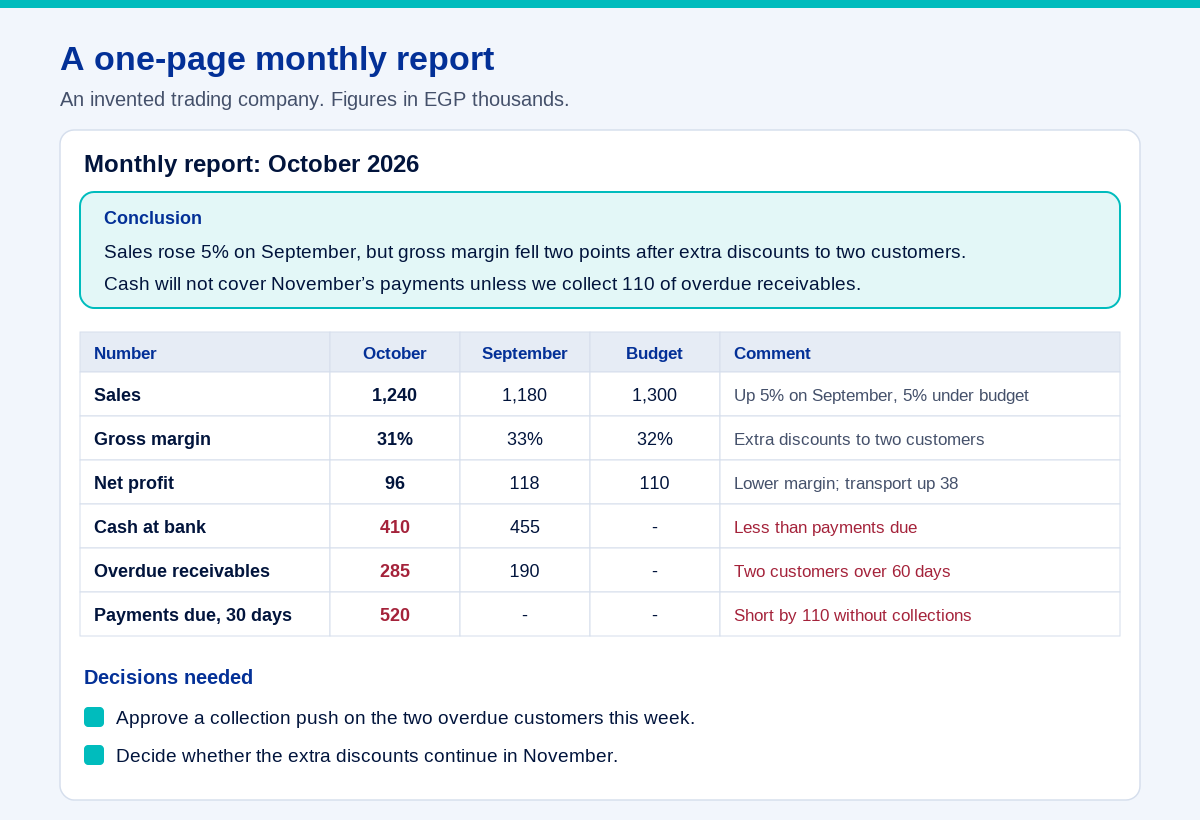
- A first page needs about six numbers: sales, gross margin, net profit, cash, money owed to the company and money it owes, each beside last month and the budget.
- Explain each large variance in one line: what changed, by how much, why, and what happens next.
- Before sending, tie every figure to the trial balance and make sure last month’s numbers have not changed since you reported them.
A manager reads a report that tells them, in its first two sentences, what changed this month, why, and what they need to decide. Everything else in it supports those sentences: about six key numbers, each beside last month and the budget, a one-line reason for every large movement, and the detail in an appendix for anyone who wants it. The usual first attempt runs the other way: a full trial balance first, and the conclusion left for the reader to find.
What does a manager want from a monthly report?
Three answers: is the business doing better or worse than expected, is there enough cash for what is coming, and is there anything they must act on. A manager or owner rarely needs every account. They need the few numbers that move those three answers, and your view of why they moved, because you are closest to the entries.
Ask your manager once which decisions the report feeds: pricing, hiring, collections, borrowing. The answer tells you which numbers to lead with, and it often differs from what the accounting system prints by default.
Which numbers belong on the first page?
For most small and medium companies, six: sales, gross margin, net profit, cash, money owed by customers that is overdue, and payments due soon. Show each beside the same figure last month and the budget, if there is one. A number with no comparison cannot tell the reader whether to worry.
| Number | Compare with | The manager’s question |
|---|---|---|
| Sales | Last month, same month last year, budget | Are we selling more or less, and is it seasonal? |
| Gross margin % | Last month and budget | Are we pricing and buying well? |
| Net profit | Last month and budget | After all costs, did we make money? |
| Cash at bank | Payments due in the next 30 days | Can we pay what is coming? |
| Overdue receivables | Last month | Who owes us, and is it getting worse? |
| Payables due | Cash at bank | Whom must we pay, and when? |
How should the report open?
With the conclusion, written as you would say it to the manager in the corridor. In the example: “October sales rose 5% on September, but the gross margin fell two points because of extra discounts to two customers. Cash will not cover November’s payments unless we collect 110,000 of overdue receivables.”
Avoid openings that describe the report instead of the business, such as “Please find attached the financial statements for October.” The reader can see the attachment. Tell them what the numbers mean, which nobody else in the company is better placed to do.
How do you explain a variance in one line?
Give four things in order: what changed, by how much in pounds and per cent, why, and what happens next. “Transport costs rose 38,000 (45%) because two shipments were sent by air after a supplier delay; we expect them back to normal in November.”
- Set a threshold before you start, for example any line that moved by more than 10% and more than a fixed amount the manager agrees. Explain only what crosses it.
- Find the cause in the entries, not in a guess: open the ledger for the account and look at the largest postings.
- Write the line in the four-part order above.
- If you do not yet know why, say so and say when you will. “Under review, answer by Thursday” is better than a reason you made up.
How should the numbers be presented?
So that the reader never has to work anything out. Round to the nearest thousand on the summary page; the detail can keep the pounds. Put the comparison in the next column, with the difference already calculated. Use one sign convention throughout, with costs either all positive or all in brackets. Use a chart only for a trend over several months, where a line shows the direction faster than a row of figures.
- Keep the first page to one page. If it does not fit, you have not decided what matters yet.
- Use the same layout every month, so the manager learns where to look.
- Label every figure with its period: “October 2026”, not “this month”, because reports get forwarded and reread.
- Mark anything provisional as provisional, with what is still open.
How do you make sure the numbers are right before you send it?
Tie the report to the trial balance, and the trial balance to the bank. A single wrong figure costs more trust than a late report, and a manager who finds one will start checking all the others. Four checks take about fifteen minutes.
- Sales, profit and cash on the summary agree with the trial balance for the same period.
- Cash agrees with the bank reconciliation, not just the ledger balance.
- Last month’s figures in your comparison column are the ones you reported last month. If an entry changed them, say so.
- Every total adds up, and every percentage is calculated from the figures beside it.
Common questions
- My manager asks for every detail. Should I still lead with a summary?
- Yes, and attach the detail behind it. A manager who wants detail still benefits from knowing where to look first, and the summary shows that you understood the numbers rather than just printed them.
- What if the books are not closed by the reporting date?
- Send it on time, mark the affected figures as provisional, and list what is still open, such as supplier invoices not yet received. Then send the final figures when they are ready, showing what changed.
- Should the report be in Excel, PDF or Power BI?
- Whatever your manager opens. The structure matters more than the tool: conclusion, six numbers with comparisons, variance lines, decisions. If your manager reads email on a phone, put the first page in the email body or a PDF.
- How long should the covering email be?
- The two-sentence conclusion, the decisions needed, and a line saying the full report is attached. If the manager reads only the email, they should still know what matters this month.