
Key points
- Two numbers answer whether you can pay: cash reconciled to the bank, and what falls due in the next 30 days.
- Four numbers answer whether you made money: sales, gross margin, operating expenses and net profit.
- One number shows money you earned but have not collected: receivables overdue by more than 60 days.
- Each number means something only beside the right comparison: last month for costs, the same month last year for sales.
- Agree a fixed day for the page each month, and expect a signature from whoever prepared it.
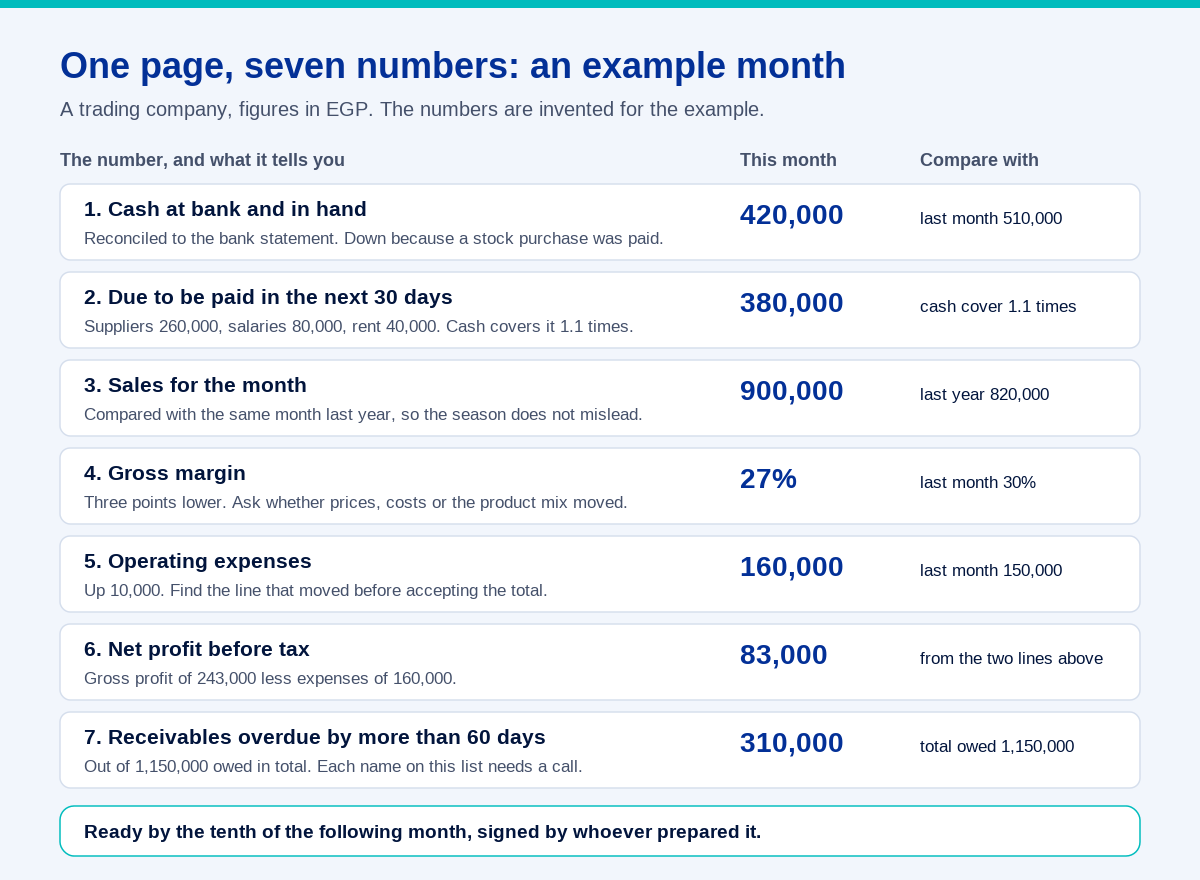
The seven numbers are: cash at bank and in hand, what falls due in the next 30 days, sales for the month, gross margin, operating expenses, net profit, and receivables overdue by more than 60 days. The first two tell you whether the company can pay its bills. The next four tell you whether it made money. The last one tells you how much of what it made is still sitting with customers. Together they fit on one page, and an owner can read that page in ten minutes once a month.
Why these seven, and not a full set of reports?
A busy owner needs to answer two questions each month: can we pay what we owe, and are we making money? Seven numbers answer both. A full set of statements answers them too, but most owners stop reading after the first page, so the important line never gets seen. Start with the seven and open the full statements only when one of them looks wrong.
The list is deliberately short. Every number on it should lead to a decision or a phone call: chase a customer, delay a purchase, ask a supplier for terms, look at a price. A number that never changes what you do is a number you can drop from the page.
Which numbers tell you whether you can pay your bills?
Two numbers: the cash you actually hold, and what you must pay in the next 30 days. Cash means the bank balance after it has been matched line by line to the bank statement, plus cash in the safe that someone has counted. Set it against suppliers, salaries, rent and loan instalments falling due, and you know whether next month is safe.
In the example, the company holds EGP 420,000 and owes 380,000 over the next month: 260,000 to suppliers, 80,000 in salaries and 40,000 in rent. Cash covers the bills about 1.1 times. That is enough, with almost nothing to spare, so one late customer payment would force a supplier to wait. An unreconciled balance is useless here. If the bank figure includes cheques that have not cleared, the cover you think you have does not exist.
Which numbers tell you whether you made money?
Four numbers, read in order: sales, gross margin, operating expenses and net profit. Sales show volume. Gross margin shows what you keep from each pound of sales after the cost of the goods sold. Operating expenses show what it costs to run the company. Net profit is what remains. Reading them in order tells you which one moved the result.
In the example, sales of EGP 900,000 at a 27% gross margin give a gross profit of 243,000. Operating expenses of 160,000 leave a net profit before tax of 83,000. The margin was 30% last month. Three points on 900,000 of sales is 27,000 of profit, more than the 10,000 rise in expenses. So this month’s question is about selling prices and purchase costs.
Why does overdue receivables earn a place on the page?
Because profit is recorded when you sell, while cash arrives when the customer pays. A company can show a profit every month and still run short of cash if customers pay late. The total owed matters less than the part that is overdue, because that part is where the money is at risk and where a phone call still helps.
Ask for the overdue figure with the names behind it. In the example, customers owe 1,150,000 in total, and 310,000 of it is more than 60 days old. That 310,000 is most of the gap between a comfortable month and the thin cover in the first two numbers. Choose the cut-off that fits your credit terms. If you give 30 days, a 60-day line already means a month late.
What should each number be compared with?
A number alone tells you little. Compare costs and margins with last month, because they should be stable. Compare sales with the same month last year, because most businesses have seasons and last month may have been Ramadan or a holiday. Compare cash with what is due, because a balance only matters against the bills it must pay.
| Number | Compare with | If it moved, ask |
|---|---|---|
| Cash at bank and in hand | Last month, and what is due | Where did the cash go, and was it planned? |
| Due in the next 30 days | Cash held | Which payment can wait if a customer is late? |
| Sales | Same month last year | Is it volume, price or one large customer? |
| Gross margin | Last month | Did prices, purchase costs or the product mix change? |
| Operating expenses | Last month, line by line | Which line moved, and will it repeat? |
| Net profit | Last month and the same month last year | Which of the four lines above explains the change? |
| Receivables overdue | Last month, by customer | Who is late, and who is calling them? |
Who should prepare the page, and by when?
Your accountant prepares it, from books closed for the month, by a fixed day you agree in advance. The tenth of the following month is a reasonable target for a small company. The page should carry the preparer’s name and signature, so every number on it has someone answerable for it.
- Agree the seven numbers, the comparisons and the day the page is due, in writing.
- Ask that the bank is reconciled and the safe counted before cash is reported.
- Ask for overdue receivables with customer names, not only a total.
- Read the page the day it arrives, and write one question beside any number that moved.
- Get the answers within the week, and keep each month’s page so next month has something to compare with.
If the page cannot be produced by the agreed day, that is information too. It usually means the books are not being closed each month, or the bank is not being reconciled, and both problems are worth fixing before you rely on any number.
What if one of the numbers looks wrong?
Ask for the detail behind that single number before you question the whole page. A sudden drop in margin usually comes from a purchase recorded at the wrong cost, a sale posted to the wrong month, or a credit note entered twice. If the same kind of error keeps appearing, the problem is in how the books are kept, and a second person reviewing them each month will find it faster than you will.
Frequently asked questions
- What about stock? I run a trading company.
- If stock is a large part of what you own, add its value as an eighth line and compare it with last month. Stock rising faster than sales means cash is being tied up on the shelves. The figure is only as good as the last count, so ask when that was.
- My accountant sends me the full financial statements. Is that not enough?
- The statements contain most of the seven numbers, but not the 30-day commitments or the overdue list, and they rarely show the comparisons side by side. Ask for the one page on top of the statements, not instead of them.
- Can I get these numbers weekly instead?
- Cash, what is due and overdue receivables can be weekly if the bank is reconciled weekly. Margin and net profit need a closed month, so a weekly profit figure is usually an estimate. Keep the monthly page as the one you act on.
- Who checks that the numbers on the page are right?
- Someone other than the person who prepared them. In a small company that is often the owner, with the bank statement in hand. Where the owner no longer has time to check entries, a monthly review by an outside accountant does that job.