
Key points
- The income statement covers a period, such as a month or a year, and ends in net profit or loss.
- Read three subtotals in order: gross profit shows whether trading pays, operating profit whether the business pays, net profit what is left for the owners.
- Compare every line with the same period last year. A cost growing faster than sales is the first thing to ask about.
- Sales are recorded when invoiced, so a profitable statement can sit beside an empty bank account.
- An uncounted stock, missing month-end entries or the owner’s personal spending in the books will make the profit figure wrong.
An income statement shows what your company earned over a period and what it cost to earn it, and it ends in one figure: net profit or loss. You can read one in ten minutes. Check the period it covers, read its three subtotals from top to bottom (gross profit, operating profit, net profit), compare each with the same period last year, and ask about any cost that grew faster than sales. If net profit is positive and the figures are complete, the company made money in that period. That still does not mean the money is in the bank.
What does an income statement show, and what does it leave out?
It shows performance over a period: sales, the costs of making those sales, and the profit or loss left at the end. It does not show what the company owns or owes, which is the balance sheet’s job, and it does not show cash. Sales count when they are invoiced, and costs count when they are incurred, whether or not money has moved.
Egyptian Accounting Standard No. 1 lists the income statement as one part of a complete set of financial statements, alongside the statement of financial position (the balance sheet), the statement of comprehensive income, the statement of changes in equity, the cash flow statement and the notes. The standard calls it the income statement (profit or loss). Owners usually call it the P&L. They are the same document.
What do the lines mean, from top to bottom?
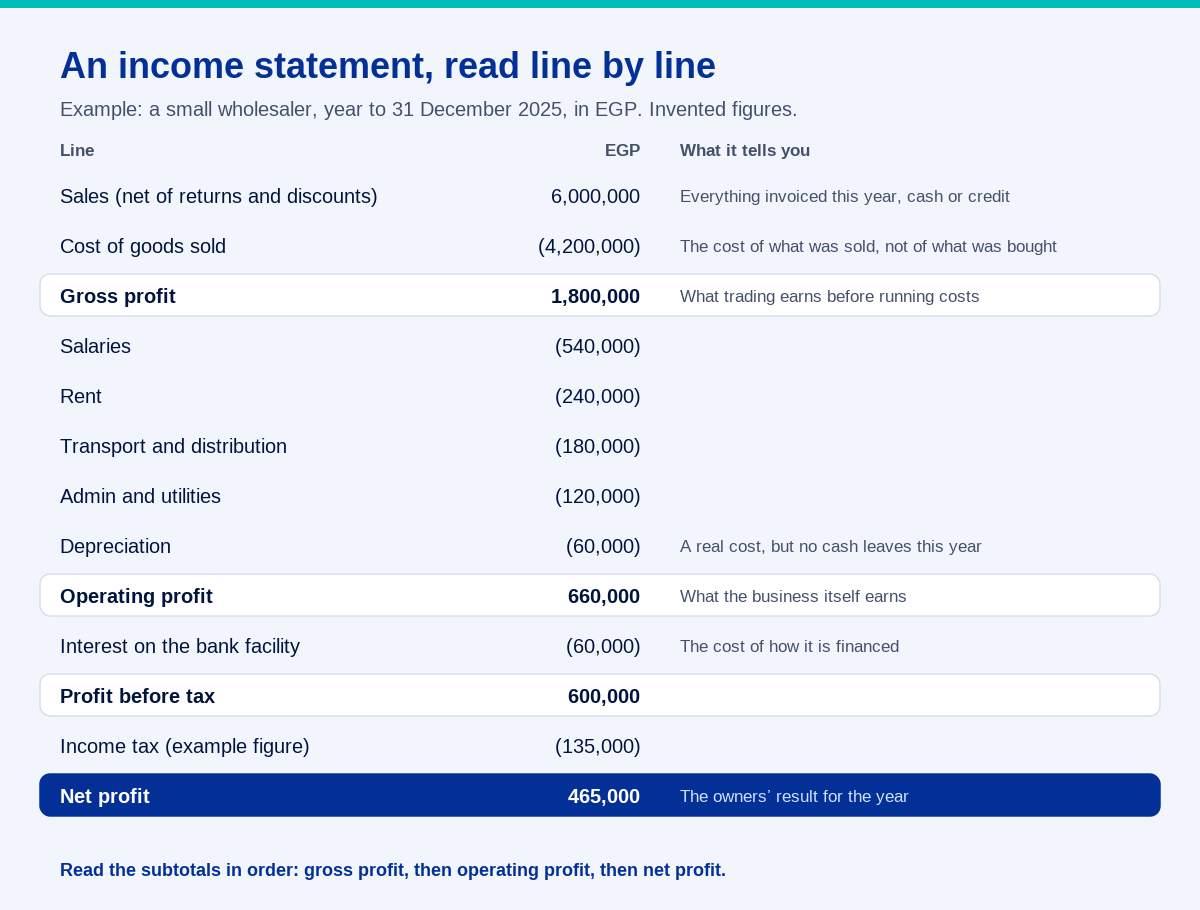
An income statement starts with sales, subtracts costs in layers, and shows a subtotal after each layer. The layers answer different questions: whether your trading pays, whether the business as a whole pays, and what is left for the owners once interest and tax are paid. The example below is an invented wholesaler of household cleaning products, used across this series of articles.
| Line | What it contains | Ask |
|---|---|---|
| Sales | Invoiced sales for the period, after returns and discounts | Why did it change, and how much of it is collected? |
| Cost of goods sold | The cost of the goods you sold: opening stock, plus purchases, minus closing stock | Was the closing stock counted, or estimated? |
| Gross profit | Sales minus cost of goods sold | Did it grow as fast as sales? |
| Operating expenses | Salaries, rent, transport, administration, depreciation | Which line grew faster than sales? |
| Operating profit | Gross profit minus operating expenses | Is the business itself profitable before financing? |
| Interest and other items | Interest on loans and facilities, gains or losses on selling assets | Will this happen again next year? |
| Net profit | What remains after interest and income tax | How does it compare with the cash the company actually has? |
Depreciation deserves a word because owners often query it. When the company buys a delivery van, the van’s cost is spread over the years it will be used, and each year’s share appears as depreciation. It is a real cost of running the business, but no cash leaves in the year it is recorded. The cash left when the van was bought.
How do you read it in ten minutes?
Work from the top down and compare as you go. Each figure on its own tells you little; the movement against last year, and against sales, is what shows you where to look. Ask for a statement with a comparison column, the same period last year beside this one, before you start.
- Check the period and the basis. Which dates does the statement cover? Are the month-end entries (depreciation, accrued rent and salaries, the stock count) in? A statement prepared before they are recorded overstates profit.
- Read sales. In the example, sales rose from EGP 5 million to EGP 6 million, a 20% increase. Ask what drove it: more customers, higher prices, or one large order that will not repeat.
- Read gross profit. It rose from EGP 1.6 million to EGP 1.8 million, only 12.5%. Gross profit grew more slowly than sales, so each sale earned less than last year. That is a question about prices, discounts or purchase costs.
- Go through operating expenses line by line and mark any that grew faster than sales. Total operating expenses in the example rose 14%, from EGP 1 million to EGP 1.14 million.
- Read operating profit. It went from EGP 600,000 to EGP 660,000. This is the cleanest measure of how the business itself performed, because it is before interest and tax.
- Read the lines below operating profit, then net profit. Interest rose because the company borrowed more. Net profit was EGP 465,000 against EGP 434,000 the year before. Remove any one-off gain, such as selling a vehicle, before you decide whether the year was good.
The example company is profitable, and its profit grew. Its gross profit grew more slowly than its sales, which is worth a conversation with whoever sets prices and buys stock. Turning those comparisons into percentages of sales, the margins, is covered in a separate article in this series.
When is the profit figure wrong?
The profit figure is only as good as the entries behind it. In small companies it is most often wrong for one of five reasons, and you can ask your accountant about each one directly. None of them needs an accounting background to check.
- Closing stock was estimated, not counted. Cost of goods sold depends on it, so an overstated stock figure inflates profit by the same amount.
- Month-end entries are missing. Rent for the last month, salaries not yet paid, the electricity bill that arrives late and depreciation all belong to the period they relate to.
- Personal spending sits in company expenses, or company income went into a personal account. Either way the statement no longer describes the business.
- A one-off item is mixed in with normal trading, such as a gain on selling a vehicle or a large write-off of damaged goods.
- Purchases were booked as expenses, or equipment was booked as an expense instead of an asset. Profit then swings from month to month for reasons that have nothing to do with sales.
Why does my income statement look different from this one?
Because the standard allows two layouts. Egyptian Accounting Standard No. 1 lets a company analyse its expenses either by nature (purchases of materials, staff costs, depreciation, transport) or by function (cost of sales, distribution, administration), whichever gives more reliable and relevant information. A company that uses the function method must show its cost of sales separately.
The example above uses the function layout, which is easier for an owner to read because gross profit appears as its own line. If your statement lists expenses by nature, ask your accountant to add a gross profit line for management use. Internationally, IFRS 18 replaces IAS 1 for annual periods beginning on or after 1 January 2027 and adds two defined subtotals to the income statement: operating profit, and profit before financing and income taxes. Egyptian standards are issued separately, so check with your accountant whether and when anything changes here.
If your accountant hands you a trial balance and calls it the accounts, ask for an income statement with a comparison column. A trial balance lists every account; the income statement arranges the revenue and expense accounts so that the subtotals answer your questions.
Common questions
- Is net profit the amount I can take out of the company?
- No. Net profit is a measure of performance, and part of it may be sitting in unpaid customer invoices or in stock. What you can take out depends on the cash available after the company’s commitments, and on what your company’s legal form and contract allow.
- Should I read the income statement every month or once a year?
- Every month, if the books are kept up to date and the month-end entries are made. A yearly statement arrives too late to change anything that happened in the year. For a seasonal business, compare each month with the same month last year, not with the month before.
- Why is there a profit when we had a loss on cash?
- Because sales count when invoiced and stock counts as a cost only when sold. Money tied up in customer balances, stock, equipment or loan repayments does not appear as an expense. The companion article on profit and cash in this series walks through an example.
- How do I know whether my gross profit is good?
- Start by comparing it with your own history as a percentage of sales. A falling percentage while sales rise is the most common warning sign in a trading company. Comparisons with other businesses only help if they sell similar goods in a similar way.
Sources
The pages the figures and rules in this article were checked against, read in November 2026.
- fra.gov.eg/wp-content/uploads/2024/03/معيار-المحاسبة-المصري-رقم-1-ع...
- ifrs.org/issued-standards/list-of-standards/ifrs-18-presentation-an...