
Key points
- The cash flow statement explains the change in cash between two balance sheets, and its closing figure must agree with the cash on the balance sheet.
- Egyptian Accounting Standard No. 4 groups cash flows into operating, investing and financing activities.
- Operating cash flow is the line to watch: it shows whether the business’s own trading brings cash in.
- A business can present operating cash flows by the direct method (receipts and payments) or the indirect method (starting from profit).
- Read the three section totals together: their signs show whether the business funds itself or depends on lenders and owners.
A cash flow statement shows where a company’s cash came from and where it went during a period. It sorts every movement into three groups (operating, investing and financing activities) and ends with the cash balance at the end of the period, which must agree with the balance sheet. Of the main financial statements it is the only one that connects profit to the bank balance, which is why it answers the question owners ask most often: where did the money go?
What does the cash flow statement show?
It shows the historical changes in a company’s cash and cash equivalents over a period, classified into operating, investing and financing activities. That is how Egyptian Accounting Standard No. 4 states its objective. The standard also requires the statement to be presented as an integral part of the financial statements for every period for which statements are presented.
Cash equivalents are short-term investments that can be turned into a known amount of cash with little risk of a change in value. The standard says an investment normally qualifies only when it matures three months or less from the date it was bought, such as a short bank deposit. It also allows a bank overdraft repayable on demand to be counted as part of cash, when the overdraft is an integral part of how the company manages its cash.
What goes into each of the three sections?
Operating activities are the company’s main revenue-producing work: cash from customers, cash paid to suppliers, staff and landlords. Investing activities are buying and selling long-term assets such as equipment, vehicles and premises. Financing activities change how the company is funded: loans drawn and repaid, capital paid in, and money paid to the owners.
| Section | Typical cash in | Typical cash out | Usual sign in a healthy small company |
|---|---|---|---|
| Operating | Receipts from customers | Suppliers, salaries, rent, interest, tax | Positive |
| Investing | Selling equipment or vehicles | Buying equipment, vehicles, fit-out, premises | Negative |
| Financing | New loans, new capital from owners | Loan repayments, withdrawals, dividends | Either, depending on the year |
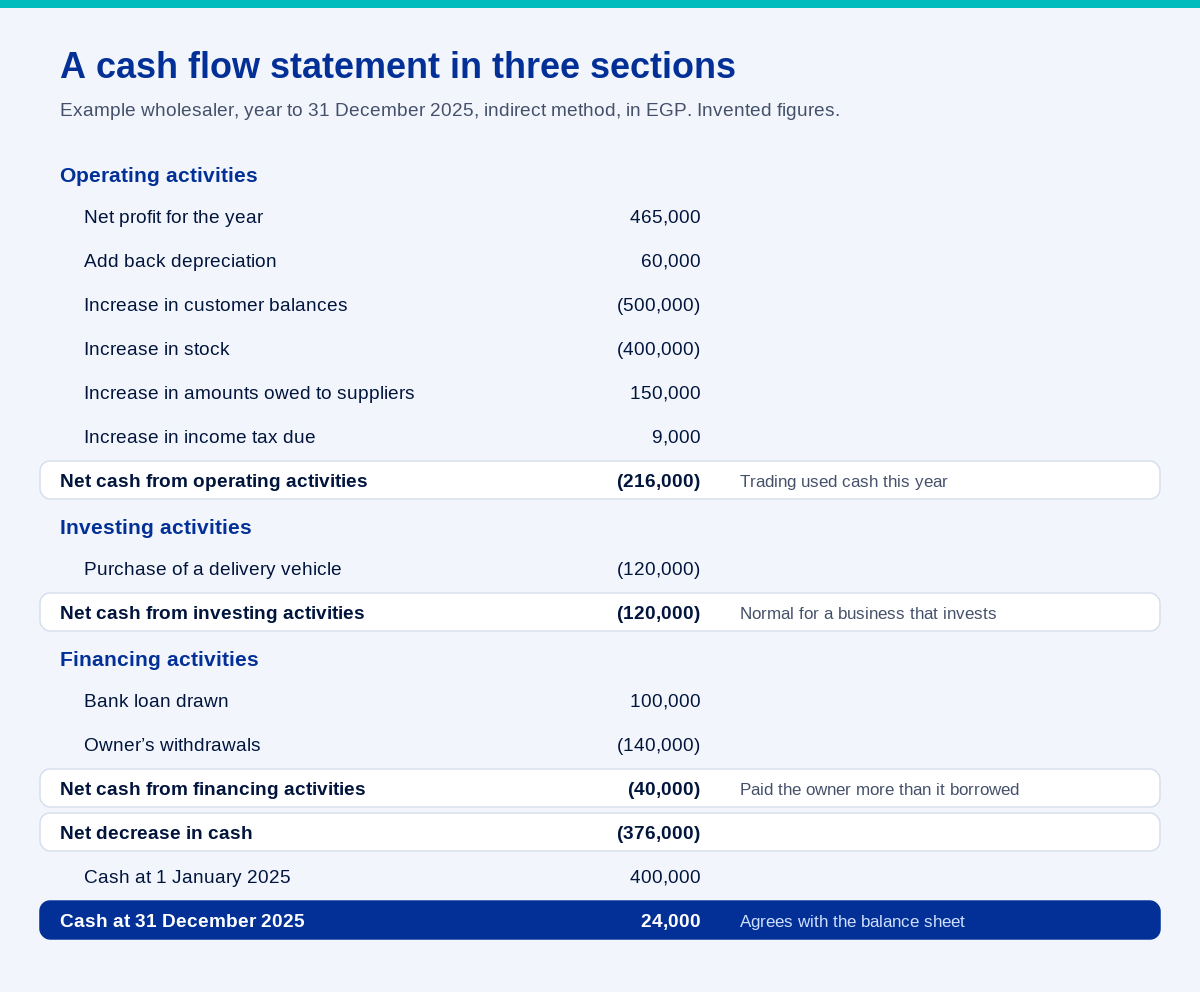
Here is the statement for the example wholesaler used across this series. It made a net profit of EGP 465,000 in 2025, yet its trading used EGP 216,000 of cash, it spent EGP 120,000 on a vehicle, and it paid the owner more than it borrowed. Cash fell from EGP 400,000 to EGP 24,000.
What is the difference between the direct and indirect methods?
They are two ways of presenting the operating section, and they reach the same total. The direct method lists the main classes of cash received and paid: from customers, to suppliers, to staff. The indirect method starts from net profit and adjusts it for items that did not move cash, such as depreciation, and for changes in stock, customer and supplier balances. Egyptian Accounting Standard No. 4 allows either, and notes that the direct method gives information that may help in estimating future cash flows.
Accountants usually prepare the indirect method because it comes straight from the two balance sheets and the income statement. Owners usually find the direct method easier, because it reads like a bank statement summary. Here is the same operating section for the example company, presented directly.
| Line | EGP | How it is worked out |
|---|---|---|
| Cash received from customers | 5,500,000 | Sales of 6,000,000 less the 500,000 increase in customer balances |
| Cash paid to suppliers | (4,450,000) | Purchases of 4,600,000 (cost of sales plus the 400,000 stock increase) less the 150,000 increase owed to suppliers |
| Cash paid for salaries, rent, transport and admin | (1,080,000) | All paid within the year in this example |
| Interest paid | (60,000) | Kept in operating activities in this example |
| Income tax paid | (126,000) | Last year’s tax, paid this year |
| Net cash from operating activities | (216,000) | The same total as the indirect method |
Seen this way, the problem is plain: the company collected EGP 5.5 million from customers and paid EGP 5.7 million out for its trading. An owner can act on that sentence. Internationally, amendments that came with IFRS 18 require the indirect method to start from operating profit rather than net profit; whether Egyptian standards follow is for your accountant to confirm.
How do you read a cash flow statement in five minutes?
Read the section totals first and the detail second. Five questions, in this order, cover what an owner needs; the detail lines only matter where a total surprises you.
- Does the closing cash agree with the cash on the balance sheet? If it does not, the statement was not built from the books.
- Is operating cash flow positive, and how does it compare with net profit? Over a few years the two should be of a similar size. Operating cash well below profit year after year means profit is being tied up in customers and stock.
- What did investing cash buy? Make sure each large outflow is an asset you approved and can see.
- Who funded any gap? A negative operating figure covered by new loans is borrowing to pay running costs, which cannot continue for long.
- Put three years side by side. One bad year can be a growth spurt or a large order; the same pattern three years running is how the business works.
Which patterns should worry an owner?
The signs of the three section totals, read together, describe how the business is running. The table gives the common combinations. None of them is a verdict on its own; each one tells you which question to ask next.
| Operating | Investing | Financing | What it usually means |
|---|---|---|---|
| Positive | Negative | Negative | Trading pays for new assets and for loan repayments or the owners. The usual healthy pattern. |
| Positive | Negative | Positive | Growing, with borrowing for expansion. Fine if the new assets will produce more operating cash. |
| Negative | Negative | Positive | Lenders or owners are paying for both running costs and new assets. Find out why trading uses cash. |
| Negative | Positive | Any | Assets are being sold to cover running costs. A warning sign unless the sale was planned. |
The example company is in the third row, with one difference: its financing total is negative because the owner withdrew more than the new loan. The opening cash balance paid for the rest. With EGP 24,000 left, it cannot do the same next year. Why a profitable company ends up here, and how to bring the cash back, is the subject of a separate article in this series.
Common questions
- Does a small company need a cash flow statement?
- Egyptian Accounting Standard No. 4 requires every entity applying it to present one with its financial statements, and says all entities need cash for the same basic reasons. Ask for one with the annual accounts, and with quarterly management accounts if you can.
- Where does interest go: operating or financing?
- Either, for a company that is not a financial institution. Egyptian Accounting Standard No. 4 allows interest paid to be shown as operating, because it affects profit, or as financing, because it is a cost of obtaining finance. Dividends paid may be financing or operating. Whichever is chosen must be applied consistently from year to year.
- Is a negative operating cash flow always bad?
- Not in a single year. A company that is growing fast, or that bought stock ahead of a busy season, can have one. It becomes a problem when it repeats and is paid for with borrowing.
- Can I build one myself from the bank statement?
- You can make a rough direct-method version by sorting a year of bank movements into the three groups. It will only be complete if every receipt and payment goes through the bank, and none of them is personal.
Sources
The pages the figures and rules in this article were checked against, read in November 2026.
- fra.gov.eg/wp-content/uploads/2024/03/معيار-المحاسبة-المصري-رقم-4-ق...
- ifrs.org/issued-standards/list-of-standards/ias-7-statement-of-cash...