
Key points
- Build the budget from last year’s books month by month, then adjust each line for changes you already know about.
- Keep it to one sheet: sales, cost of sales, gross profit, fixed costs and profit, then a cash section underneath.
- A profit budget alone can mislead. When customers pay later than suppliers, the busiest months can leave the least cash.
- Compare budget with actual every month and explain any large difference in a line or two.
- Re-forecast the remaining months each quarter, and keep the original budget unchanged for comparison.
A simple 12-month budget is one spreadsheet with a column for each month and a handful of rows: sales, cost of sales, gross profit, fixed costs and profit, followed by a cash section that shows when money actually comes in and goes out. You build it from last year’s books, adjust it for what you already know about next year, and compare it with the actual figures every month. A small company does not need anything bigger to start, and most of its value comes from comparing it with the actual figures each month.
What goes into a simple budget?
Five profit rows and a short cash section. Sales, cost of sales and gross profit show what each month earns before overheads. Fixed costs, such as rent, salaries and utilities, are listed line by line. Profit is what is left. The cash section then moves sales and purchases to the months when they are actually paid, and ends with the bank balance at the end of each month.
| Row | How to estimate it | Where to find it in your books |
|---|---|---|
| Sales | Same month last year, adjusted for known changes | Sales account, by month |
| Cost of sales | Sales multiplied by (1 minus your actual gross margin) | Cost of sales, or purchases adjusted for stock |
| Fixed costs | Last year’s amount plus known increases, in the month paid | Each expense account, by month |
| Cash from customers | Each month’s sales moved to the month they are collected | Customer statements, average days to pay |
| Cash to suppliers | Each month’s purchases moved to the month they are paid | Supplier statements and payment terms |
How do you estimate sales for each month?
Start from the same month last year, because most businesses have a season and an annual average hides it. Then change only what you have a reason to change: a price increase already announced, a customer who has signed, a contract that ends in June. Write the reason in a note next to the number. If you cannot name a reason, keep last year’s figure.
This only works if last year’s books are right month by month. If sales were recorded late, or the stock was only counted at year end, the monthly pattern you copy will be wrong. Fixing the monthly books first is often the most useful step in building the budget.
Why does the budget need a cash section as well as profit?
Because profit is earned when you sell and cash arrives when customers pay. If customers pay after 60 days and you pay suppliers after 30, every increase in sales takes cash before it brings any in. A budget that shows only profit can look healthiest in exactly the months when the bank balance is lowest.
A worked example makes this concrete. A distribution company budgets sales of EGP 5,980,000 for the year, rising from EGP 350,000 a month in summer to EGP 800,000 in December. Its gross margin is 35% and its fixed costs are EGP 140,000 a month. It starts the year with EGP 150,000 in the bank. The year’s budgeted profit is EGP 413,000, of which EGP 350,000 is earned in the last quarter. Yet cash falls from EGP 228,000 at the end of August to EGP 50,500 at the end of November, because the season’s purchases are paid before its customers pay.
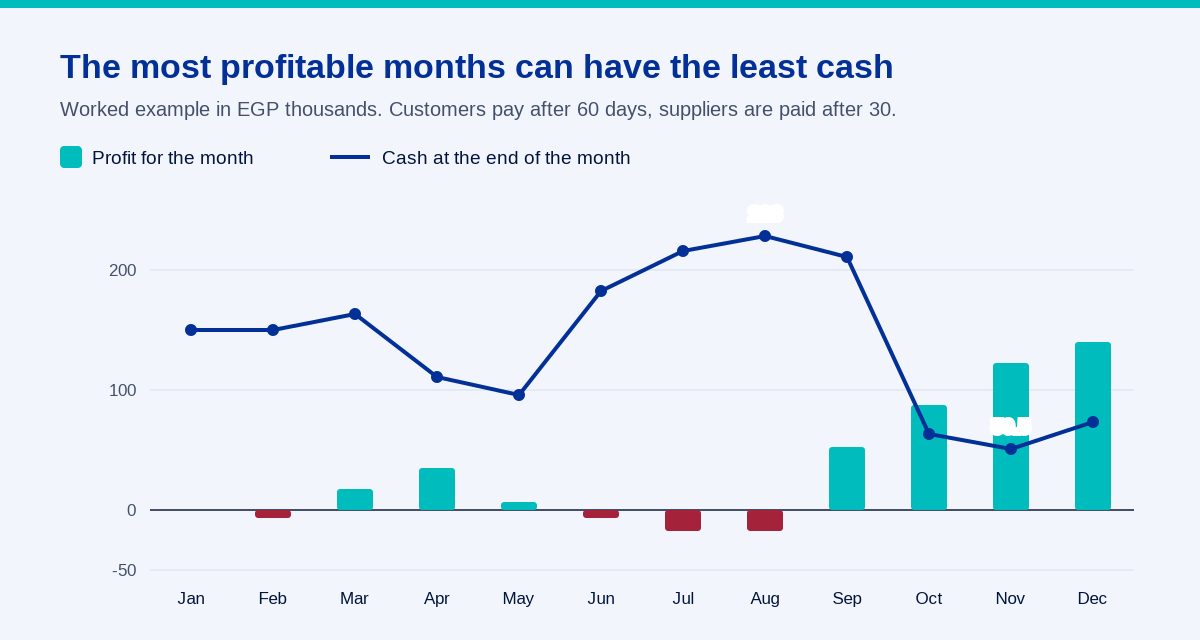
| Quarter | Sales | Profit | Cash at quarter end |
|---|---|---|---|
| January to March | 1,230,000 | 10,500 | 163,000 |
| April to June | 1,300,000 | 35,000 | 182,500 |
| July to September | 1,250,000 | 17,500 | 210,500 |
| October to December | 2,200,000 | 350,000 | 73,000 |
Knowing this in January gives the owner time to act: arrange a facility before the season, ask for a deposit on large orders, negotiate longer supplier terms, or delay a purchase of equipment. Discovering it in November leaves fewer options.
How do you use the budget once the year starts?
After each month is closed, put the actual figures next to the budget and look at the differences. Set a threshold in advance, for example any line more than 10% or EGP 20,000 away from budget, and write a line explaining each one above it. Some differences are timing, such as an invoice that slipped into the next month. Others are real, such as a margin that is lower than planned, and those need a decision.
Every quarter, update the remaining months in a separate forecast column. Keep the original budget as it was, so that at year end you can still see how far the plan and the result were apart, and learn from it when you build next year’s.
What are the steps, in order?
- Export last year’s income statement month by month: sales, cost of sales and each fixed cost.
- Set each month’s sales from the same month last year, adjusted only for changes you can name.
- Calculate cost of sales from your actual gross margin, and list fixed costs in the month they are paid.
- Move sales to the month customers pay and purchases to the month you pay suppliers, and run a month-end cash balance.
- After closing each month, compare actual with budget and explain every difference above your threshold.
- Each quarter, re-forecast the remaining months in a separate column and keep the original budget unchanged.
Common questions
- Do I need budgeting software?
- Not to start. A spreadsheet with twelve columns is enough for most small companies. What matters more is that your books close each month on time, so the actual figures are there to compare.
- What is the difference between a budget and a forecast?
- The budget is the plan you set before the year starts and do not change. The forecast is your latest estimate of the remaining months, updated as the year goes on. Keeping both lets you see how the year is moving against the plan.
- My books are not reliable month by month. Can I still budget?
- You can use bank statements and sales invoices to rebuild an approximate monthly pattern, but treat the result as rough. Getting the monthly books right for the coming year will make next year’s budget far better.
- How detailed should the fixed costs be?
- Detailed enough that you would notice if one went wrong. Rent, salaries, utilities, transport and marketing as separate lines usually suffice. Put annual payments, such as insurance or licence renewals, in the month they are paid rather than spreading them evenly, or the cash section will be wrong.