
Key points
- Start with the profit of the first branch on its own, after its own rent, salaries and stock losses. Company-wide profit can hide a branch that loses money.
- The cash a new branch needs is more than the fit-out: add opening stock, deposits, the monthly losses until break-even, and a reserve.
- Break-even sales are the branch’s fixed monthly costs divided by its gross margin percentage. Compare that figure with what the first branch actually sells.
- Your chart of accounts must carry a branch dimension before opening day, or you will not know which branch makes the money.
- Cash, stock and approvals must work without you on site: daily cash reports, a named custodian per branch, and regular counts.
Before you open a second branch, you need four numbers: what the first branch earns on its own, how much cash the new branch will consume before it pays for itself, the monthly sales at which it breaks even, and how long it will take to reach them. You also need books that can produce those numbers for each branch separately once both are open. Most owners have a feel for the first number and a quote for the fit-out. The rest is usually missing, and it is the rest that decides whether the second branch strengthens the company or drains the first one.
How much does your first branch really earn on its own?
Take the first branch’s sales, subtract the cost of what it sold, then subtract every cost that exists only because the branch exists: its rent, its staff, its utilities, its stock shortages and its delivery. What remains is the branch’s contribution. If the company has one location, this is close to its operating profit before head office costs such as your own salary and the accountant’s.
This is the number the new branch will be compared with, so it has to be right. Three things commonly distort it. Stock counted once a year makes the cost of sales a guess for eleven months. Owner withdrawals booked as expenses, or expenses paid from the owner’s pocket and never booked, move profit in both directions. And a cash business that records only part of its sales shows a margin nobody can plan from. If any of these applies, fix the books for at least the last six months before you use them to justify a second lease.
How much cash will the new branch need before it pays for itself?
Add five amounts: fit-out and equipment, opening stock, rent deposits and advances, the losses of every month before the branch breaks even, and a reserve for sales that grow slower than planned. The total is the cash you must have before signing. Owners who budget only the fit-out run short in the third or fourth month, when the branch is still losing money.
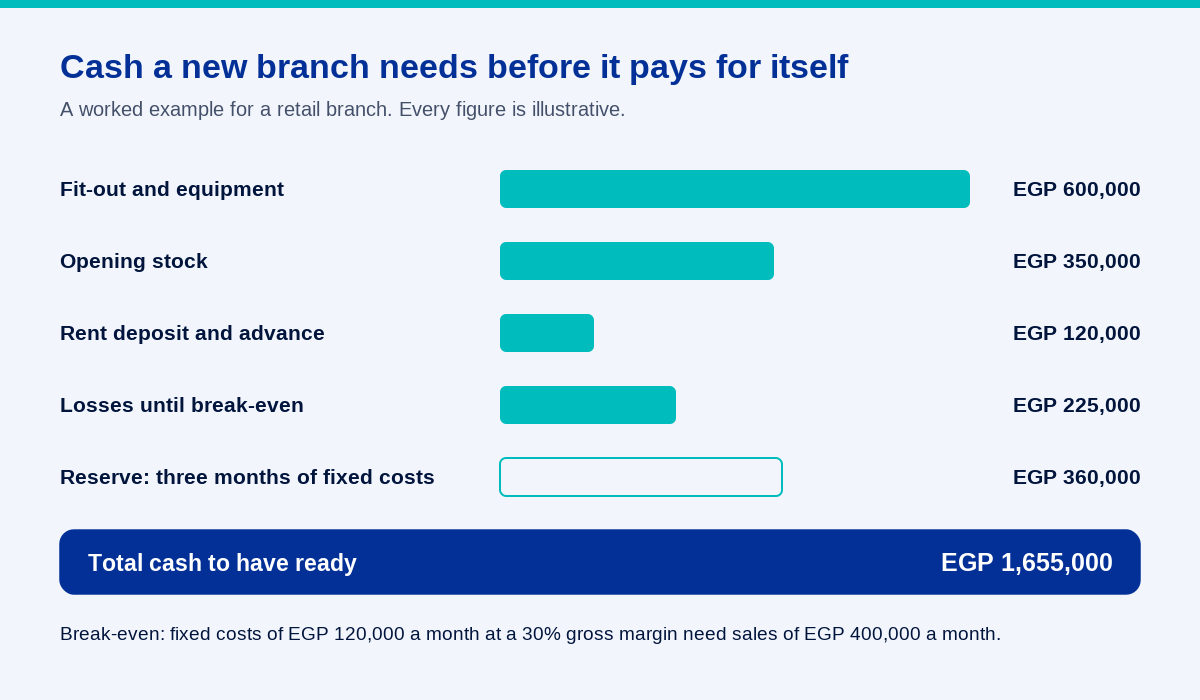
Here is a worked example. A retail company plans a branch with EGP 600,000 of fit-out, EGP 350,000 of opening stock and EGP 120,000 of rent deposit and advance. Its fixed costs will be EGP 120,000 a month and its gross margin 30%. If sales start at EGP 150,000 in the first month and grow by EGP 50,000 a month, the branch loses EGP 75,000, then 60,000, 45,000, 30,000 and 15,000, and breaks even in month six. Those losses add up to EGP 225,000. With a reserve of three months of fixed costs, the branch needs EGP 1,655,000 of cash, close to three times the fit-out quote.
If customers will buy on credit, add the receivables too: a branch that sells EGP 400,000 a month on 60-day terms has about EGP 800,000 owed to it at any time, and that money is not in the bank.
At what monthly sales does the new branch break even?
Divide the branch’s fixed monthly costs by its gross margin percentage. Fixed costs of EGP 120,000 at a 30% margin need EGP 400,000 of sales a month before the branch earns anything. Then compare that figure with what the first branch sells today, in a location you already know. If the new branch must beat the old one to break even, the plan rests on hope.
Use the margin the first branch actually achieves after discounts and shortages, not the price list margin. A new branch often starts with lower margins, because opening offers and slow-moving stock eat into them. Run the calculation again at a margin two or three points lower and see how far the break-even moves. In the example, a 27% margin raises it to about EGP 444,000 a month.
Can your books report each branch separately?
Only if the branch is set up in the accounts before the first sale. That means a cost centre or branch code on every revenue and expense line, a separate stock location for each branch, a separate cash account or custody for each cashier, and a document for every transfer of goods between branches. Adding these after six months of mixed entries means reclassifying every one of them by hand.
| Item | How to set it up | What goes wrong without it |
|---|---|---|
| Sales | Branch code on every invoice | You know total sales but not which branch made them |
| Stock | One stock location per branch, with transfer documents | Shortages cannot be traced to a store or a custodian |
| Cash | A separate cash account per branch, closed daily | One cash balance for all branches, and no one responsible for a gap |
| Expenses | Cost centre on rent, salaries and utilities | Branch profit is impossible to calculate |
| Shared costs | A written rule for splitting head office costs | Each month’s split is argued again |
What controls must work when you are not in the branch?
Three: a daily cash report that ties the till to the bank deposit, a named custodian for each branch’s stock and cash who signs for it, and stock counts on a fixed schedule. With one branch, the owner’s presence does much of this informally. A second branch removes that presence for half of every week, so the controls have to exist on paper.
Write down who may give discounts and how large, who may approve a purchase and up to what amount, and who may move stock between branches. These approval limits matter more with distance, because the person asking for approval is no longer standing next to you.
What should you check, in order, before you sign the lease?
- Close the books of the first branch for the last six to twelve months, with a stock count at the end.
- Calculate the first branch’s contribution after its own costs, and its real gross margin after discounts and shortages.
- List the new branch’s fixed monthly costs and calculate its break-even sales.
- Compare break-even sales with the first branch’s actual sales, and with a margin a few points lower.
- Build a month-by-month plan for the first year and add up the losses until break-even.
- Add fit-out, opening stock, deposits, those losses and a reserve: that is the cash you need.
- Confirm where the cash comes from: profits already in the bank, a partner, or a bank facility, and what that facility costs each month.
- Set up the branch in the chart of accounts, stock locations, cash accounts and approval limits before opening day.
If the numbers work at a lower margin and slower sales, the decision is reasonably safe. If they only work in the best case, the honest options are a cheaper location, a smaller format, or waiting until the first branch has built the cash itself.
Common questions
- Should head office costs be charged to each branch?
- For the decision to open a branch, judge it first on its own contribution, before any share of head office. A branch that covers its own costs and adds something towards head office is worth keeping. Splitting shared costs is useful for reporting later, as long as the rule is written down and stays the same each month.
- How long should a new branch take to break even?
- It depends on the business and the location, and there is no standard figure to rely on. What matters is that you set your own expectation in writing before opening, then compare each month’s actual sales with it. If a branch misses the plan three months in a row, decide then whether to change it or close it.
- Can I run both branches from one cash box and one stock account?
- You can, but you will lose the ability to tell which branch is profitable and where a shortage happened. Separate locations and cash accounts cost almost nothing to set up before opening and a great deal to reconstruct afterwards.
- Does this article cover registering the branch with the authorities?
- No. Commercial registration, licences and tax registration for a branch are legal steps that depend on your company’s form and activity. Ask your lawyer and your tax adviser about them; Kayan Finance does not represent clients before the tax authority.