
Key points
- There is no single list. Each bank sets its documents per product, and the pages we read in November 2026 ask for anything from one year of statements to three.
- Statements can change the size of the facility: on NBE’s programmes for the commercial sector, the maximum is EGP 3 million without financial statements and EGP 4.5 million with them.
- Audit is sometimes tied to size: Banque Misr’s POS loan page requires recent audited statements once yearly revenue exceeds EGP 20 million.
- A bank will compare the statements with your bank statements and tax position, so the books underneath have to be closed and reconciled first.
- Ask the bank for its written document list for the exact product before you prepare anything.
When a bank asks for financial statements for a facility, it wants your company’s balance sheet, income statement and usually the notes and cash flow statement, for one or more recent years, so a credit officer can judge whether the company can repay. How many years, whether they must be audited, and what else goes in the file depend on the bank, the product and the amount. The bank’s own document list for the product you are applying for is the only reliable answer, and the first thing to ask for.
What do Egyptian banks actually ask for?
It varies by bank and by product, so treat any general list with caution. In November 2026 we read the SME pages of three banks. They ask for one year of statements on some products and three on others, and some products need none at all below a certain size. The common core is a commercial register, a tax card, the national IDs of the people involved and, above the smallest amounts, financial statements.
| Bank and product | Financial statements | Other items on the page |
|---|---|---|
| National Bank of Egypt: Al Ahly Business programmes for the commercial sector | Optional, but they raise the maximum from EGP 3 million to EGP 4.5 million | National ID, commercial register, tax ID; other documents depend on the project |
| Banque Misr: Express Loan and Express Overdraft | Financial statements are one of five documents | National ID, commercial registration, tax card, tax status |
| Banque Misr: POS loan | Recent audited statements if yearly revenue is over EGP 20 million; not required below that | POS statements, tax and insurance clearance |
| Banque Misr: Mashroui Mashrouak | Budgets since the start of activity, or at most the last three; a new project brings a feasibility study from a certified public accountant | Other documents are on the bank’s small enterprises page |
| Banque Misr: working capital Murabaha for companies and factories | Certified statements for the last three years, for existing enterprises | Tax and insurance status certified by a legal accountant |
| Suez Canal Bank: Your Loan, Your Aid | Financial statements for the last three years | Bank statement for the last year, IDs of partners and guarantors, commercial register, tax and social insurance record |
Statements are often what moves a company from the smallest product to a larger one, as on NBE’s commercial-sector programmes. The word “audited” appears on some pages and not on others, which is why you should ask the bank in writing whether it needs statements with an auditor’s report, or management statements signed by the company.
What does “financial statements” mean in a bank file?
A full set has a balance sheet (statement of financial position), an income statement, a cash flow statement, a statement of changes in equity and the notes that explain them. Audited statements add an independent auditor’s report. A trial balance printed from your system, or a one-page summary of sales and profit, is not a set of financial statements, and a credit officer will usually send it back.
Kayan Finance prepares books and statements; it does not issue audit reports. If the bank needs an audited set, the audit is done by a licensed auditor, and it goes faster and costs less when the books arrive closed and reconciled.
What will the credit officer look for in your statements?
Whether the company earns enough cash to pay the instalments, and whether the numbers hold together. Expect questions on the sales trend, the profit after all costs, how much customers owe and for how long, how much stock is held, existing loans, and whether equity is growing or being withdrawn. Expect the sales in the statements to be compared with the deposits in your bank statements.
A worked example shows why this matters. A company shows sales of EGP 12 million in its income statement, but its bank statements show deposits of EGP 7 million. Some of the difference may be cash kept in the till, or customers who paid another company account. Unless the notes or your accountant can explain it, the officer will trust the smaller figure, and the facility will be sized on it.
Why do statements get sent back or delay a facility?
Most delays start in the books underneath the statements. These problems come up again and again when a company prepares statements for the first time because a bank asked:
- Bank accounts never reconciled, so the cash in the balance sheet does not match the bank statement at year end.
- Stock taken from a system balance, with no physical count behind it.
- Owner and company money mixed: personal expenses booked as costs, or company receipts paid into a personal account.
- Customer and supplier balances nobody has confirmed, some of them years old.
- Statements that differ from the figures in the tax return for the same year, with no reconciliation between them.
- Earlier years never closed, so this year’s opening balances cannot be supported.
How do you prepare statements a bank can rely on?
Work from the bank’s list backwards to the books. Get the written requirements first, then close and reconcile the years the bank wants, count the stock, prepare the statements and notes, and only then go to the auditor if an audit is required. If earlier years were never closed, this can take several weeks.
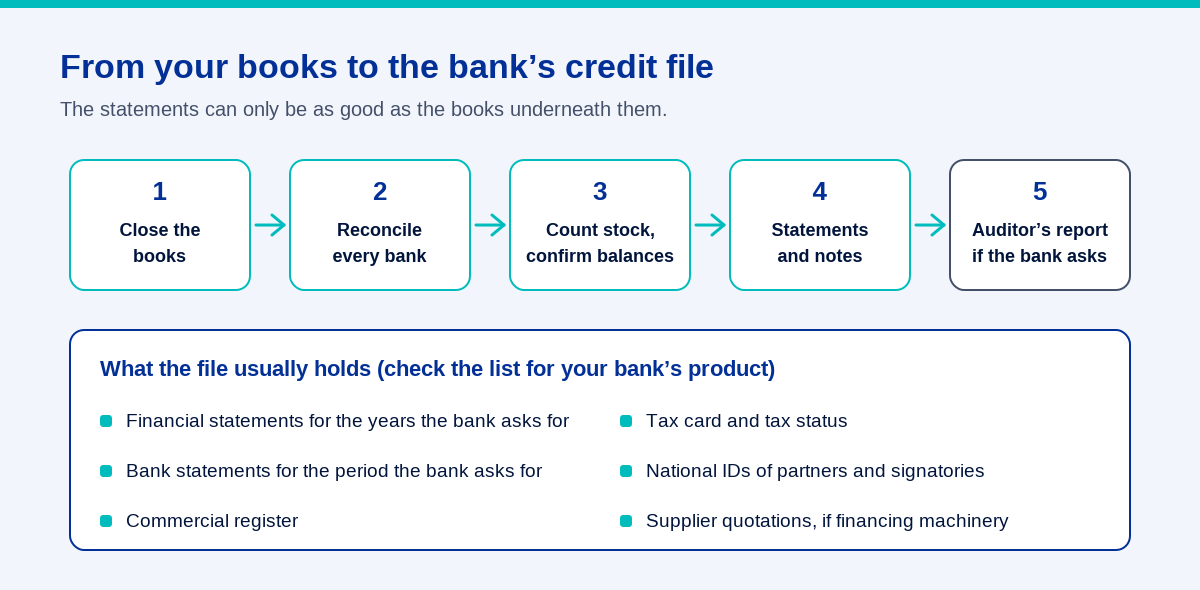
- Ask the bank for the written document list for the exact product and amount, including how many years and whether the statements must be audited.
- Close every year the bank asks for: all entries posted, accruals booked, owner items separated.
- Reconcile each bank account to its statement at every year end.
- Count stock at the latest year end, or use a count close to it and roll it forward, and confirm the main customer and supplier balances.
- Prepare the full set: balance sheet, income statement, cash flow statement, changes in equity and notes.
- Reconcile the statements with the tax return for the same year and keep the reconciliation ready.
- If an audit is required, give the auditor the closed books, reconciliations and count sheets.
- Put the file together with the other documents on the bank’s list and keep a copy of everything you submit.
Common questions
- Can I get a facility without financial statements?
- On some products, yes, usually with a lower limit. NBE’s commercial-sector programmes, for example, go up to EGP 3 million without statements, and Banque Misr’s POS loan does not ask for them below EGP 20 million of yearly revenue. Larger facilities generally need them.
- Can I use the statements I filed with my tax return?
- Often they are the same statements, and that is the simplest position to be in. If you prepared different figures for the bank, expect the bank to notice and to ask which set is right. Keep one set of books and explain any difference in writing.
- My company is new. What do I give the bank?
- Some products accept a feasibility study instead. Banque Misr’s Mashroui Mashrouak page, for example, asks recently established projects for a feasibility study from a certified public accountant. Ask your bank which of its products accept one.
- Does Kayan Finance deal with the bank for me?
- We prepare and clean up the books and statements the bank will read, and we can explain them to you so you can answer the credit officer’s questions. We do not issue audit reports, and the application itself stays between you and the bank.
Sources
The pages the figures and rules in this article were checked against, read in November 2026.
- nbe.com.eg/NBE/E
- banquemisr.com/en/Pages/SMEs-services
- banquemisr.com/en/SMEs/POS-Loan
- banquemisr.com/SMEs/Small-Enterprises-Projects
- banquemisr.com/ar-EG/Home/SMEs/Small-Enterprises-Projects
- banquemisr.com/en/SMEs/islamic-banking/Kenana-business/SMEs-Financi...
- scbank.com.eg/SME_Specialized_programs.aspx