
Key points
- An investor will rebuild your profit from the evidence. Anything you cannot support is taken out, and the price falls with it.
- Close the years they will review, reconcile every bank account, and count the stock before you share any numbers.
- Separate owner and company money: personal spending in company costs, or company costs paid from your pocket, both distort profit.
- Age the receivables and write off what will not be collected. An investor will do it anyway, at a worse moment for you.
- Disclose problems you find yourself. A gap found by the investor’s accountant costs more trust than one you explained first.
Before a partner or investor joins, the books must let a stranger verify your profit: the years they will review closed, every bank account reconciled, stock counted, receivables that will really be collected, and your own money clearly separated from the company’s. Whoever is buying a share will price it on profit they can prove from documents. Every number they cannot prove gets removed from their calculation, and the price falls with it. Cleaning up before they look costs less, and it lets you explain each adjustment instead of defending it.
What will a partner or investor check in your books?
They will test whether the profit in your statements is real and whether it will continue. In practice that means comparing sales with bank deposits, checking that stock exists, asking which customers owe money and since when, looking for costs that are missing or personal, and checking what the company owes, including tax and social insurance. A small investor may do this with their own accountant; a fund may send a team.
This review is often called due diligence. Its scope is set by the investor, so ask early which years and which areas they want, and prepare at least those plus the current year to date.
Which problems lower the price or stop the deal?
Problems that make profit look higher than it is lower the price directly. Problems that make the numbers impossible to check do worse: they make the investor doubt everything else. The table sets out the usual ones and what to do about each before the review starts.
| Problem in the books | What the investor concludes | Fix before the review |
|---|---|---|
| Banks not reconciled | Cash and sales cannot be trusted | Reconcile every account, every month of the review period |
| Stock from the system, never counted | Profit may include stock that does not exist | Count, investigate differences, book the adjustment |
| Old customer balances | Part of the profit will never become cash | Age receivables, chase or write off the old ones |
| Owner pays some costs personally | True costs are higher than booked | Book them for the review period, and stop the practice |
| Personal spending in company costs | Profit is understated, but the books are unreliable | Reclassify to the owner’s current account and list each item |
| Years never closed | Opening balances cannot be supported | Close each year in order, starting with the oldest |
How much can unclean books cost you in price?
Take a worked example. A company reports a yearly profit of EGP 2,000,000. The investor’s accountant finds a stock shortage of EGP 300,000 at the count, EGP 250,000 of receivables that will not be collected, and EGP 150,000 of costs the owner paid personally and never booked. The profit the investor will use is EGP 1,300,000.
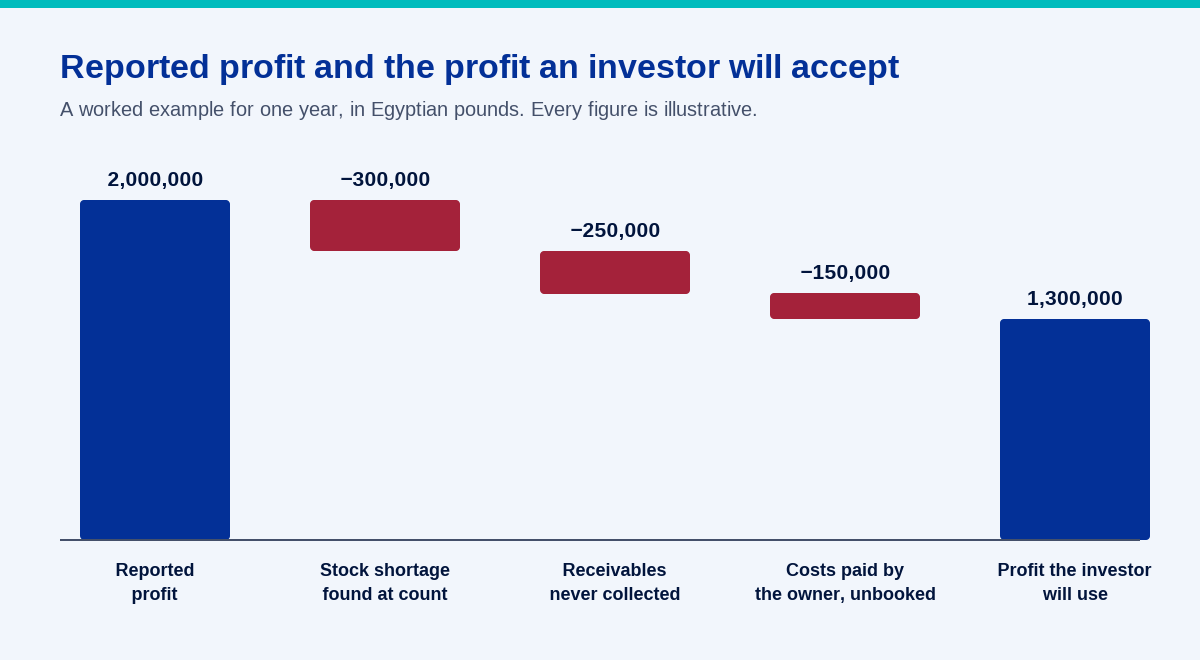
If, for the sake of the example, both sides agreed to value the company at five times yearly profit, the reported figure would suggest EGP 10 million and the adjusted one EGP 6.5 million. The real multiple depends on the business and the negotiation, and whatever it is, every pound of unsupported profit is multiplied by it. Finding these items yourself does not make them disappear, but it lets you explain them, correct the practice behind them, and show that this year’s numbers are clean.
Why does the owner’s current account matter so much?
Because it is where owner and company money meet. In many small companies the owner pays suppliers from a personal account, takes cash from the till, and puts family expenses through the company. If each of these goes through one current account in the owner’s name, with a document, the investor can see it, total it and agree it. If they are scattered across expenses, cash and suppliers, nobody can tell what the company really earns.
The balance of that account also matters. A large amount owed by the owner to the company, or by the company to the owner, will be part of the negotiation: an investor will want to know whether it will be repaid, converted to capital or written off before they join.
What should you prepare, and in what order?
- Ask the investor which years and which areas they will review.
- Close those years in order, oldest first, so each one’s closing balances become the next one’s opening balances.
- Reconcile every bank account for every month in the period.
- Count the stock, investigate the differences and book the adjustment.
- Age the receivables, confirm the large balances with customers and write off what will not be collected.
- Move every owner item into the owner’s current account, with a list that explains each one.
- List what the company owes: suppliers, loans, and the tax and social insurance position as confirmed by your tax adviser.
- Prepare statements for each year and a short note explaining every adjustment you made, and keep the documents behind them in order.
What changes once the partner has joined?
You now report to someone. A partner will expect monthly figures they can trust, prepared the same way each month, without waiting for you to explain them. Agree early what they will receive and by which day of the month: usually an income statement, the bank balances, receivables and payables. Keeping the books at the standard reached during the clean-up is far cheaper than repeating the clean-up a year later.
Common questions
- Should I clean up before or after I start talking to the investor?
- Start before. Closing old years and reconciling banks can take weeks, and you do not want the first numbers you share to change later. If talks have already started, tell the investor that a clean-up is under way and when it will finish.
- Does the investor need audited statements?
- Some do and some rely on their own review. Ask. If they want audited statements, the audit is done by a licensed auditor; Kayan Finance prepares the books and statements but does not issue audit reports.
- What if the clean-up shows the company earns less than I thought?
- Then you have learned it before signing rather than after, and you can decide whether to change the price you ask, fix the causes first, or wait a year and come back with clean numbers.
- Does this cover the legal side of bringing in a partner?
- No. The contract, the change to the company’s articles and registration, and any tax consequences are for your lawyer and tax adviser. Kayan Finance does not represent clients before the tax authority.