
Key points
- Start with the oldest open year. Each year’s closing balances are the next year’s opening balances, so a later year cannot be right while an earlier one is wrong.
- Your starting point is the last balance sheet someone approved. If there is none, it is a position you can prove today: cash counted, bank statements, stock counted.
- Reconcile bank, cash, stock, customers and suppliers to outside evidence such as statements and counts, not to another ledger in the same books.
- Correct with dated adjusting entries that carry their reason. Delete nothing, and report a balance you cannot support instead of estimating it.
- Sign off each year before opening the next. Keep recording the current year normally while the old ones are being closed.
Start with the oldest year that was never closed, and before you post a single entry, find the last balance you can prove: the closing balance sheet of the last year someone approved, or, if there is none, a position you can show today with bank statements, a cash count and a stock count. From there, close the years one at a time in order. In each year you reconcile the accounts that hold value to outside evidence, correct what is wrong with documented entries, and sign the year off before you open the next one.
How do you know a year was never really closed?
A year is closed when its accounts were reconciled, its financial statements were approved by someone with authority, and the period was locked so nobody can post into it. If any of the three is missing, the year is still open, even if a tax return was filed for it and the software has moved on to a new year.
Most owners find out when someone outside the company asks for the numbers: a bank reviewing a credit facility, a new partner, or an examiner. The signs are usually visible much earlier, in the books themselves.
| What you see | What it usually means |
|---|---|
| The bank balance in the books differs from the bank statement | The bank was not reconciled, so unrecorded charges, returned cheques or duplicate entries are still inside the figures |
| The opening balances of one year do not equal the closing balances of the year before | Someone typed opening balances by hand, or posted into the old year after it was reported |
| A large balance sits in a suspense or sundry account | Amounts that nobody could classify were parked there and never cleared |
| Customer balances in the books disagree with what customers say they owe | Receipts, returns or discounts were not recorded, or were recorded against the wrong customer |
| There are no signed financial statements for the year | Nobody reviewed the year as a whole, so nobody can vouch for it |
Why start with the oldest year and not the current one?
Because every year’s closing balances become the next year’s opening balances. A wrong bank balance at the end of 2023 is the opening bank balance of 2024, and every reconciliation in 2024 will carry the same difference. If you fix 2025 first, you will reopen it later, when the work on 2023 changes the numbers it starts from.
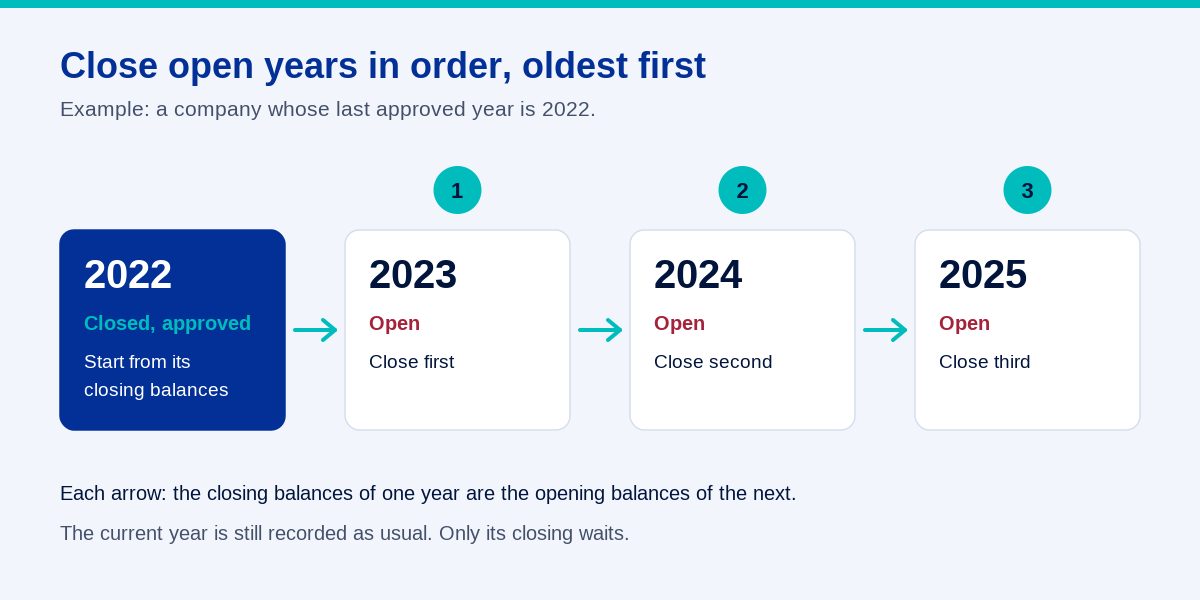
The current year does not stop while this happens. Keep recording sales, purchases and payments as usual, and keep reconciling the bank every month going forward. What waits is closing the current year, because its opening balances will move once the earlier years are corrected.
What if no year was ever properly closed?
Then you build the starting point instead of inheriting it. Pick a date you can prove a position at, usually the end of the most recent month, and establish each balance from outside evidence: the bank statement for each account, a counted cash box, a stock count, statements from your main customers and suppliers, and the invoices for your fixed assets. That position becomes your opening balance sheet.
The difference between that proven position and what the old books say is the size of the problem. Whether you then go back and correct each old year, or open clean books from the proven date and keep the old years as reference, depends on who will ask about those years. A bank or a partner may want approved statements for past years, and an examination covers the years it covers whatever you decide internally.
What should you gather before posting any entry?
Gather the outside evidence for every open year before you change anything: bank statements, the last approved statements, counts, and statements of account from customers and suppliers. Corrections made before the evidence is complete tend to be made twice. The list below is the usual minimum.
- Bank statements for every account, for every month of every open year. If any are missing, your bank can usually issue copies.
- The last financial statements anyone approved, and the tax returns filed for the open years, so you know which figures have already left the company.
- A trial balance and general ledger export for each open year from the accounting system or the spreadsheets.
- Stock count sheets for each year end, if counts were made.
- Statements of account from your largest customers and suppliers, and loan statements from any lender.
- Purchase invoices for fixed assets, and the contracts behind rent, loans and large recurring payments.
Egypt’s Commercial Law (Law 17 of 1999, Article 26) requires a trader to keep the commercial books and the documents supporting their entries for five years. For a company several years behind, the oldest open year may already be near that limit, which is one more reason to start with it.
How do you close one open year, step by step?
Each year follows the same sequence: fix its opening balances, reconcile every account that holds value to outside evidence, correct the errors with documented entries, then approve and lock the year. Work on the accounts that carry money first, bank and cash, because they are the easiest to prove and they explain many differences elsewhere.
- Fix the starting point. Agree every opening balance of the year to the approved closing balance sheet of the year before. If they differ, find out why before going further.
- Reconcile bank and cash. Reconcile each bank account to its statement month by month, and agree the cash balance to a count or to the petty cash records.
- Agree customers and suppliers. Compare each large balance with the other party’s statement and list every difference with its cause.
- Support stock and fixed assets. Use the year-end stock count if there is one, check the fixed asset list against invoices, and recalculate depreciation.
- Clear the suspense accounts. Trace every amount parked in suspense or sundry accounts to a document, and report what cannot be traced as unexplained.
- Post documented corrections. Each correction is an adjusting entry dated inside the year with its reason written next to it. Nothing is deleted or overwritten, so the original entry, the correction and the reason all stay visible.
- Approve and lock. Prepare the financial statements, go through them with the owner line by line, sign them, and lock the period in the system. Only then open the next year.
What does a bank reconciliation for an old year look like?
It starts from the balance in the books at the year end and adds or subtracts each item until it reaches the balance on the bank statement. Some items only need checking in the following month; others are real errors in the old year and need an entry. In the example below, two of the four items change the 2023 books.
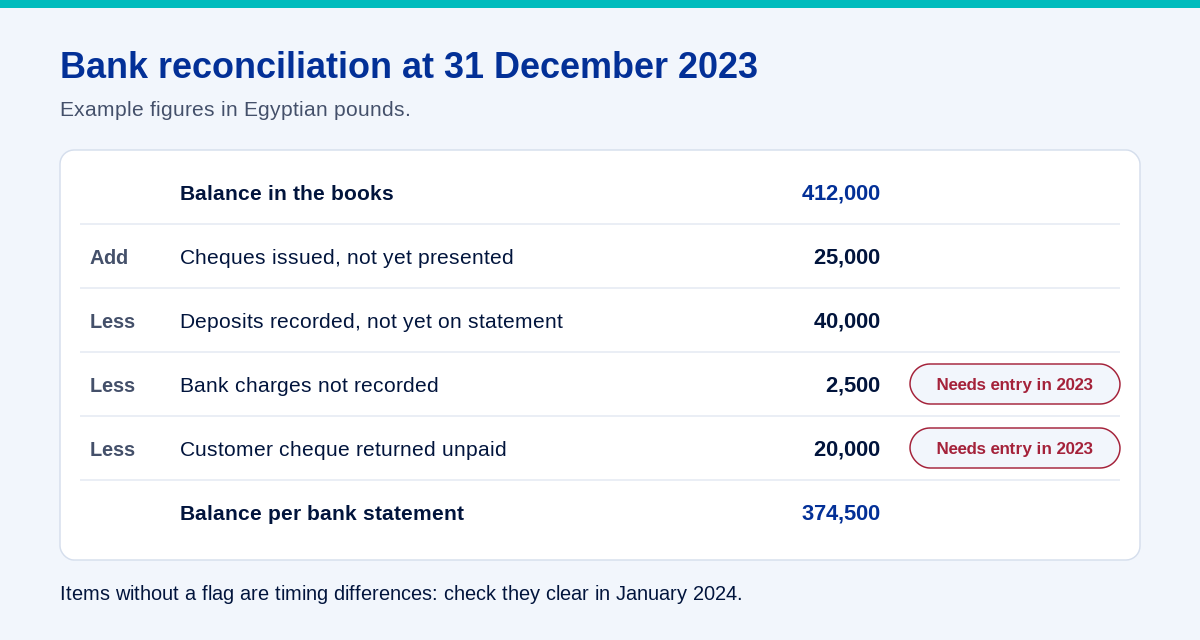
The returned cheque matters beyond the bank account. The customer it came from still owes the EGP 20,000, so their balance in the books was understated by the same amount. One bank item often leads you to a second account, which is why bank and cash come first.
What do you do when documents are missing?
Rebuild what you can from the other party’s records, and report the rest as unsupported. A bank can reissue statements, and customers, suppliers and lenders can send statements of account. A balance that no document supports should be listed with its amount and left for the owner to decide on. It should never be estimated into place or absorbed into another account.
A correction you cannot explain later is a new problem. Write the reason next to every adjusting entry while you still remember it.
Do corrections go into the old year or into this year?
If the old year was never reported to anyone, correct it inside that year and then close it. If its statements were already issued, the international standard IAS 8 says a material error from a prior period is corrected retrospectively: the comparative figures are restated, or, if the error is older than the earliest period presented, the opening balances of that period are restated.
| Situation of the old year | Where the correction goes | Who else to involve |
|---|---|---|
| Never reported, no statements issued | Inside the old year, before it is closed | The owner, who approves the year |
| Statements issued, error is material | Restated comparatives or opening balances, as IAS 8 describes | Your auditor, if the company has one |
| A tax return was filed on the old figures | The books are corrected as above; the return is a separate decision | Whoever represents you before the tax authority |
Corrected books can differ from a tax return that was already filed. That difference should be written down with its cause, and what to do about the return is a decision for you and your tax adviser. Kayan Finance does not represent clients before the tax authority.
How long does it take, and should you wait?
It depends on three things: how many years are open, how many transactions each year holds, and what records exist. Nobody can give an honest figure before seeing the books. Waiting makes it slower: each month adds transactions to reconcile, and the documents and the people who remember them become harder to find.
Most companies start this work because a bank, a partner or an examination has set a deadline. Starting before that gives you time to close the years in order and to deal with gaps calmly. Once the old years are closed, a monthly review of the bank reconciliation and the trial balance keeps the books from falling behind again.
Common questions
- Can we skip the old years and start fresh from this year?
- You can open clean books from a date whose balances you have proved by count and statement. The old years still exist, though, and a bank, a partner or an examiner may ask for them. Decide based on who will ask, and keep the old records accessible either way.
- Our accountant says the trial balance balances. Is the year closed?
- A balanced trial balance only shows that debits equal credits. An unreconciled bank, a wrong customer balance or a large suspense account can all sit inside a trial balance that balances.
- Do we need an auditor to close the old years?
- Closing the books and auditing them are different jobs. The books are closed first. If your company needs audited statements, the auditor examines them afterwards. Kayan Finance closes and corrects books; it does not carry out statutory audits.
- How far back should we go?
- Back to the last year whose closing balances someone approved and you can still support. If there is none, build a proven starting position as described above and decide with whoever will rely on the old years how far back they need statements.
Sources
The pages the figures and rules in this article were checked against, read in November 2026.
- ifrs.org/content/dam/ifrs/publications/html-standards/english/2026/...
- lawyeregypt.net/قانون-التجارة-رقم-17-لسنة-1999