
Key points
- In the first days, take back every login, the cheque books, the petty cash and the files. The owner should hold the administrator account of every system.
- Do not trust the last report the accountant gave you. Find the last month whose bank reconciliation you can see and check.
- Books reconciled to within a few months can be continued by a new accountant. Years with nothing reconciled need closing before anyone continues.
- Ask for a paid handover meeting if the relationship allows it. A few hours of explanation can save weeks of reconstruction.
- Prevent the next one: written procedures, a monthly close with a signature, and a second person who knows each task.
Start by taking back control of access and money: every system login, the bank users, the cheque books, the petty cash and the files. Then find the last month whose bank reconciliation you can actually see. If it is recent, a new accountant can continue from there. If it is a year or more back, the books have to be closed and corrected before anyone builds on them. Do both before you judge what the accountant left behind, because the gaps are usually different from what you expect.
What should you do in the first week?
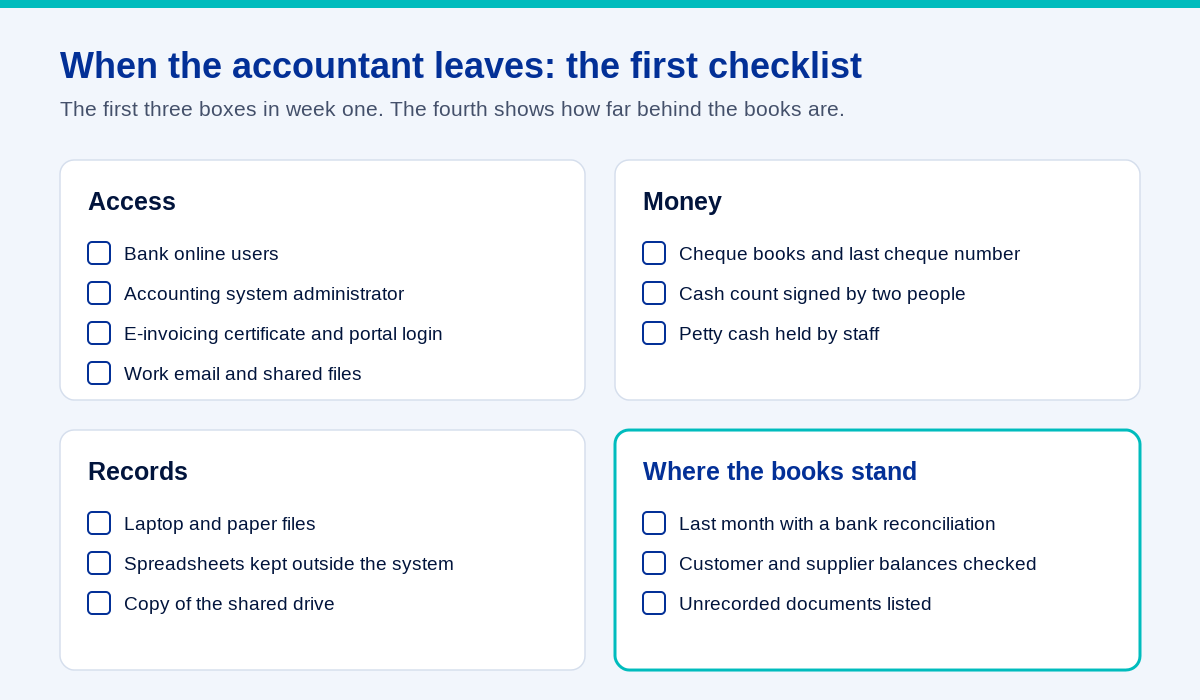
In the first week, secure what can move money or lock you out: online banking users, the accounting system, the e-invoicing setup, email and shared files, cheque books and the cash box. None of this assumes bad intent. A company whose only administrator has left cannot reset a password, add a user or produce a report, and that becomes urgent the first time a bank or a customer asks for something.
- Banks: ask each bank to remove the accountant as an online banking user and, if they were one, as a signatory. Collect every cheque book and note the last cheque number used.
- Accounting system: make sure the owner holds the administrator account, change its password, and disable the accountant’s user rather than deleting it, so their entries stay traceable to them.
- E-invoicing: systems that submit Egyptian e-invoices sign them with the company’s e-seal certificate. Find out where that certificate is kept, who can use it, and who holds the login for the tax authority’s e-invoicing portal.
- Cash: count the cash box and any petty cash with a second person present, write down the result, and both sign it.
- Files: collect the laptop, the paper files and any spreadsheets kept outside the system. Copy the shared drive and the accountant’s work email before anything is deleted.
- People: tell your main suppliers and customers who to contact now, so nobody keeps sending statements or payment requests to an empty inbox.
What should you ask the accountant to hand over?
If the accountant is still reachable, ask for a short written handover and, if possible, a few paid hours to walk a successor through it. The goal is to capture what was never written down: which spreadsheet holds what, which balances are known to be wrong, and which payments are promised but not yet made.
| Ask for | Why |
|---|---|
| The last bank reconciliation for each account, and the list of unreconciled items | It tells you the last date the books agreed with the bank |
| Customer and supplier balances, with any disputes | Disputed balances are the ones a successor will get wrong |
| Payments promised but not yet made, and post-dated cheques issued | They will hit the bank whether or not anyone remembers them |
| Filing dates for tax and social insurance, and what was filed last | A successor needs to know what is due next and on what figures the last filing was based |
| Every spreadsheet kept outside the system, with a line on what each is for | Much of the real work in small companies lives in these files |
| Known problems: balances they know are wrong, entries they meant to fix | Nobody else will find these quickly |
If the accountant left on bad terms or does not answer, you can still rebuild most of this from outside sources. Banks can reissue statements, customers and suppliers can send statements of account, and the records in your own system belong to the company. A dispute over withheld records or money is a matter for a lawyer.
How do you find out where the books really stand?
Look for the last month in which the bank balance in the books was reconciled to the bank statement, with the reconciliation on file. That month is your real cut-off. Anything after it may be right, but nobody has checked it. The last profit figure the accountant reported tells you much less, because it was never tested against the bank.
Then run three quick checks. Compare the balances of your five largest customers with what they say they owe. Look for a drawer, folder or email of invoices and receipts that were never entered. And compare the cash count from the first week with the cash balance in the books. Each difference you find is a list of work, and its size tells you which situation below you are in.
Can a new accountant just continue, or do the books need rebuilding?
It depends on how far back the last real reconciliation is. A gap of a month or two is normal catching up, and a new accountant can do it. A gap of a year or more, or a year that was never closed, means the new accountant would be building on figures nobody has checked, so the books should be closed and corrected first.
| What you find | What to do |
|---|---|
| Bank reconciled to within one or two months, balances agree with customers and suppliers | Hire or assign a new accountant to continue. Give them the handover list. |
| Last reconciliation several months back, a pile of unentered documents | Catch up month by month from the last reconciled month, reconciling each month before entering the next. |
| No reconciliation for a year or more, or a year never closed | Close the open years in order before anyone continues. A new accountant should start from closed, approved balances. |
| Cash or stock does not match and nobody can explain why | Count again with two people, document the difference, and investigate it before adjusting anything. |
Do not ask a newly hired accountant to fix two years of someone else’s books while also keeping this month current. Separate the cleanup from the daily work, or neither gets done.
How do you stop this from happening again?
The problem is a company where one person holds the access, the process and the knowledge, so the fix is to spread those three. It does not need a bigger team. With the habits below in place, the next departure costs a few days of handover.
- The owner holds the administrator account of the accounting system and is a user on every bank account. The accountant has their own user, never the master one.
- The documentary cycle is written down: who raises a purchase order, who approves a payment, where each document is filed.
- The month is closed with a bank reconciliation and a trial balance that the owner, or someone the owner trusts, reviews and signs.
- Spreadsheets that matter live in a shared folder the company controls, not on one laptop.
- Someone else, inside the company or outside it, can do the monthly close if the accountant is away for two weeks.
The monthly signature matters most. An owner who looks at the bank reconciliation every month knows where the books stand on any given day, whoever is keeping them.
Common questions
- Should I hire the new accountant first, or fix the books first?
- Secure access and cash first, whatever else you do. If the books are within a few months of current, hire and let the new accountant catch up. If they are a year or more behind, get the old periods closed by someone working on that alone, so the new accountant starts from balances that are known to be right.
- Is it worth paying the old accountant for a handover?
- Usually yes, if they are willing. They know which spreadsheets matter and which balances are wrong, and a successor can take weeks to find that out alone. Agree the hours and the list of items in advance.
- I cannot log in to the accounting system. What do I do?
- Contact the software vendor or the company that installed it, with proof that you own the company and the licence. Vendors have a process for this. Until it is solved, keep a dated list of everything that happens so it can be entered later.
- How long will it take to catch up?
- It depends on how many months are unchecked, how many transactions each month holds, and whether the documents exist. Find the last reconciled month first; nobody can give a fair estimate before that.
Sources
The pages the figures and rules in this article were checked against, read in November 2026.