
Key points
- A purchase passes through six documents: request, purchase order, goods receipt note, supplier invoice, payment voucher, and cheque or transfer.
- Each document is prepared by one person and signed by another, and no one both approves a purchase and receives the goods.
- The accountant pays only when the order, the receipt note and the invoice agree on item, quantity and price.
- Pre-numbered documents make a missing one visible: a gap in the sequence is a question someone must answer.
In a sound documentary cycle, a purchase moves through six documents and no person signs two consecutive ones. The department that needs an item signs a purchase request, the holder of the right authority approves the purchase order, the storekeeper signs the goods receipt note, accounts matches the supplier invoice to both, the authority holder approves the payment voucher, and the bank signatories sign the cheque or transfer. Each signature confirms one fact that the next person relies on, so any payment can be traced back to the need that started it.
What is a documentary cycle?
It is the written path each type of transaction follows, from the first document to the accounting entry. For each step it names the document, who prepares it, who signs it, where the copies go and when it is recorded. A company usually has a few cycles: purchases, sales, stock movements, payroll and petty cash. This article walks through the first two.
Without a cycle, the record of a purchase is whatever the person who made it remembers. With one, a shortage in the store or a payment nobody recognises becomes a question with a paper answer: which receipt note, signed by whom, against which order.
Who signs what in the purchase cycle?
Six documents, six signatures, and the same person never signs two in a row. The person who needs the item asks for it, someone with authority agrees to the spend, the storekeeper confirms what actually arrived, accounts confirms the invoice matches, the authority holder approves the payment, and the bank signatories release the money.
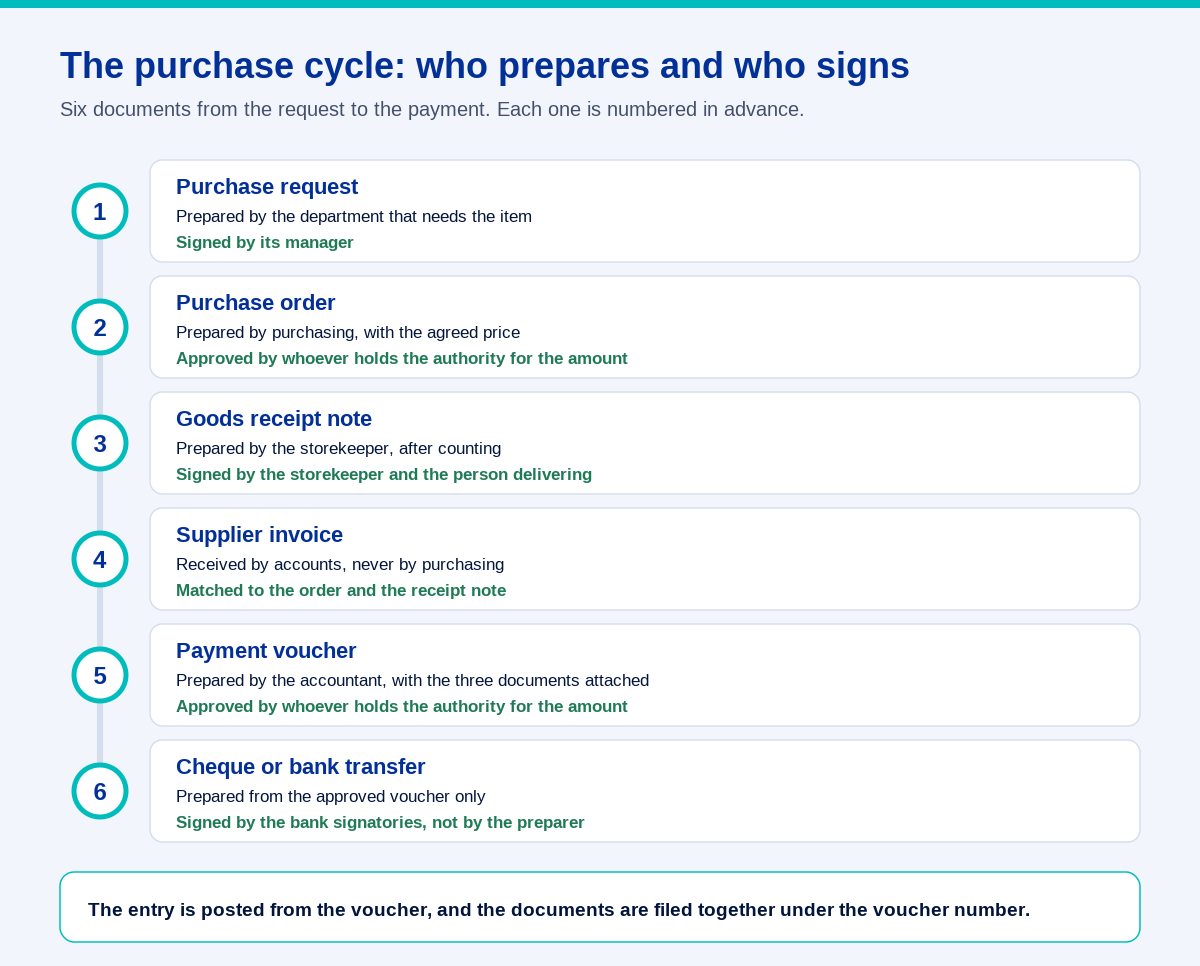
- Purchase request. The department that needs the item writes what, how many and by when. Its manager signs to confirm the need is real.
- Purchase order. Purchasing gets prices, chooses the supplier and issues a numbered order with the agreed price. Whoever holds the authority for that amount approves it before it goes to the supplier.
- Goods receipt note. The storekeeper counts what arrived against the order and records the quantity actually received, not the quantity ordered. The storekeeper and the person delivering both sign.
- Supplier invoice. It goes to accounts, not to purchasing. The accountant checks that the order, the receipt note and the invoice agree on item, quantity and price.
- Payment voucher. The accountant prepares it with the three documents attached. The authority holder approves it after seeing them.
- Cheque or transfer. It is prepared only from an approved voucher and signed by the bank signatories. The person who prepared the voucher does not sign the cheque.
Why must three documents match before anything is paid?
Because each one proves something different. The order proves you agreed to buy at that price. The receipt note proves the goods arrived in that quantity. The invoice is what the supplier says you owe. Pay against the invoice alone and you pay for whatever the supplier billed, including goods that never came and prices nobody agreed.
A worked example: an order for 200 cartons at EGP 150 each, a receipt note for 190 cartons, and an invoice for 200 cartons at EGP 155. Matching catches both problems. The company pays for 190 cartons at the agreed 150, which is EGP 28,500, and asks the supplier for a corrected invoice in place of one for EGP 31,000.
What does the sales cycle look like?
The same idea in the other direction: a customer order, a sales invoice, a delivery note signed by the customer, and a receipt when the money comes in. The rule that matters most is that the person who collects cash does not also record what the customer owes, so a collection cannot disappear between the two.
| Document | Prepared by | Signed or checked by |
|---|---|---|
| Customer order or quotation accepted | Sales | Sales manager, who checks the price list and the customer’s credit limit |
| Sales invoice | Accounts or sales, from the order | Accounts, which checks it against the order |
| Delivery note (issue note) | Storekeeper | The customer, on receipt, with name and date |
| Receipt for payment | Cashier or collector, from a numbered book | Accounts, which reconciles receipts to the bank and the safe |
Why do the documents need to be numbered in advance?
A pre-numbered document cannot quietly go missing. If receipt notes run from 1041 to 1060 and 1052 is not in the file, someone must explain where it went: cancelled, spoiled, or used for goods that never reached the books. Cancelled documents are kept, marked cancelled, in their place in the sequence.
Filing follows the voucher. Once a purchase is paid, the request, the order, the receipt note, the invoice and a copy of the cheque or transfer advice are filed together under the voucher number, and the invoice is stamped paid so it cannot be presented twice. In accounting software the same rule applies, with the scans attached to the entry.
What if the company is too small to separate every step?
Then keep the documents and move the check to the owner. In a company of six people, the same person may order and receive. The cycle still works if the owner signs every payment voucher after seeing the order, the receipt note and the invoice together, and reviews the bank statement each month. What the company cannot drop is the paper itself, because without it there is nothing to check.
Who may approve which amount is a separate decision, written in the company’s approval authorities. The cycle says that an approval is needed at each step. The authorities say whose it is.
How is a documentary cycle written for a company?
It is written around how the company really works: how goods arrive, who receives them, what is signed and when it is recorded. In Kayan’s Foundation Package the cycle is designed on site, the document set that carries it is produced (receipt notes, issue notes, transfer forms, cash vouchers), the owner approves the written cycle, and the team is trained on it with its own documents before handover.
Frequently asked questions
- Is a documentary cycle only for companies with stock?
- No. A service company buys services, pays salaries and bills clients, and each of those needs a path. The receipt note becomes a confirmation that the service was delivered, signed by whoever used it.
- Can the cycle run inside the accounting software instead of on paper?
- Yes, if the system has purchase orders, receipts and approvals. The rules stay the same: separate users for each step, approval rights set per user, and scans of signed paper attached where a signature is still needed.
- What about urgent purchases that cannot wait for a purchase order?
- Small urgent purchases usually go through petty cash, with a receipt and a voucher. For larger ones, write in the cycle who may approve an order after the fact, by when, and keep a list of every such case so the exception does not become the habit.
- How do I know whether my current cycle works?
- Pick five payments from last month and ask for the full set of documents behind each one. If any set is incomplete, or the same name appears on the order, the receipt and the cheque, the cycle exists on paper only.