
Key points
- Write approvals as a matrix: the type of spending down the side, amount bands across the top, and one named role in each cell.
- Set the bands so the owner sees the few large or unusual payments, not every small one.
- Keep three duties apart: approving a transaction, recording it, and holding the cash or goods.
- Where the team is too small to separate duties, write down the control that replaces the separation.
- Make the bank signatories match the matrix, and update both the day someone leaves.
Spending should be approved by the person the company has named in writing for that type of spending and that amount, and that person should never be the one who records the payment or holds the money. In practice this is a one-page matrix. Small, routine items are approved by the manager closest to them, larger ones by the general manager, and the largest or most unusual by the owner. Two rules sit above the matrix: nobody approves a payment to themselves, and an order may not be split to stay under a limit.
What are approval authorities?
They are the written answer to one question: who may commit the company’s money, for what, and up to how much. They cover purchases, payments, discounts given to customers, debts written off, and changes to who the company pays. Without them, approval belongs to whoever is in the room, and the owner finds out about a commitment when the invoice arrives.
The documentary cycle says that each step needs an approval. The approval authorities say whose approval it is. The two are written together, and each refers to the other.
What does an approval matrix look like?
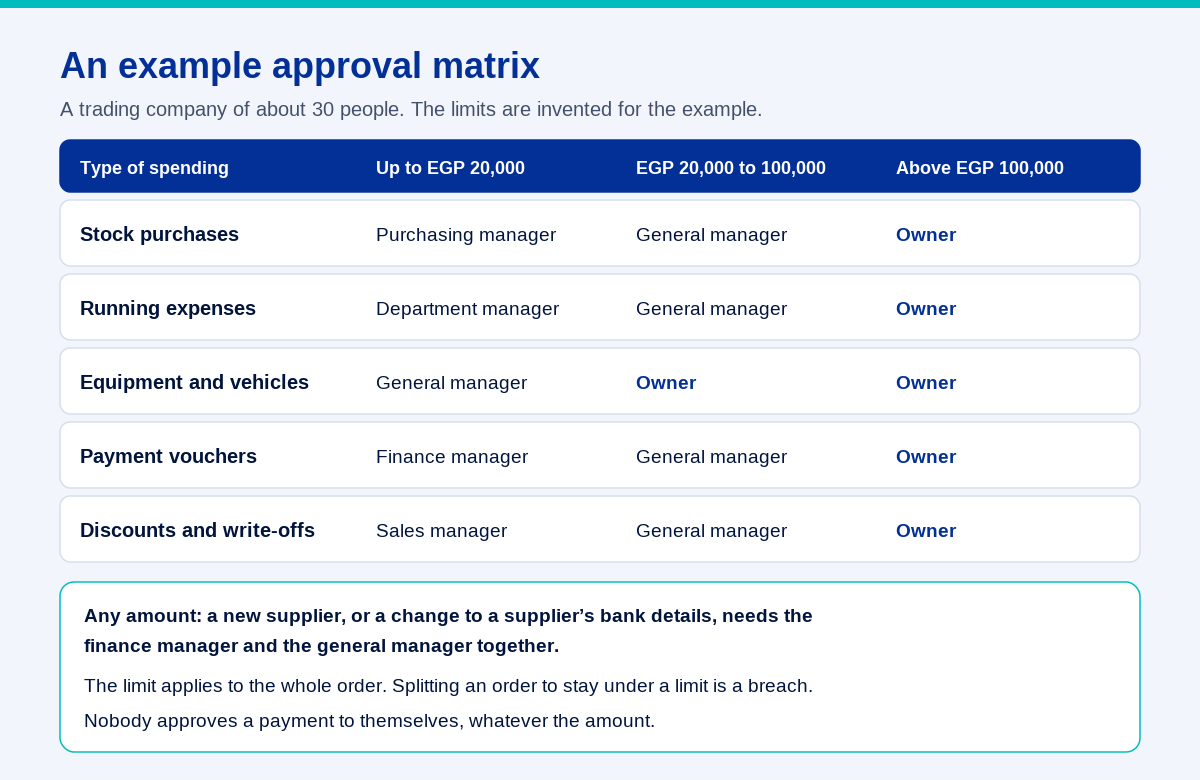
It is a table. Types of spending run down the side: stock purchases, running expenses, equipment, payment vouchers, discounts and write-offs. Amount bands run across the top. Each cell names one role, not one person, so the matrix survives staff changes. Some rows have no amount at all, because the risk is in the act itself.
How do you choose the amount limits?
Start from your own payments, not from another company’s matrix. List the last three months of payments by size. Put the top band where the owner will see a manageable number each week, and the bottom band where routine items stop waiting for the general manager. If the owner is signing forty vouchers a day, the limits are too low and the signing has become a rubber stamp.
- Apply each limit to the whole order or contract, including tax, never to a single instalment.
- Treat splitting an order to fit under a limit as a breach, and ask the accountant to watch for several orders to one supplier on the same day.
- Give some rows no amount band at all: a new supplier, a change of supplier bank details, a payment to a related party.
- Review the limits once a year, or when the business changes size, and date every version.
Which duties should one person never combine?
Approving a transaction, recording it, and holding the cash or goods it concerns. McGill University’s internal audit office names these three as the duties to divide, and quotes COSO’s 2013 framework: segregation of duties is typically built into the selection and development of control activities. One person with two of the three can both cause a loss and hide it.
| Duties combined | What one person could then do | Keep apart by |
|---|---|---|
| Approving purchases and receiving goods | Approve an order and sign for goods that never came | The storekeeper signs the receipt note, not the buyer |
| Recording payments and signing cheques | Pay a supplier twice and post it once | Cheques are signed by people who do not post entries |
| Collecting cash and recording customer balances | Keep a collection and leave the customer’s balance unpaid | The collector issues numbered receipts and accounts posts them |
| Adding suppliers and approving payments | Create a supplier and approve payments to it | Supplier changes need two people, neither of whom approves the payment alone |
What if the company is too small to separate duties?
Then the owner becomes the separation, and the policy says so in writing. With one accountant who records and also prepares payments, the control moves to what the owner checks: every payment voucher with its documents, and the bank statement each month. The aim is that no single person can both make an error and keep it hidden for long.
- The owner signs every cheque and approves every transfer, and sees the documents behind each one.
- The bank statement goes to the owner directly, from the bank or its online service, before the accountant reconciles it.
- Cash in the safe is counted by someone other than the person who holds it, on a day they do not choose.
- Supplier bank details are changed only after the owner confirms them with the supplier by phone.
What happens when an approver is away, and does the bank know?
Write the delegation into the matrix: who stands in for each role, for how long, and only upwards or sideways, never down to the person who raised the request. A delegation should be in writing, with a start and end date, so an approval given during a holiday can be traced later.
The bank only knows the signatories and limits you registered with it. If the matrix says the owner signs above EGP 100,000 and the bank accepts the finance manager’s single signature on any amount, the bank’s version is the one that works. Check that the two match, and change the bank’s records the day a signatory leaves.
How are approval authorities put in place?
They are one of the written policies in Kayan’s Foundation Package: who approves, who records, who holds, and what each limit is. The documents are short, meant for the people doing the work, and approved by the owner. Where team size makes full separation impossible, the policy states the control that replaces it. Once the company runs on them, a monthly independent review can check that approvals are actually followed.
Frequently asked questions
- Should the owner approve everything?
- In a very small company, often yes. As it grows, an owner who signs everything stops reading what they sign, and the company waits for one person. Keep the large and unusual items, and delegate the routine ones with limits.
- Is an approval on WhatsApp valid?
- Only if the policy says so and the message is kept with the voucher. If you allow it, say so in writing, require the document to be attached to the message, and print or save the approval with the payment file.
- Who approves the owner’s own expenses?
- Nobody can approve their own payment, the owner included. Where there are partners, another partner approves. Where there is one owner, the expense is recorded with its receipt and reviewed by the accountant or an outside reviewer, so it is at least visible.
- Can the accounting software enforce the matrix?
- If your system has approval workflows, it can route a document for approval by amount and block posting until it is approved. That helps, but only if users do not share logins and the person who sets the rules is not the one approving.
Sources
The pages the figures and rules in this article were checked against, read in November 2026.