
Key points
- If every journal entry balances, the trial balance can only fail through posting, extracting or adding, so the search is narrower than it looks.
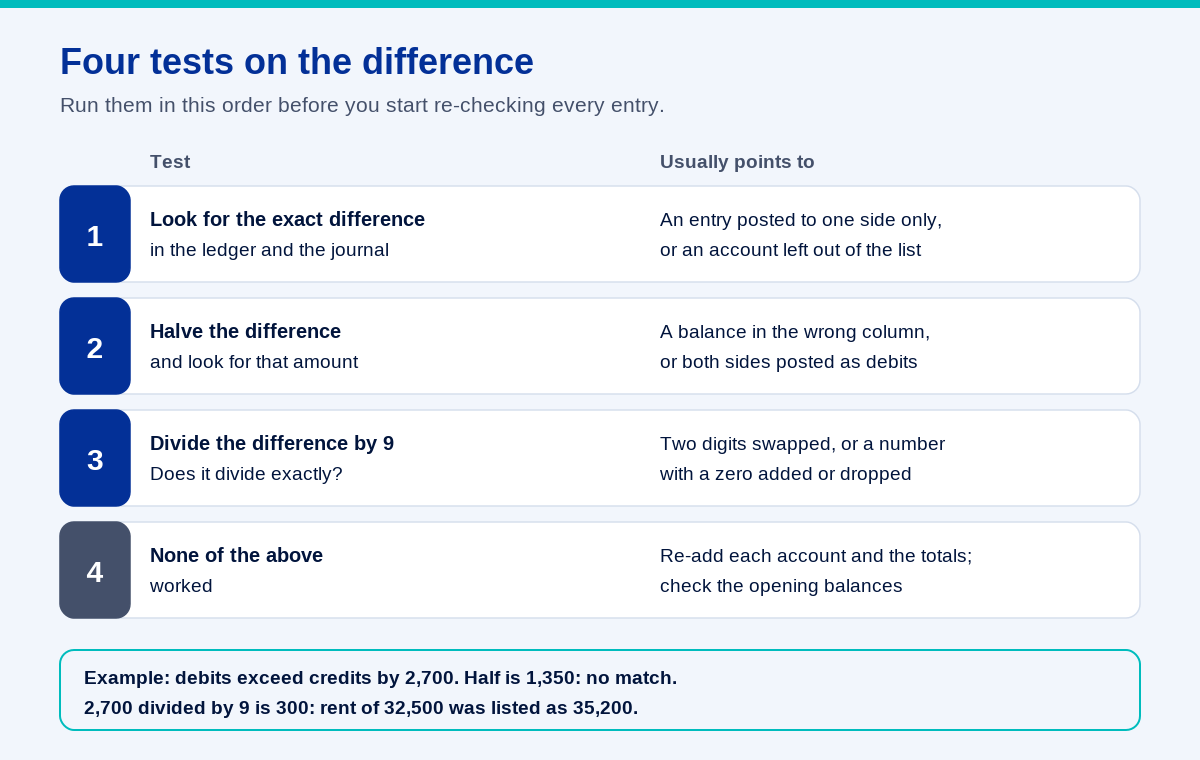
- Start from the difference: look for that exact amount, then for half of it, then check whether it divides by 9.
- A difference that divides exactly by 9 usually means two digits were swapped or a zero was added or dropped.
- A trial balance that balances can still be wrong: omissions, wrong accounts and compensating errors leave the totals equal.
When a trial balance does not balance, the error is almost always in one of eight places: an entry posted to one side only, different amounts on each side, two digits swapped, a zero added or dropped, an entry posted twice to the same side, a balance in the wrong column, an account missing from the list, or a mistake in adding up. You find it fastest by testing the difference itself before re-checking anything: look for that exact amount, then half of it, then see whether it divides by 9. Each test points to a different kind of mistake.
What does an unbalanced trial balance tell you?
It tells you that something went wrong after the journal. Every correct journal entry has equal debits and credits, so if each entry is posted correctly and every balance is listed correctly, the two totals must agree. When they do not, the mistake is in posting from the journal to the ledger, in working out an account’s balance, in copying balances into the trial balance, or in adding up.
That is useful, because it rules out a lot. You do not need to question whether rent was charged to the right account or whether a sale was recorded at all; neither of those would unbalance the totals. You are looking for a mechanical slip.
What are the eight common causes?
Each cause leaves a recognisable mark on the difference. Knowing the mark tells you which test will find the error, so read the third column of the table as much as the first.
| Cause | Example | The difference equals |
|---|---|---|
| 1. Posted to one side only | A 6,000 purchase debited to purchases but never credited to the supplier | The amount itself: 6,000 |
| 2. Different amounts on each side | Debit 4,500, credit 4,050 | The gap between them: 450 |
| 3. Two digits swapped | A balance of 32,500 listed as 35,200 | A multiple of 9: 2,700 |
| 4. A zero added or dropped | 12,000 written as 1,200 | A multiple of 9: 10,800 |
| 5. Both sides posted to the same side | A 3,000 entry posted as two debits | Twice the amount: 6,000 |
| 6. A balance in the wrong column | A 1,350 debit balance listed as a credit | Twice the balance: 2,700 |
| 7. An account left out | A bank account missing from the list, or a SUM range that stops a row early | That account’s balance |
| 8. An adding mistake, or opening balances that never agreed | A ledger account added wrongly, or last year’s balances keyed in unbalanced | Any amount; test 4 finds it |
How do you find the error without re-checking everything?
Work out the exact difference and which side is larger, then run four tests on it in order. The first three take minutes and catch most errors. Only if all three fail do you go back to adding every account again, and by then you have ruled out the common causes.
- Write down the two totals, the difference, and which side is larger.
- Search the journal and the ledger for an entry of exactly that amount. If you find one, check that both sides were posted and that the account appears in the trial balance.
- Halve the difference and search for that amount. If you find a balance of that size, check which column it is in; if you find an entry, check that it was not posted to the same side twice.
- Divide the difference by 9. If it divides exactly, compare each balance in the trial balance with the ledger, looking for swapped digits or a missing or extra zero.
- If none of that works, re-add each ledger account and both columns of the trial balance, and check that the opening balances brought forward agree.
Why does dividing by 9 work?
Because of how place value works. When two neighbouring digits swap, one digit moves up a place and the other moves down, and the change in value always comes out as 9 times something. Swapping the 2 and the 5 in 32,500 to get 35,200 adds 2,700, which is 9 times 300. The same happens when a zero is added or dropped: 12,000 written as 1,200 is short by 10,800, which is 9 times 1,200.
The result of the division also gives you a hint. For swapped neighbouring digits in the thousands and hundreds, the result is 100 times the gap between the two digits: 300 means two digits 3 apart, such as 2 and 5. A difference that divides by 9 is a strong lead, but other errors can produce one by chance, so confirm it against the ledger before you correct anything.
What does the search look like on a real trial balance?
Take a worked example with made-up numbers. A small trading company’s trial balance shows debits of EGP 1,284,200 and credits of EGP 1,281,500, so debits are larger by 2,700. No entry of 2,700 exists. Half is 1,350, and the bank charges account does show 1,350, but it is correctly in the debit column, so that is a coincidence. 2,700 divides by 9 to give 300, so you look for a debit balance with two neighbouring digits 3 apart. Rent shows 35,200 in the trial balance and 32,500 in the ledger. Correct the trial balance and both totals become 1,281,500.
Fix the cause where it happened. If the error was in the ledger, correct it with a dated entry and a narration. Never type a balancing figure into the trial balance to make the totals meet.
Which errors does a balanced trial balance still hide?
Any error that affects debits and credits equally. A trial balance proves only that debits equal credits. It says nothing about whether the right accounts, amounts and periods were used, so a balanced one is where review starts.
| Error | Example | How it is usually found |
|---|---|---|
| Omission: the entry was never made | A supplier invoice left in a drawer | Supplier statement reconciliation |
| Wrong account of the same type | Customer A’s receipt credited to Customer B | Customer statements and confirmations |
| Error of principle | A new machine charged to repairs expense | Review of large expense items |
| Wrong amount on both sides | An invoice for 8,700 entered as 7,800 throughout | Checking entries against source documents |
| Debit and credit reversed | A payment recorded as a receipt | Bank reconciliation |
| Compensating errors | Sales overstated by 1,000 and an expense overstated by 1,000 | Detailed review; often found by accident |
Does this still happen in an accounting system?
Less often. Accounting systems normally refuse to post an entry whose debits and credits differ, and they add up the balances themselves, so causes 1 to 6 and most adding mistakes are rare there. What still happens is unbalanced opening balances imported at go-live, and trial balances exported to Excel and then edited, re-sorted or summed with a range that misses rows. If the system’s own trial balance agrees and your spreadsheet does not, the error is in the spreadsheet.
Common questions
- Can I put the difference in a suspense account and carry on?
- Only with your senior’s agreement, only for a short time, and with a note of what you have already tested. A suspense balance is a list of unfinished work and should be empty at month-end.
- The difference is very small. Does it matter?
- Yes. A small difference can be two large errors that partly cancel out, and you cannot know which until you find them. Find the cause first, then decide.
- There is more than one error. Do the tests still work?
- Not as cleanly, because the difference is a sum. Run them anyway: if one finds an error, correct it and test the new, smaller difference. If none works, test 4 still finds everything.
- How often should I prepare a trial balance?
- At least at every month-end, before the financial statements. A month’s entries are far easier to search than a year’s.