
Key points
- An accrued expense is a cost of this month whose bill has not arrived: record an estimate now and correct it when the bill comes.
- A prepayment is paid now for later months: record it as an asset and move one month’s share to expense each month.
- Depreciation spreads a fixed asset’s cost less its residual value over its useful life, starting when the asset is available for use.
- Money received before goods are delivered is a liability to the customer until delivery, not revenue.
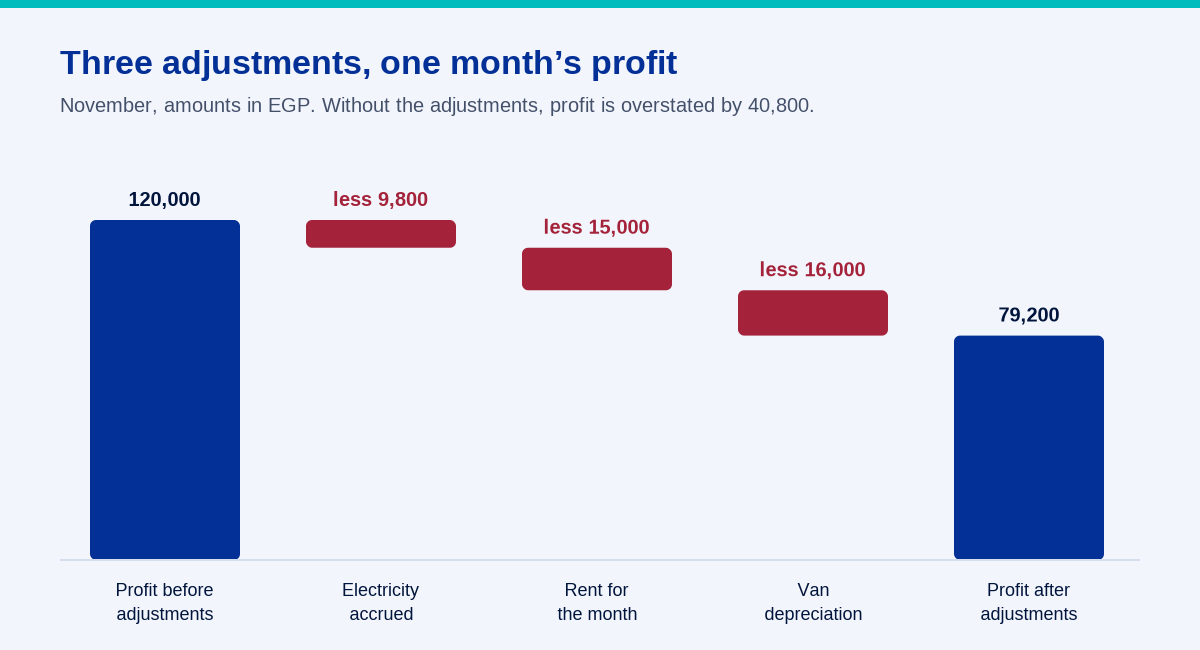
- In the worked example, three adjustments cut one month’s profit from EGP 120,000 to EGP 79,200.
Adjusting entries are the entries made at the end of a month to put income and expenses in the month they belong to, whatever the date of the invoice or the payment. There are four common kinds: accrued expenses (used now, billed later), prepayments (paid now, used later), depreciation (a fixed asset’s cost spread over its life) and deferred revenue (cash received before the goods or service are delivered). This article works through each with numbers from one month of a Cairo distributor, in Egyptian pounds.
Why are adjusting entries needed at all?
Because financial statements are prepared on the accrual basis: income and expenses are recognised when they are earned or incurred, not when cash moves. The IFRS for SMEs Accounting Standard states this directly in paragraph 3.16A, with cash flow information as the only exception. Without adjustments, a month’s profit would depend on when bills happened to arrive and when rent happened to be paid.
| Type | What happened | Month-end entry | Example |
|---|---|---|---|
| Accrued expense | Used this month, no bill yet | Debit expense, credit accrued expenses | Electricity, a consultant’s hours |
| Prepayment | Paid now for later months | Debit expense, credit prepaid asset | Rent, annual insurance |
| Depreciation | A fixed asset was used for the month | Debit depreciation, credit accumulated depreciation | Delivery van, computers |
| Deferred revenue | Cash received, goods not yet delivered | At delivery: debit customer advances, credit sales | A deposit on a large order |
How do you record an accrued expense?
Estimate the cost of what was used in the month, record it as an expense with a liability called accrued expenses, and correct the estimate when the real bill arrives. The estimate needs a basis you can show, such as last month’s bill or a meter reading. An accrual with no basis is a guess, and a reviewer will ask for it.
The warehouse electricity bill for November arrives in mid-December. October’s bill was EGP 9,800, and the warehouse worked the same hours, so you accrue 9,800 on 30 November: debit Electricity expense 9,800; credit Accrued expenses 9,800. In December the bill comes to EGP 10,150. You debit Accrued expenses 9,800 and Electricity expense 350, and credit the electricity company 10,150. The 350 difference lands in December, which is acceptable for a small estimate error; a large one should be explained.
How do you handle rent or insurance paid in advance?
Record the payment as an asset, prepaid expenses, because the company has bought a benefit it has not used yet. Then, at each month end, move one month’s share to the expense account. Keep a small schedule listing each prepayment, its monthly amount and the month it ends, so the releases stop on time.
On 1 October the company paid EGP 45,000 for three months of warehouse rent and recorded it as Prepaid rent. At the end of each of October, November and December: debit Rent expense 15,000; credit Prepaid rent 15,000. After December the prepaid balance is zero. Annual vehicle insurance of EGP 36,000 paid in January works the same way at EGP 3,000 a month. One mistake to watch for is to keep releasing after the balance has reached zero, which pushes the prepaid account into credit.
How is monthly depreciation calculated?
Take the asset’s cost, deduct its residual value (what you expect to get for it at the end), and spread the rest over its useful life. IAS 16, the IFRS standard on fixed assets, defines depreciation as the systematic allocation of that depreciable amount over the asset’s useful life. In Egypt the corresponding standard is EAS 10. With the straight-line method, every month carries the same charge.
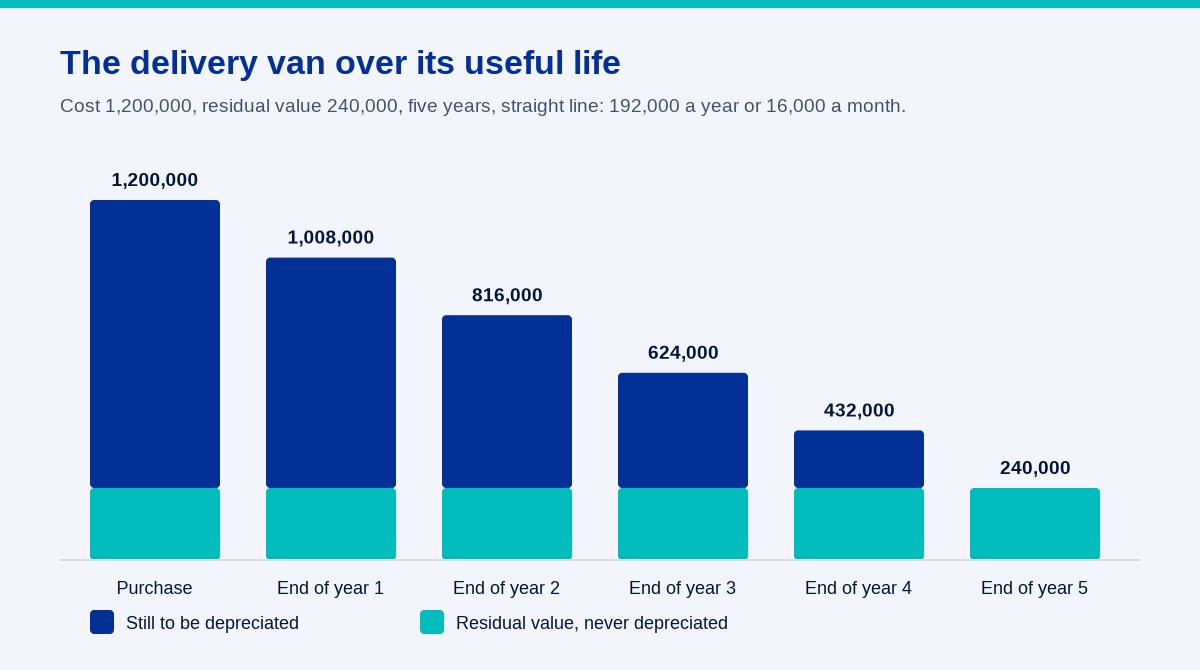
The company buys a delivery van for EGP 1,200,000. It expects to use it for five years and sell it for EGP 240,000. The depreciable amount is 960,000, which is 192,000 a year or 16,000 a month. Each month end: debit Depreciation expense 16,000; credit Accumulated depreciation, vehicles 16,000. The van stays in the books at cost, and the accumulated depreciation beside it shows how much of that cost has been used.
- Depreciation starts when the asset is available for use, meaning it is where and in the condition management intends, which is not necessarily the purchase date. A van bought on 20 October and licensed on 3 November starts in November.
- Straight line is one method among several. The IFRS for SMEs Standard also names diminishing balance and usage-based methods such as units of production, and rules out methods based on revenue.
- Useful life and residual value are estimates. ACCA’s guide to IAS 16 notes that they must be reviewed at each reporting date, so a van that wears out faster than expected gets a higher charge from then on.
- Keep a fixed asset register: one line per asset with cost, date available for use, life, residual value and accumulated depreciation. The monthly entry comes from its total.
What about money received before the goods are delivered?
It is a liability until the goods are delivered, because the company owes the customer either the goods or the money back. Record the receipt in a customer advances account, and move it to sales in the month of delivery. Recording it as sales on receipt makes the month look better than it was and the next month worse.
A hotel chain pays EGP 60,000 on 25 November for an order to be delivered on 8 December. In November: debit Bank 60,000; credit Customer advances 60,000. In December, on delivery, the advance is applied against the sale and the revenue appears in December. VAT is left out of this example for clarity; when VAT falls due on an advance payment is a tax question to check against the Tax Authority’s rules.
How much do adjustments change a month’s profit?
It can be large. In November the distributor’s books showed a profit of EGP 120,000 before adjustments. The accrued electricity (9,800), the month’s rent (15,000) and the van’s depreciation (16,000) together reduce it by 40,800, to EGP 79,200. The owner who saw 120,000 in an early report would have overestimated the month by about half.
How do you prepare adjusting entries every month without missing one?
Work from standing schedules instead of memory. Most adjustments repeat every month with the same accounts, so a list of recurring accruals, a prepayment schedule and a fixed asset register cover nearly all of them. The rest come from reading the month’s documents for anything used but not billed, or billed but not delivered.
- Reverse last month’s accruals, or clear them against the bills that have arrived.
- Go down the recurring accruals list: utilities, professional fees, interest, anything billed in arrears.
- Release the month’s share of each prepayment from the schedule.
- Post depreciation from the fixed asset register, including assets that became available for use this month.
- Check customer advances against deliveries and move delivered amounts to sales.
- Write the basis of every estimate next to the entry, and have a second person review the entries before the month is locked.
Common questions
- Do I need an invoice to record an accrual?
- No. The point of an accrual is that the invoice has not arrived. You need a reasonable estimate and a written basis for it, such as last month’s bill, a contract rate or a meter reading.
- What if my estimate turns out wrong?
- Correct it when the real figure arrives, in the month it arrives. Small differences are normal. A pattern of large ones means the basis of the estimate needs changing.
- Can I post depreciation once a year instead of monthly?
- The annual statements would come out the same, but every monthly report during the year would overstate profit. If the owner reads monthly figures, post it monthly.
- Is an accrued expense the same as a supplier balance?
- Both are liabilities, but a supplier balance rests on an invoice you have received, while an accrual is your estimate before the invoice exists. Keeping them in separate accounts shows the owner which liabilities are confirmed.
Sources
The pages the figures and rules in this article were checked against, read in November 2026.
- ifrs.org/content/dam/ifrs/publications/html-standards/english/2025/...
- accaglobal.com/us/en/student/exam-support-resources/fundamentals-ex...
- fra.gov.eg/en