
Key points
- Every entry has equal debits and credits, but a real one often has three or more lines because VAT, cost of sales or deductions are involved.
- Assets and expenses increase with a debit; liabilities, equity and revenue increase with a credit.
- Selling from stock produces two entries: the sale to the customer, and the cost of the goods that left the warehouse.
- A trial balance that balances proves the debits equal the credits, not that every entry went to the right account.
Double entry means every transaction is recorded in at least two accounts, with the total debits equal to the total credits, so the books always balance. In a real company the entry starts from a document, usually carries VAT, and often has three or more lines. This article follows one month of an invented Cairo distributor of cleaning products through eight transactions, from the document to the entry to the trial balance, with every amount in Egyptian pounds.
What is the debit and credit rule, in one table?
Assets and expenses increase on the debit side and decrease on the credit side. Liabilities, equity and revenue work the other way: they increase with a credit and decrease with a debit. Every entry in this article follows from that rule. When you are unsure, ask which accounts moved and in which direction, then apply the table.
| Account type | Increases with | Decreases with | Example from this month |
|---|---|---|---|
| Assets | Debit | Credit | Bank, inventory, customer, prepaid rent |
| Expenses | Debit | Credit | Cost of goods sold, salaries, bank charges |
| Liabilities | Credit | Debit | Supplier, VAT on sales, payroll deductions payable |
| Equity | Credit | Debit | Capital |
| Revenue | Credit | Debit | Sales (returns reduce it with a debit) |
What does the example company do?
It buys detergent from a manufacturer at EGP 230 a carton and sells it to supermarkets at EGP 320, on credit. It is registered for VAT, and as of November 2026 the general VAT rate in Egypt is 14%, so every purchase and sale invoice carries tax. It uses accounting software that tracks stock continuously. The owner opens the company with EGP 1,000,000 paid into the bank: debit Bank 1,000,000, credit Capital 1,000,000. It is the only entry this month that looks like a textbook exercise.
How is a purchase on credit recorded with VAT?
With three lines instead of two. The goods go to inventory at their net cost, the VAT goes to its own account, and the supplier is credited with the full invoice total. The supplier invoice, matched to the purchase order and the goods received note, is the document behind the entry.
The company buys 200 cartons at EGP 230: EGP 46,000, plus VAT of EGP 6,440, a total of EGP 52,440. Debit Inventory 46,000 and debit VAT on purchases 6,440; credit Supplier 52,440. A textbook exercise usually leaves out the tax line. In practice the tax line needs the most care, because the VAT accounts feed the monthly VAT return.
Why does one sale produce two entries?
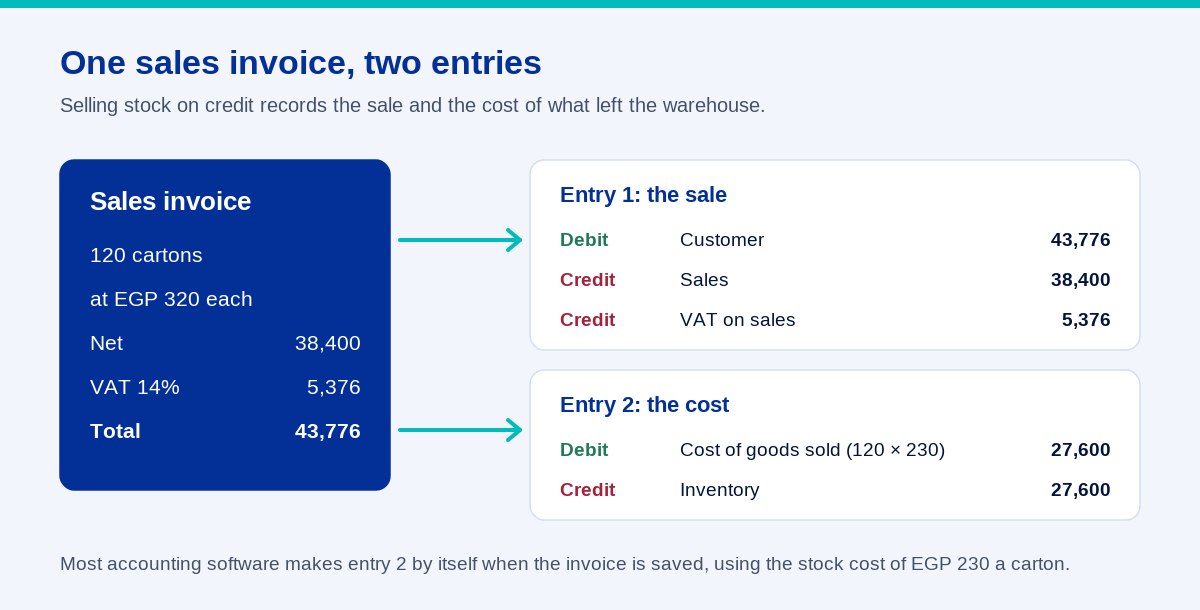
Because a sale from stock changes two things. The company earns revenue and gains a receivable from the customer, and at the same time goods leave the warehouse, so inventory falls and the cost of goods sold rises. When stock is tracked continuously, both entries are made on the invoice date, usually by the software itself.
The company sells 120 cartons at EGP 320: EGP 38,400 plus VAT of EGP 5,376, a total of EGP 43,776. Entry one: debit Customer 43,776; credit Sales 38,400 and credit VAT on sales 5,376. Entry two: debit Cost of goods sold 27,600 (120 cartons at EGP 230); credit Inventory 27,600. The gross profit on the invoice, 38,400 less 27,600, is EGP 10,800.
How do you record a sales return?
By reversing both halves of the sale for the goods that came back, against a credit note (إشعار دائن) issued to the customer. The sale and its VAT are reduced, the customer owes less, and the cartons go back into inventory at cost. Using a separate Sales returns account, instead of debiting Sales directly, lets the owner see how much came back.
The supermarket returns 10 damaged cartons. Entry one: debit Sales returns 3,200 and debit VAT on sales 448; credit Customer 3,648. Entry two: debit Inventory 2,300; credit Cost of goods sold 2,300. If the cartons are too damaged to sell, the cost goes to a damaged stock expense instead of back to inventory, a decision someone with authority should approve in writing.
What happens when money moves through the bank?
The bank account moves, and the customer or supplier balance is cleared. The document is the bank advice or the statement line. Watch for amounts that appear only on the statement, such as transfer fees: they have no invoice, so you learn about them during the bank reconciliation and record them then.
The customer pays the balance of EGP 40,128 (43,776 less the 3,648 credit note): debit Bank 40,128; credit Customer 40,128. The company pays the supplier EGP 52,440 and the bank charges EGP 25 for the transfer: debit Supplier 52,440 and debit Bank charges 25; credit Bank 52,465. Both the customer and the supplier balances are now zero.
How are rent paid in advance and salaries recorded?
Rent paid for several months is an asset when paid and becomes an expense month by month. Salaries are an expense at their gross amount, even though employees receive less, because the deductions are still owed to someone else. Both show how the amount paid out of the bank and the amount recorded as an expense can differ.
The company pays EGP 45,000 for three months of warehouse rent: debit Prepaid rent 45,000; credit Bank 45,000. At the month end, one month (EGP 15,000) moves to rent expense through an adjusting entry, which has its own article. Gross salaries are EGP 60,000, of which EGP 9,000 is withheld for the employees’ social insurance and income tax: debit Salaries 60,000; credit Bank 51,000 and credit Payroll deductions payable 9,000. The 9,000 is cleared when the company pays the authorities.
Does it all balance at the end of the month?
Yes. After eight transactions the trial balance lists twelve accounts with balances, and total debits equal total credits at EGP 1,052,328. Inventory stands at EGP 20,700, which is 90 cartons at EGP 230: 200 bought, 120 sold, 10 returned. The customer and supplier have no balance, and the bank holds EGP 891,663.
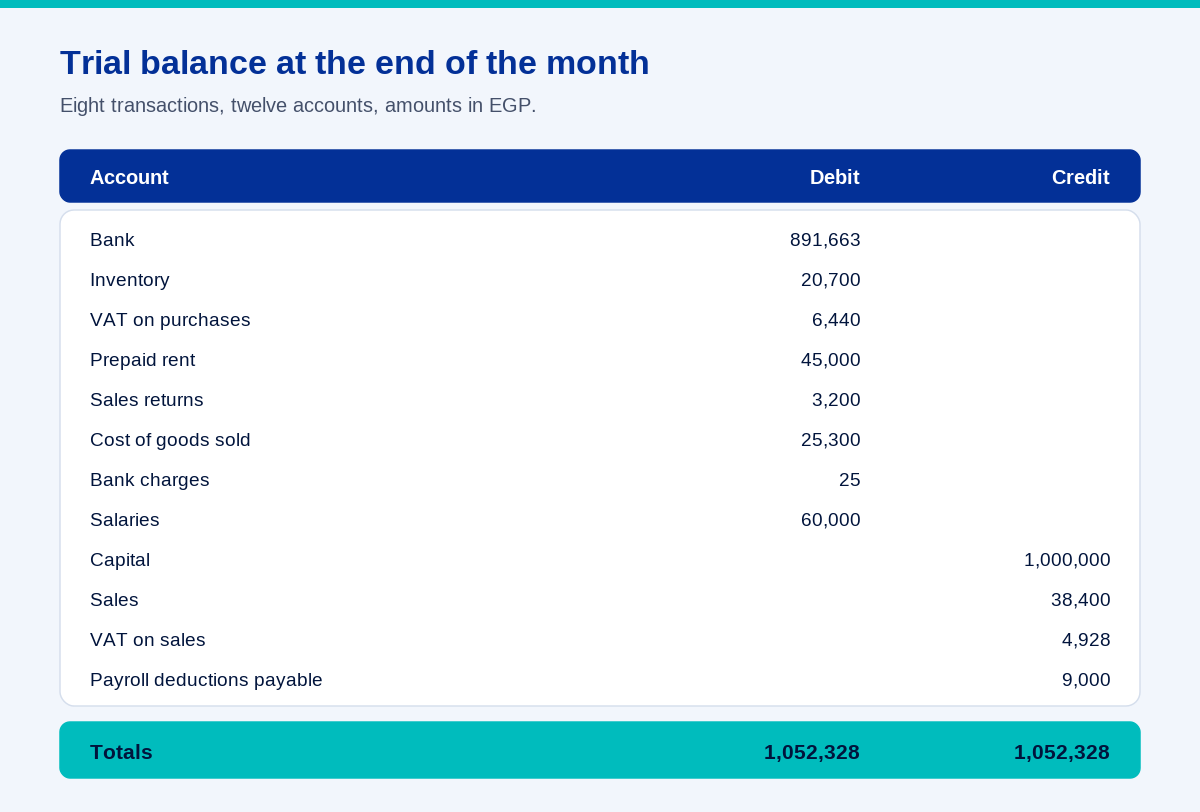
A balanced trial balance proves only that debits equal credits. These errors leave it balanced: posting the delivery van’s fuel to salaries, entering 2,300 as 3,200 on both sides, recording the same invoice twice, or forgetting an invoice entirely. That is why the month-end close compares balances with outside evidence, such as the bank statement, a supplier’s statement and a stock count.
How do you practise double entry on real documents?
Take documents that the software has already posted and write the entry yourself before looking at what the system made. Where yours differs, find out why. A month of this teaches more than another textbook chapter, because the documents include the VAT, the returns and the bank charges that exercises leave out.
- Pick ten documents of different kinds: a purchase invoice, a sales invoice, a credit note, a payment, a receipt, a payroll sheet.
- For each, write down which accounts move and in which direction, using the rule table.
- Write the full entry with amounts, and check that debits equal credits.
- Open the entry the system made and compare it line by line.
- Ask a senior colleague about every difference, and note the answer next to the chart of accounts.
Common questions
- Why does my deposit show as a credit on the bank statement?
- Because the statement is the bank’s record, not yours. To the bank, your money is a liability it owes you, so a deposit increases it with a credit. In your books the same deposit is a debit to Bank.
- Is VAT an expense?
- In this example the company is VAT-registered, so the tax sits in VAT accounts on the balance sheet and does not touch profit. Whether input tax can be deducted in a particular case is a tax question; check it with the Tax Authority’s rules or a tax adviser.
- What is a compound entry?
- An entry with more than one debit or more than one credit, such as the purchase with VAT above. In Arabic books it is written “من مذكورين” or “إلى مذكورين”. Most entries in a real company are compound.
- Do I still need double entry if the software does it?
- Yes, to check it. The software balances whatever it is given, so a wrong account or customer produces a balanced, wrong entry. Reading an entry and knowing whether it makes sense is the skill.
Sources
The pages the figures and rules in this article were checked against, read in November 2026.
- taxsummaries.pwc.com/egypt/corporate/other-taxes
- taxsummaries.pwc.com/egypt/individual/other-taxes
- taxsummaries.pwc.com/egypt/individual/tax-administration