
Key points
- The bank statement is written from the bank’s point of view, so your deposits appear as credits and your payments as debits.
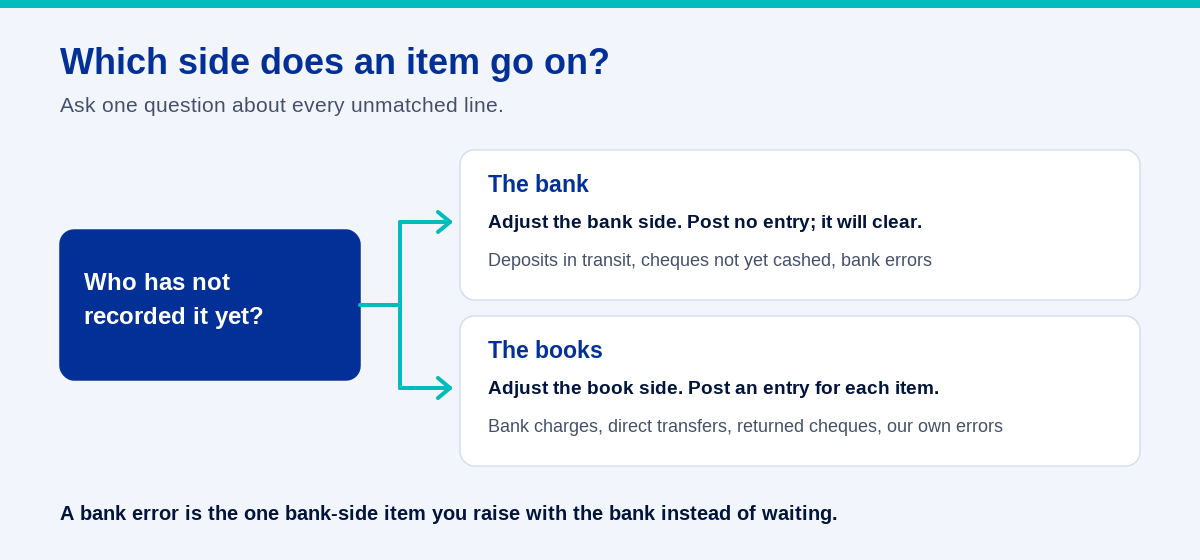
- For every unmatched line ask who has not recorded it yet. If it is the bank, adjust the bank side; if it is the books, adjust the book side.
- Only book-side items get journal entries. Deposits in transit and uncashed cheques clear by themselves next month.
- Start each month from last month’s outstanding items, and check that they cleared.
A bank reconciliation starts from two balances on the same date, the bank statement and the cash-at-bank account in your ledger, and adjusts each one only for the items it has not recorded yet, until both reach the same figure. Then you post journal entries for the items your books were missing, and nothing for the items the bank was missing. Most first attempts go wrong on that one point, putting an item on the wrong side. The rest of this article walks through a full example so you can see where each line belongs.
Why does the bank statement show my deposits as credits?
Because the statement is a copy of the bank’s own ledger account for you. To the bank, the money in your account is money it owes you, a liability, so a deposit increases that liability and is a credit. In your books the same money is an asset, cash at bank, so the deposit is a debit. Every line on the statement is the mirror image of the line in your ledger.
Once you see that, the matching is mechanical: a credit on the statement pairs with a debit to cash at bank in the ledger, and a debit on the statement pairs with a credit. Do not try to compare the columns by name.
What do you need before you start?
You need two records for the same account and the same period, plus the reconciliation from the month before. Without last month’s reconciliation you cannot tell which unmatched lines are new and which were already known, so ask for it first. If this is the account’s first reconciliation ever, start from a month-end balance your senior confirms.
- The bank statement for the month, for this one account.
- The ledger for cash at bank for the same account and dates, printed or exported from the system.
- Last month’s reconciliation, with its list of deposits in transit and uncashed cheques.
- The bank’s advices for charges, interest and incoming transfers, if they came separately.
- The cheque register or payment vouchers, so you can match by cheque number.
Which items go on the bank side and which on the book side?
Ask one question of every unmatched line: who has not recorded it yet? If the bank has not, the item goes on the bank side and needs no entry, because the bank will record it soon. If your books have not, it goes on the book side and needs a journal entry, because nothing will put it in your books except you.
| Item | Side | Add or deduct | Journal entry? |
|---|---|---|---|
| Deposit in transit: recorded by us, not yet by the bank | Bank | Add | No |
| Cheque issued, not yet presented by the payee | Bank | Deduct | No |
| Bank charges and commissions | Books | Deduct | Yes |
| Interest credited by the bank | Books | Add | Yes |
| Customer transfer straight to the account | Books | Add | Yes |
| Customer cheque returned unpaid | Books | Deduct | Yes |
| Our own recording error | Books | Either, by the error | Yes, a correcting entry |
| The bank’s error | Bank | Either, by the error | No; ask the bank to correct it |
What does a full reconciliation look like, with numbers?
Here is a worked example with made-up figures. At month-end the bank statement shows EGP 486,300 and the cash-at-bank ledger shows EGP 424,050. After ticking every matched line, seven items are left, and the question above sorts them into three for the bank side and four for the book side.
- Cash of EGP 45,000 deposited on the last day is in the ledger but not on the statement. The bank has not recorded it: bank side, add.
- Cheques 1042 (EGP 18,500) and 1047 (EGP 61,200) were issued and recorded, but the payees have not cashed them. Bank side, deduct both.
- The statement shows EGP 1,350 of charges with no entry in the ledger. Book side, deduct.
- Customer A transferred EGP 52,000 directly; nobody recorded it. Book side, add.
- A cheque for EGP 24,000 from Customer B was deposited and recorded, then returned unpaid. The statement shows the reversal; the ledger does not. Book side, deduct.
- Cheque 1039 to a supplier cleared at EGP 7,800, but the ledger shows EGP 8,700. The books took out EGP 900 too much. Book side, add 900.
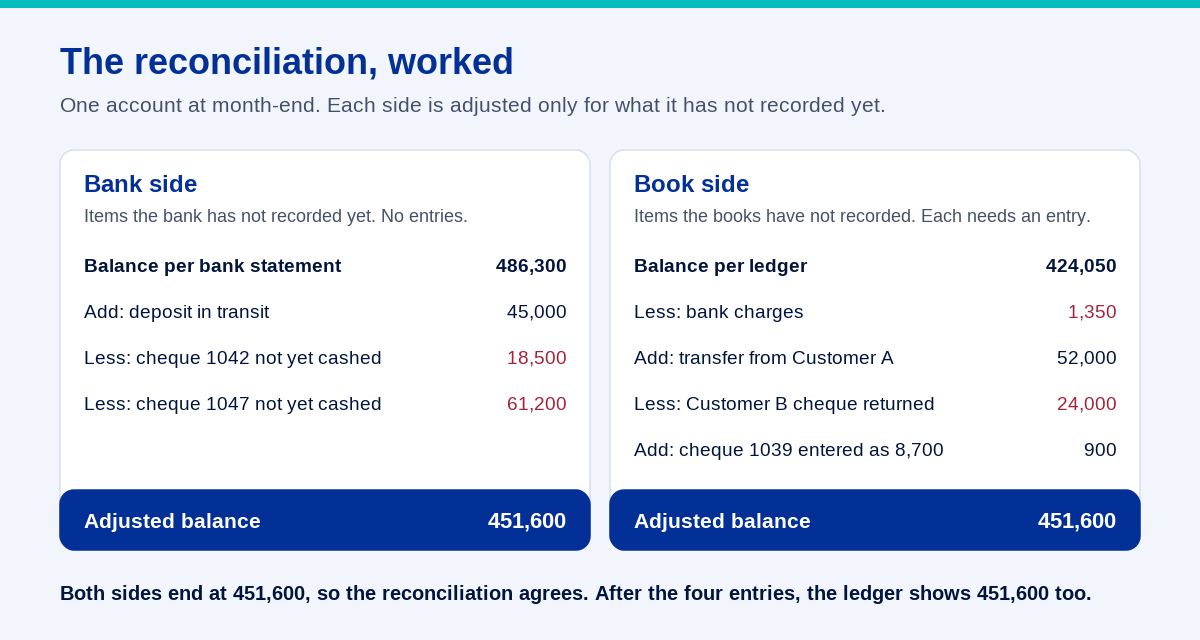
The bank side: 486,300 plus 45,000, minus 18,500 and 61,200, gives 451,600. The book side: 424,050 minus 1,350, plus 52,000, minus 24,000, plus 900, also gives 451,600. The two agree, so every difference is explained.
The entries for the book side
- Bank charges: debit bank charges expense 1,350; credit cash at bank 1,350.
- Customer A’s transfer: debit cash at bank 52,000; credit Customer A 52,000.
- Customer B’s returned cheque: debit Customer B 24,000; credit cash at bank 24,000. The customer owes the money again.
- Cheque 1039: debit cash at bank 900; credit the supplier 900. The original entry overstated both by 900, so this brings them back to 7,800.
After these four entries the ledger shows 451,600, the same as the adjusted balance. The deposit and the two cheques get no entry. They stay on the list, and next month you look for them on the statement.
What goes wrong the first time?
The usual mistakes are putting an item on the wrong side, posting entries for timing items, and forgetting last month’s list. Each one makes the reconciliation look finished while the books are still wrong, so check for all of them before you hand it in.
- Adding an uncashed cheque to the book balance. The books already recorded it; only the bank side moves.
- Posting an entry for a deposit in transit. Next month, when the bank records it, the deposit will be in your books twice.
- Starting from zero each month. Last month’s uncashed cheques should appear on this statement; if one does not, it stays on the list.
- Matching by amount alone. Two payments of the same amount can cross over; use the cheque number or transfer reference.
- Using balances from different dates, such as a statement to the 30th and a ledger printed on the 3rd with next month’s entries in it.
- Typing a balancing figure to close a small gap. Find the item; a gap of a few pounds can be two large errors netting off.
How do you check your own work before handing it in?
Check that the opening figure is the real statement balance and the real ledger balance on the same date, that every bank-side item has a date and a reference, and that the ledger after your entries equals the adjusted balance. Then look ahead: a deposit in transit should appear in the first days of next month’s statement. If it does not, tell your senior straight away.
If your company’s accounting system has a bank reconciliation screen, it does the ticking for you, but the logic is the same, and you still decide which side each leftover line belongs to. Learning it once by hand makes the screen much easier to trust and to question.
Common questions
- The two sides still differ after all the items. Where do I look?
- Recheck the arithmetic and the opening balances first. Then look for an amount equal to the difference, or to half of it (an item on the wrong side moves the total by twice its value). If the difference divides exactly by 9, look for two digits swapped, as in cheque 1039.
- A cheque has been uncashed for many months. Do I reverse it?
- Not on your own. Raise it with your senior: the payee may still present it, or the cheque may need to be cancelled with the bank and reissued. The decision and the entry belong to someone with authority.
- Do I reconcile to the bank balance or the book balance?
- To neither. Both are adjusted to a third figure, the true cash at bank on that date. In the example it is 451,600, different from both starting balances.
- How often should a bank reconciliation be done?
- At least monthly for every account, and more often for a busy account. The shorter the period, the fewer items you have to trace and the fresher the documents are.