
Key points
- Recording errors leave traces: a matching surplus in a similar item, a link to a specific invoice or transfer, or a difference that is an exact multiple of a pack size.
- Physical loss survives a recount by another team, has no document behind it, and tends to sit in small, valuable items and to recur.
- Not every physical loss is theft: damaged, expired and spoiled goods are losses with a cause you can document.
- Under IAS 2, losses of inventory are recognised as an expense in the period they occur, so record each part of the shortage by its cause.
- Take legal advice before accusing anyone. An unexplained shortage is first a control problem.
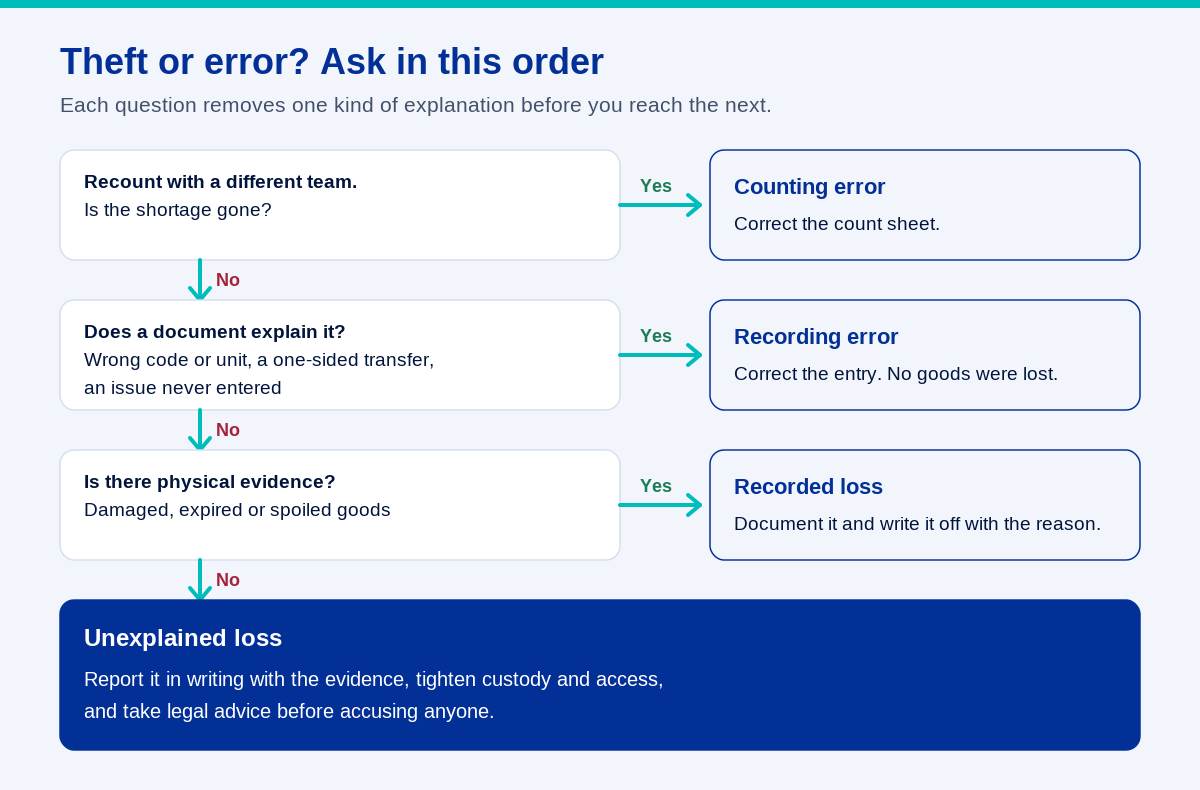
You tell theft from a recording error by looking at the pattern of the shortage; its size tells you little. A recording error usually leaves a trace you can follow: a surplus in a similar item, a link to one invoice or transfer, or a difference that is an exact multiple of a carton. Real loss survives a recount by a different team, has no document behind it, and tends to concentrate in small, valuable items and to come back count after count. Most shortages turn out to be a mix, so work through the recording explanations first and treat whatever is left as unexplained until the evidence says more.
This article starts where the count ends. How to run the count itself, and how to protect the evidence when it shows a large shortage, is covered in our stock count checklist.
Why not assume the worst straight away?
Because the stock figure in the books is only as good as the documents behind it, and a shortage is the gap between two numbers, one of which may be wrong. If the book quantity is overstated by a recording mistake, nothing has left the store. Accusing a storekeeper over a paperwork error damages trust and your position, and it leaves the real cause in place to produce the same shortage next year.
What does a recording error look like?
A recording error usually has a partner somewhere else in the records: an equal surplus, a document with the same quantity, a pack size that divides the difference exactly. Look for that partner before anything else. The table lists the patterns we check first and the document that confirms each one.
| What you see | Likely cause | What to check |
|---|---|---|
| A shortage in one item and a similar surplus in a similar item | Goods received or issued under the wrong code | Receipts and issues for both codes since the last count |
| A difference that is an exact multiple of the pack size | Cartons and pieces mixed up in one of the entries | The unit on the purchase and sales invoices against the unit in the system |
| A shortage equal to the quantity on one invoice or delivery note | Goods delivered but never deducted from stock, or a receipt entered twice | Delivery notes and issue vouchers around that date |
| Equal and opposite differences in two stores | A transfer recorded on one side only | The transfer document and both stores’ item cards |
| A shortage in items received just before the count | Stock entered from the supplier’s invoice, not from what arrived | The receiving note against the supplier invoice |
| A shortage that dates back to a system change or an opening balance | Wrong opening quantities carried forward | The item’s history back to the first balance |
What does a real loss look like?
A real loss is a shortage that is still there after an independent recount and after every document has been checked. It also has a shape. It sits in items that are easy to carry and easy to sell, it repeats from one count to the next, and it is often concentrated in one store, one shift or one period.
- It survives a recount by a team that does not work in that store.
- No receipt, issue, transfer or return explains it.
- It is concentrated in small, high-value or easily resold items rather than spread evenly.
- It recurs, count after count, in the same items or the same place.
- It began, or grew, at a time you can name: a new storekeeper, a new shift, an unlocked back door.
Physical loss also has innocent causes. Breakage, expiry, spoilage, and goods that lose weight or volume in storage all reduce what is on the shelf. They differ from theft in one practical way: you can usually see them, photograph them and document them, so they should not stay unexplained.
How do you work through a shortage, item by item?
Rank the shortage by value, take the largest items first, and put each one through the three questions. A handful of items usually account for most of the value, so you can explain most of the money long before you reach the bottom of the list.
- Value every shortage and surplus at cost, and sort the list by value, largest first.
- Before you investigate any shortage, look for a surplus in a similar item. Pair them where the codes, sizes or descriptions are close.
- Pull the item card for each large shortage: every receipt, issue, transfer and return since the last count.
- Check the unit of measure on the item and on the invoices that moved it.
- Check cut-off: documents dated in the last days before the count and the first days after it.
- Put each item’s shortage into one of four groups: counting error, recording error, recorded loss, unexplained. Total each group.
| Finding | Value (EGP) | Group |
|---|---|---|
| An item sold by the carton but deducted from stock as single pieces | 72,000 | Recording error |
| Deliveries in the last two days, invoiced but never issued from stock | 48,000 | Recording error |
| Broken and expired goods set aside with no document | 21,000 | Recorded loss |
| No document and no physical evidence | 45,000 | Unexplained |
| Total | 186,000 | All four groups |
In this example, a shortage that looked like EGP 186,000 of missing goods comes down to EGP 45,000 that nobody can explain. That is still a serious figure, and it now has a size, a list of items and a location, which is what you need to act on it.
How is a shortage recorded in the accounts?
Each group is recorded differently. A recording error is fixed by correcting the original entry, which often moves the amount into cost of sales, because the goods were in fact sold. A real loss, whether documented or unexplained, is an expense: IAS 2, the international standard on inventories, says losses of inventory are recognised as an expense in the period the loss occurs. Damaged goods that can still be sold for less are written down to what they will fetch, net of selling costs.
Keep the four groups separate in the entry narrative so that next year you can compare like with like. How a stock loss is treated for tax depends on the facts and the documents, so ask your tax adviser before you file. We do not represent clients before the Tax Authority.
When is it reasonable to suspect theft?
When the unexplained part is large enough to matter, keeps coming back, concentrates in particular items or a particular place, and the controls around that stock have a gap someone could use. Even then, a suspicion is something to investigate, and the first steps are to secure the evidence and close the gap in the controls.
- Keep the count sheets, the item cards and your analysis together, signed and dated.
- Separate custody from recording: the person who holds the stock should not be the person who enters its movements.
- Count the affected items more often, without notice, with a team from outside the store.
- Restrict access to the store and keep a record of who enters.
- Take legal advice before you confront or accuse anyone, or deduct anything from wages.
If the shortage keeps appearing because receipts, issues and transfers are not documented consistently, the fix is the documentary cycle, which the Foundation Package builds. If the cycle exists and you want someone outside the company to look at the stock movements every month, that is the monthly review.
Common questions
- What percentage of shortage is normal?
- There is no single figure that fits every business; it depends on the goods. Set your own tolerance per type of item from your history of documented breakage and spoilage, write it down, and investigate anything above it.
- Can I make the storekeeper pay for the shortage?
- That is a legal question that depends on the employment contract, the custody documents and the evidence. Take legal advice, and do not decide anything until the analysis has separated recording errors from real loss.
- Can I post one adjustment and move on?
- You can post the adjustment only after the analysis, split by group. One unexplained adjustment treats sold goods as lost, hides real loss among paperwork errors, and leaves you with nothing to compare against next year.
- Should the shortage be shown to the auditor?
- Yes. Give the auditor the count, the analysis and the adjustments. A shortage that has been analysed and documented is far easier to support than a single figure.
Sources
The pages the figures and rules in this article were checked against, read in November 2026.