
Key points
- IAS 2 and Egyptian Accounting Standard No. 2 allow FIFO or weighted average for interchangeable items, and specific identification for items that are not.
- IAS 2 does not permit LIFO; the IASB removed it in its 2003 revision of the standard.
- In the worked example, with purchase prices rising, FIFO gives cost of sales of EGP 273,500 and weighted average EGP 278,778 for the same 650 cartons.
- Whichever formula you use, stock is carried at the lower of cost and net realisable value, and the same formula must be used for items of a similar nature and use.
FIFO and weighted average are the two cost formulas IAS 2 and Egyptian Accounting Standard No. 2 allow for stock items that are interchangeable, such as cartons of the same product. FIFO assumes the oldest units leave first, so closing stock carries the latest prices; weighted average gives every unit the same average cost. When purchase prices rise, FIFO shows lower cost of sales and higher profit. This article works one month of a distribution company’s stock through both, so you can see the difference in numbers.
Which inventory cost methods are allowed in Egypt?
Egyptian Accounting Standard No. 2, as amended in 2015, names three. Specific identification is for items that are not interchangeable, such as goods made for a particular project (paragraphs 23 and 24). For all other items, paragraph 25 requires FIFO or weighted average. The standard does not provide for LIFO, and IAS 2 does not permit it.
| Method | When it is used | Allowed? |
|---|---|---|
| Specific identification | Items not ordinarily interchangeable, or kept for a specific project | Yes, and required for those items |
| FIFO, first in first out | Interchangeable items | Yes |
| Weighted average, periodic or after each delivery | Interchangeable items | Yes |
| LIFO, last in first out | None | No: IAS 2 does not permit it, and EAS 2 does not provide for it |
Paragraph 25 adds a consistency rule: the same formula must be used for all inventories of a similar nature and use. Paragraph 26 says that keeping stock in different regions, or under different tax rules, is not by itself a reason to use different formulas for the same kind of stock. The IASB removed LIFO when it revised IAS 2 in 2003, explaining in its Basis for Conclusions that the method does not reliably show actual stock flows and can distort profit.
What does the worked example look like?
A food distribution company sells one product, cartons of cooking oil, at EGP 520 a carton. In November it starts with 200 cartons, buys twice at rising prices and sells twice. The figures are invented for the example, but the pattern of rising purchase prices is the case where the choice of method matters most.
| Date | Movement | Cartons | Unit cost | Total |
|---|---|---|---|---|
| 1 Nov | Opening stock | 200 | 400 | 80,000 |
| 5 Nov | Purchase | 300 | 420 | 126,000 |
| 12 Nov | Sale | 350 | By method | By method |
| 18 Nov | Purchase | 400 | 450 | 180,000 |
| 25 Nov | Sale | 300 | By method | By method |
| 30 Nov | Closing stock | 250 | By method | By method |
Goods available for sale are 900 cartons costing EGP 386,000 (80,000 + 126,000 + 180,000). Sales are 650 cartons, bringing in EGP 338,000. Every method splits the same 386,000 between cost of sales and closing stock; only the split changes.
How do you calculate cost of sales with FIFO?
Issue each sale from the oldest layer first, and move to the next layer only when the oldest is used up. In the example, cost of sales comes to EGP 273,500 and the 250 cartons left are all from the 18 November purchase, valued at EGP 112,500.
- 12 November sale of 350 cartons: all 200 opening cartons at 400 (80,000) plus 150 from the 5 November purchase at 420 (63,000). Cost: 143,000.
- 25 November sale of 300 cartons: the remaining 150 from 5 November at 420 (63,000) plus 150 from 18 November at 450 (67,500). Cost: 130,500.
- Cost of sales for the month: 143,000 + 130,500 = 273,500.
- Closing stock: 250 cartons from 18 November at 450 = 112,500. Check: 386,000 less 273,500 = 112,500.
How do you calculate weighted average cost?
Paragraph 27 of EAS 2 allows the average to be worked out periodically or each time a delivery arrives. The periodic version uses one average for the whole month. The moving version recalculates the average after every purchase, which is what most accounting systems do automatically. They give slightly different answers.
- Periodic average: 386,000 ÷ 900 cartons = EGP 428.89 a carton. Cost of sales: 650 × 428.89 = 278,778 (rounded). Closing stock: 250 cartons = 107,222.
- Moving average, after 5 November: 500 cartons costing 206,000, an average of 412. The 12 November sale of 350 costs 144,200, leaving 150 cartons at 61,800.
- Moving average, after 18 November: 550 cartons costing 241,800, an average of 439.64. The 25 November sale of 300 costs 131,891 (rounded), leaving 250 cartons at 109,909.
- Moving average cost of sales: 144,200 + 131,891 = 276,091. Check: 386,000 less 109,909 = 276,091.
How different are the results?
With prices rising through the month, FIFO gives the lowest cost of sales and the highest gross profit, because the cheaper old cartons are charged first. The periodic average gives the highest cost of sales. Between them, the gap in gross profit is EGP 5,278 on one product in one month. If prices were falling, the order would reverse.
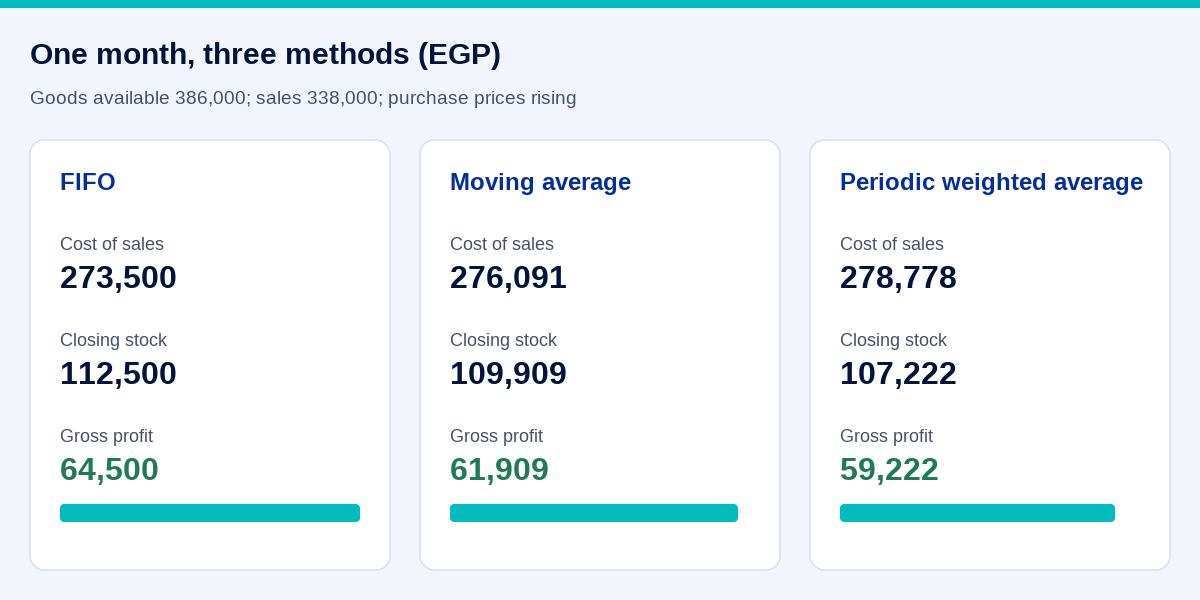
| Method | Cost of sales | Closing stock | Gross profit |
|---|---|---|---|
| FIFO | 273,500 | 112,500 | 64,500 |
| Moving average | 276,091 | 109,909 | 61,909 |
| Periodic weighted average | 278,778 | 107,222 | 59,222 |
What happens when stock is worth less than its cost?
It is written down. Both standards measure inventory at the lower of cost and net realisable value, the expected selling price less the costs still needed to sell. Suppose 50 of the closing cartons are dented and can only be sold at EGP 380, with EGP 20 of selling costs each. Their net realisable value is 360 against a FIFO cost of 450, so the company writes them down by 50 × 90 = EGP 4,500, recognised as an expense in the period (EAS 2, paragraph 34).
If the price recovers in a later period while the cartons are still in stock, paragraph 33 of EAS 2 requires the write-down to be reversed, but only up to the amount originally written down, so the stock never goes back above cost.
Which method should a distribution company choose?
Choose the one your system and your team can apply correctly every month, then keep it. FIFO matches the physical flow of most food and consumer goods, where old stock should leave first, and its closing stock is close to current prices. Moving average is simpler to run in a system and smooths price swings. Changing method later counts as a change in accounting policy, so decide carefully at the start.
- Set the method in the ERP or accounting system before the first receipt, and check that it is the same for every warehouse holding the same kind of stock.
- Make sure every receipt is posted before the sales that follow it. With moving average, a late-posted purchase changes the cost of every later sale.
- Count stock at least at each year end, and reconcile the count to the system before closing.
- Review slow-moving and damaged items each quarter for net realisable value.
Common questions
- Can I use FIFO in one warehouse and weighted average in another?
- Not for the same kind of stock. EAS 2 paragraph 26 says a different location is not by itself a reason for a different formula. Different kinds of stock with a different use can justify different formulas.
- Is LIFO allowed for tax purposes in Egypt?
- This article covers the accounting standards, which do not provide for LIFO. For tax treatment, check the current law with the Egyptian Tax Authority; Kayan Finance does not represent clients before it.
- Which method gives the higher profit?
- When purchase prices are rising, FIFO; when they are falling, weighted average. Over the life of the business the total profit is the same; the methods move it between periods.
- Do I include transport and customs in the cost?
- Yes. EAS 2 includes in the cost of purchase the purchase price, import duties and non-recoverable taxes, transport and handling, less trade discounts. Recoverable VAT is not part of cost.
Sources
The pages the figures and rules in this article were checked against, read in November 2026.
- ifrs.org/issued-standards/list-of-standards/ias-2-inventories
- aasb.gov.au/admin/file/content105/c9/IAS2_BC_1-22.pdf
- tarekmansour.com/wp-content/uploads/2021/06/02-المخزون.pdf
- fra.gov.eg/wp-content/uploads/2025/05/معاييرالمحاسبةالمصرية110لسنة2...