
Key points
- The income statement records a sale when it is invoiced. The bank records it when the customer pays. The gap between the two is where profitable companies run short.
- Six things absorb profit before it reaches the bank: customer balances, stock, equipment, loan repayments, owner withdrawals and the timing of tax and supplier payments.
- In our example a wholesaler made EGP 465,000 of profit in a year, and its cash fell by EGP 376,000.
- Growth uses cash: more sales mean more money waiting with customers and more stock on the shelves.
- Comparing two balance sheets, a year apart, shows where your own cash went in under an hour.
Your company can be profitable and short of cash at the same time because profit and cash are measured at different moments. Profit counts a sale when you invoice it and a cost when you incur it. Cash moves only when money is paid. Between those two moments the profit sits in places the bank balance does not show: invoices your customers have not paid, stock you have not sold, equipment you bought, loans you repaid and money the owner took out. The cash is in whichever of these grew during the period.
Why is profit different from the cash in the bank?
Accounts are kept on an accrual basis: income belongs to the period in which it is earned, and costs to the period in which they are incurred, whatever the date of payment. That makes the income statement a fair measure of performance. It also means the income statement says nothing about whether the money has arrived. A sale on 60 days’ credit is profit today and cash in two months, if the customer pays on time.
Some cash payments never appear on the income statement at all. Buying stock is not an expense until the stock is sold. Buying a van is not an expense; only its yearly depreciation is. Repaying a loan’s principal is not an expense; only the interest is. Money the owner withdraws is not an expense either. Every one of these takes cash out of the bank and leaves profit untouched.
Where does the profit go before it reaches the bank?
Take the example wholesaler used across this series. In 2025 it made a net profit of EGP 465,000. Its bank balance went from EGP 400,000 on 1 January to EGP 24,000 on 31 December, a fall of EGP 376,000. The owner’s first reaction was that the accountant had made a mistake. The accountant had not. The money had gone into the places below.
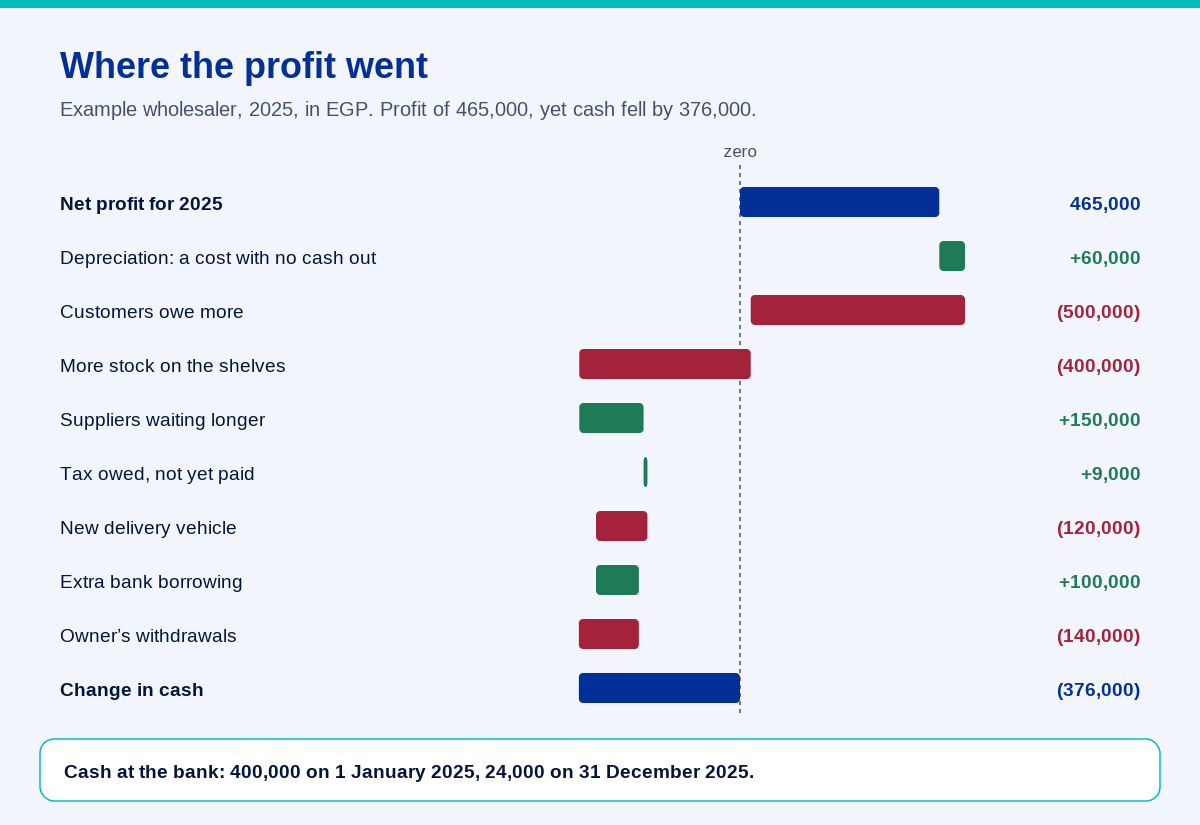
| Where | What happens | Example, EGP |
|---|---|---|
| Customers | Sales are invoiced on credit and counted as profit before they are collected | 500,000 more owed by customers |
| Stock | Goods are paid for when bought but become a cost only when sold | 400,000 more stock |
| Equipment and vehicles | Paid in full on purchase, charged to profit slowly through depreciation | 120,000 for a delivery vehicle |
| Loans | Repaying principal uses cash but is not an expense; new borrowing brings cash in | 100,000 of net new borrowing (cash in) |
| The owner | Withdrawals and dividends leave the bank but are not expenses | 140,000 withdrawn |
| Timing of payments | Suppliers, tax and other bills owed but not yet paid hold cash in the company for now | 150,000 more owed to suppliers, 9,000 more tax due (cash kept) |
Add the profit and depreciation (EGP 525,000), take away the cash that went to customers, stock, the vehicle and the owner (EGP 1,160,000), and add back what suppliers, the tax authority and the bank effectively lent the company (EGP 259,000). The result is the fall of EGP 376,000.
Is it growth, or is something wrong?
Usually some of each. Growth always uses cash: when sales rise, more money waits with customers and more stock sits on the shelves, even if nothing else changes. The way to separate the two is to measure how many days of sales your customers owe and how many days of cost your stock represents, and compare with last year.
In the example, customers owed EGP 900,000 at the end of 2024 on sales of EGP 5 million, about 66 days of sales. At the end of 2025 they owed EGP 1.4 million on sales of EGP 6 million, about 85 days. Stock went from about 75 days of cost of sales to about 96. Had both stayed at last year’s level, customers would have owed about EGP 320,000 less and stock would have been about EGP 235,000 lower. That is EGP 555,000, more than the whole fall in cash. Growth explains part of the story. Slower collection and heavier buying explain the rest.
Days of sales owed by customers = customer balances ÷ annual sales × 365. Days of stock = stock ÷ annual cost of goods sold × 365. Work both out for this year and last year; a rise in either one is cash you can get back.
How do you find out where your own cash went?
Compare two balance sheets, one at the start of the period and one at the end, and list what changed. You need the income statement for the same period and an hour. The formal version of this exercise is the cash flow statement, covered in its own article in this series, but the rough version below is enough to start a conversation with your accountant.
- Write down net profit for the period, and add back depreciation.
- Subtract the increase in what customers owe you (or add it, if it fell).
- Subtract the increase in stock (or add it, if it fell).
- Add the increase in what you owe suppliers, tax and other bills (or subtract it, if it fell).
- Subtract what you spent on equipment, vehicles and fit-out.
- Add new borrowing and subtract loan principal repaid.
- Subtract what the owners took out.
- Compare the total with the actual change in the bank and cash balances. If they do not agree, something is missing from the books, and that is a finding in itself.
What can you do to bring the cash back?
Work on the places that grew. For most small trading companies that means customers and stock first, because those are where the largest sums sit and where a few weeks of attention release cash without new borrowing.
- Customers: invoice on the day of delivery, agree credit terms in writing, and review an ageing list every week. Stop new credit to a customer whose old invoices are overdue.
- Stock: list the items that have not moved in 90 days and stop reordering them. Buy against confirmed sales where you can, and count regularly so the stock figure is real.
- Suppliers: ask for terms that match what you give your customers. If you pay suppliers in 15 days and customers pay you in 60, you are financing the 45 days between them yourself.
- Equipment: pay for long-lived assets with long-term money, such as a loan or the owner’s capital, so the cash you need for daily trading is not used up.
- The owner: agree a monthly withdrawal the company can afford, and take more only after the cash forecast shows it is there.
- Forecast: keep a simple weekly cash forecast for the next three months, so a shortfall is visible before it arrives.
Common questions
- Can a profitable company run out of cash?
- Yes. Salaries, rent and suppliers are paid in cash, not profit. A company that grows quickly on credit sales can be profitable every month and still miss a payroll.
- Why do you add depreciation back?
- Depreciation reduced profit, but no cash left the company when it was recorded. The cash left when the asset was bought, so it is counted there instead. Adding depreciation back does not create cash; it stops it being counted twice.
- Should I take a loan to fix the shortage?
- Find out first where the cash went. If it is in overdue customer balances or slow stock, a loan pays interest on money you could collect yourself. Borrowing makes more sense for a planned asset purchase or a seasonal peak you can forecast.
- My numbers do not reconcile to the bank. What does that mean?
- It usually means the books are incomplete: unrecorded transfers, personal payments through the company account, or a bank account that is not reconciled. Reconcile the bank first; until then neither the profit nor the cash picture can be trusted.