
Key points
- Most interviews for a junior accountant mix four kinds of question: technical basics, a short practical test of journal entries, Excel, and personal questions.
- Answer a technical question in three moves: define the term, give a small example with numbers, then say where it shows in the financial statements.
- Expect to write entries for purchases and sales with VAT at the standard 14% rate, an accrual and a month of depreciation.
- Know VLOOKUP as well as XLOOKUP: Microsoft notes that XLOOKUP is not available in Excel 2016 and Excel 2019.
A fresh accounting graduate in Egypt is usually asked four kinds of question: technical basics such as the accounting equation and accruals, a short practical test of journal entries, Excel, and personal questions about how you work. This article gives the questions that come up most often in each group, a model answer for each, and a worked practical test with six transactions. The answers are short on purpose, because an interviewer is listening for understanding and a long answer hides it.
What does an accounting interviewer want to find out?
Three things: whether you understand double entry well enough to record a transaction you have not seen before, whether you can work in Excel without help, and whether you will check your own work. Every question below tests one of those. A graduate is not expected to know tax law in depth or to have used a particular ERP.
| Kind | Typical question | What it checks |
|---|---|---|
| Technical basics | What is the difference between an accrual and a prepayment? | That you understand the logic, not only the definitions |
| Practical test | Record these five transactions | That you can apply double entry quickly and accurately |
| Excel | How would you total sales by customer? | That you can work without someone beside you |
| Personal | Tell me about a mistake you made | Honesty, and whether you check your own work |
Which technical questions come up most, and how should you answer them?
Answer each in three moves: define the term in one sentence, give a small example with numbers, and say where it appears in the financial statements. That structure shows understanding and stops you rambling. The ten questions below cover most of what a junior interview asks, and the model answers use that structure.
- 1. What is the accounting equation?
- Assets equal liabilities plus equity. If a company borrows EGP 100,000, cash rises by 100,000 and loans by 100,000, so the equation still holds. It is the structure of the balance sheet.
- 2. Which accounts are debited and which credited?
- A debit increases assets and expenses; a credit increases liabilities, equity and income. Paying rent of EGP 20,000 by bank debits rent expense and credits the bank.
- 3. What is the difference between the accrual basis and the cash basis?
- The accrual basis records income when earned and expenses when incurred; the cash basis records them when money moves. November electricity billed in December belongs to November under the accrual basis, as an accrued expense.
- 4. What is the difference between an accrued expense and a prepaid expense?
- An accrued expense is used but not yet paid, so it is a liability. A prepaid expense is paid but not yet used, so it is an asset: a year’s rent of EGP 240,000 paid in January is released at EGP 20,000 a month.
- 5. What does a trial balance prove, and what does it not?
- It proves total debits equal total credits. It does not catch an entry posted to the wrong account, an entry left out completely or the same error on both sides.
- 6. How do you prepare a bank reconciliation?
- Start from the bank statement balance, adjust for cheques issued but not yet cashed and deposits not yet credited, and compare with the books. Items only the bank knows, such as bank charges, are entered in the books.
- 7. How do the three financial statements connect?
- Net profit from the income statement goes into retained earnings on the balance sheet. The cash flow statement starts from that profit and explains the change in the cash balance on the balance sheet.
- 8. What is depreciation, and why is it not a cash payment?
- It spreads a fixed asset’s cost over its useful life. The cash left when the asset was bought; a machine of EGP 120,000 over five years with no residual value gives EGP 24,000 of expense a year.
- 9. What is the difference between FIFO and weighted average?
- FIFO assumes the oldest units are sold first, so closing stock carries the latest prices. Weighted average values every unit at the average cost. Both are allowed under IAS 2 and Egyptian Accounting Standard No. 2; IAS 2 does not permit LIFO.
- 10. How does VAT work on a purchase and a sale?
- A registered company adds VAT to its sales and deducts the VAT it paid on related purchases; the difference is paid to the Tax Authority. At the standard 14% rate, VAT of 21,000 on sales less 14,000 on purchases leaves 7,000 to pay.
What does a practical accounting test look like?
Usually a sheet of five to ten transactions for one month, and you write the journal entry for each. Some companies add a question at the end, such as the VAT due or the balance of one account. Below is a worked example for a small trading company in November, with VAT at the standard 14% rate under Law No. 67 of 2016.
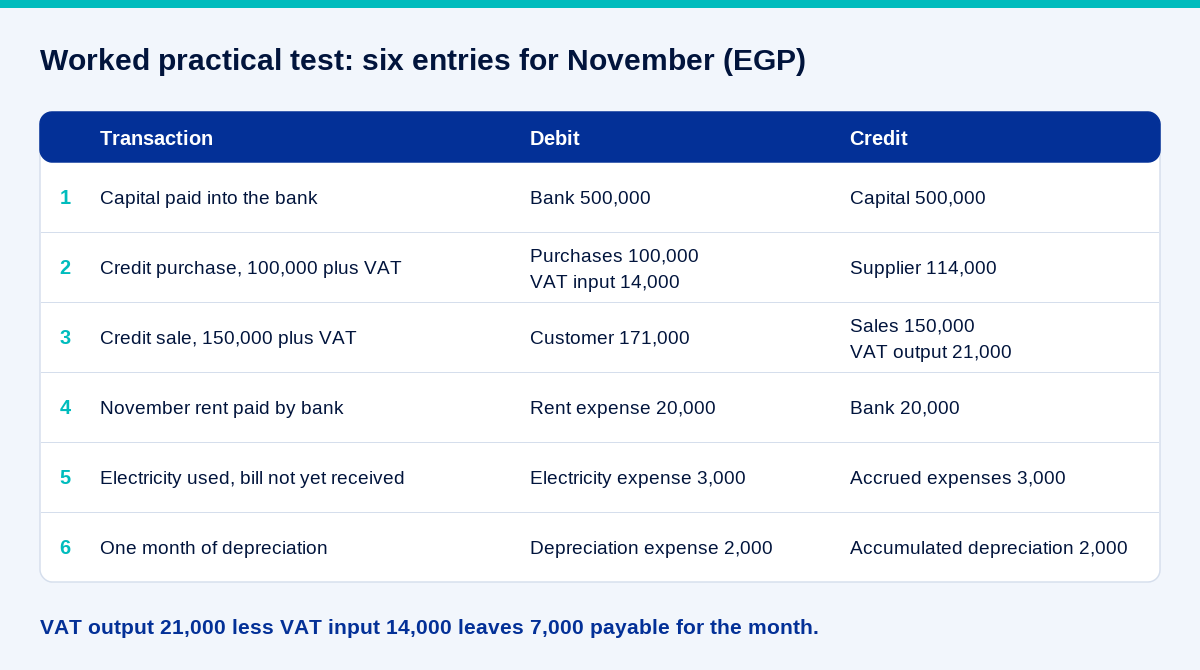
| Transaction | Debit | Credit |
|---|---|---|
| Owner pays in capital of 500,000 to the bank | Bank 500,000 | Capital 500,000 |
| Goods bought on credit for 100,000 plus VAT | Purchases 100,000; VAT input 14,000 | Supplier 114,000 |
| Goods sold on credit for 150,000 plus VAT | Customer 171,000 | Sales 150,000; VAT output 21,000 |
| November rent paid by bank transfer | Rent expense 20,000 | Bank 20,000 |
| November electricity, bill not yet received, estimated | Electricity expense 3,000 | Accrued expenses 3,000 |
| One month’s depreciation on equipment | Depreciation expense 2,000 | Accumulated depreciation 2,000 |
Two habits score points here. Write the explanation line under each entry, as you would in a real journal, and check that every entry balances before you move on. If a transaction is ambiguous, write the assumption you made in one line.
What Excel questions should you expect?
Expect to be asked how you would total, look up and summarise data, and sometimes to do it on a laptop in front of the interviewer. Learn both VLOOKUP and XLOOKUP: Microsoft’s own page notes that XLOOKUP is not available in Excel 2016 and Excel 2019, and you may be given an older version.
- Totals with conditions: SUMIFS, for example sales by customer and month. Say why you prefer it to filtering and adding by hand.
- Lookups: VLOOKUP and XLOOKUP, for example bringing a customer’s credit limit from another sheet. Know what the error means when the value is not found.
- Summaries: a PivotTable of sales by branch and month, built in under two minutes.
- Checking: how you would compare two lists, such as the bank statement and the bank ledger, to find the items in one and not the other.
- Rounding: why ROUND belongs in an invoice formula, so totals agree to the piastre.
How do you answer the personal questions?
With a short true story: what happened, what you did and what came of it. A graduate has less work history, so use training, a graduation project, a part-time job or a family business. Keep each answer to about a minute, and end on what you would do the same way next time.
| Question | What they want to know | A way to answer |
|---|---|---|
| Tell me about yourself | Whether you can be brief and relevant | Degree, one piece of practical experience, why this job, in under a minute |
| Tell me about a mistake you made | Honesty, and whether you learn from errors | A real, small mistake, how you found it, how you fixed it and what you now check |
| Why should we hire you? | Whether you understand the job | Two things you can do from day one, such as entries and Excel, and one you are learning |
| What salary do you expect? | Whether you have looked at the market | Give a range you have checked with people in similar jobs, and say you are flexible for the right training |
| Where do you see yourself in five years? | Whether you will stay and grow | A direction, such as cost accounting or audit, and the qualification you plan to study for |
How should you prepare in the week before?
Spend most of the week on practice rather than reading. Saying answers aloud and writing entries by hand exposes gaps that rereading notes hides. Five steps are enough, and none needs more than an evening.
- Revise the basics aloud: answer the ten technical questions above, each in under a minute, with a number in every answer.
- Write the practical test by hand without looking, then check each entry and the VAT balance.
- Build one small Excel file: a sales list of 50 rows, then SUMIFS, VLOOKUP or XLOOKUP, and a PivotTable on it.
- Prepare three short stories: a mistake you found, a deadline you met and something you learned alone.
- Read about the company: what it sells, its size and which accounting system it uses, and write two questions to ask.
What should you ask at the end of the interview?
Ask about the work itself. Good questions show you are already thinking about doing the job, and the answers tell you whether you will learn there.
- Which accounting system do you use, and who would train me on it?
- What would a normal month look like for this role, and when is the month closed?
- Who reviews my entries in the first months?
- Is there a documented chart of accounts and documentary cycle, or is that still being built?
Common questions
- Will the interview be in Arabic or English?
- It depends on the company. Prepare the technical answers in both, because an interviewer may switch to English for terms such as accruals or trial balance even in an Arabic interview.
- What if I do not know the answer?
- Say so, then say how you would find out: which standard, which colleague or which report you would check. Guessing confidently and being wrong costs more than an honest gap.
- Do I need to know a specific accounting system?
- Not as a graduate. Knowing what any system does, such as posting, ledgers, reports and period closing, matters more than one product. If you have used one, say which and what you did in it.
- Should I mention certificates I am still studying for?
- Yes, with the stage you have reached, such as one part passed. Do not list it as complete.
Sources
The pages the figures and rules in this article were checked against, read in November 2026.
- eta.gov.eg/sites/default/files/2024-02/Law-english-no.67-2016.pdf.pdf
- support.microsoft.com/en-us/office/xlookup-function-b7fd680e-6d10-4...
- ifrs.org/issued-standards/list-of-standards/ias-2-inventories
- aasb.gov.au/admin/file/content105/c9/IAS2_BC_1-22.pdf
- tarekmansour.com/wp-content/uploads/2021/06/02-المخزون.pdf