
Key points
- Keep the CV to one page: contact details, a two-line profile, education, practical experience, skills, then training and languages.
- With little work history, practical experience includes summer training, a graduation project, part-time work and a family business.
- Write each line as what you did and what came of it, with a number where you have one: 120 invoices a month, not "handled invoices".
- List training such as a CFI course under training, and a qualification you are still studying for with the stage reached.
A fresh accounting graduate’s CV should be one page that shows, in this order, how to reach you, what you studied, what practical accounting work you have done, and which tools you can use. The person reading it is usually an accountant or a manager with a pile of CVs and a short time for each, looking for proof that you can record entries, use Excel and check your work. This article gives the sections, a sample, and the mistakes that most often make a good graduate look weaker on paper.
What sections should a fresh graduate’s CV have?
Six sections, on one page: contact details, a short profile, education, practical experience, skills, and training with languages. Put practical experience above skills, because it is the evidence for them. Leave out anything that does not help an accounting manager decide, such as hobbies, a full home address or a photo unless the advert asks for one.
| Section | What to include | Keep it to |
|---|---|---|
| Contact details | Name, mobile, email, city, LinkedIn link; for men, military service status | Two lines |
| Profile | Degree, the work you want, two things you already do well | Two sentences |
| Education | Degree, faculty, university, year, grade; graduation project title | Three or four lines |
| Practical experience | Training, part-time work, family business, projects, each with what you did | Two or three items, three lines each |
| Skills | Accounting tasks you can do, Excel functions, any system used | Four to six lines |
| Training and languages | Courses with provider and year; Arabic and English level, honestly | Three or four lines |
What does a good fresh graduate CV look like?
The sample below is invented, but every line is the kind a real graduate can write. Notice that the experience section is built from summer training and a family shop, and that each line says what was done and how much of it. Nothing on it claims more than a graduate could show in an interview.
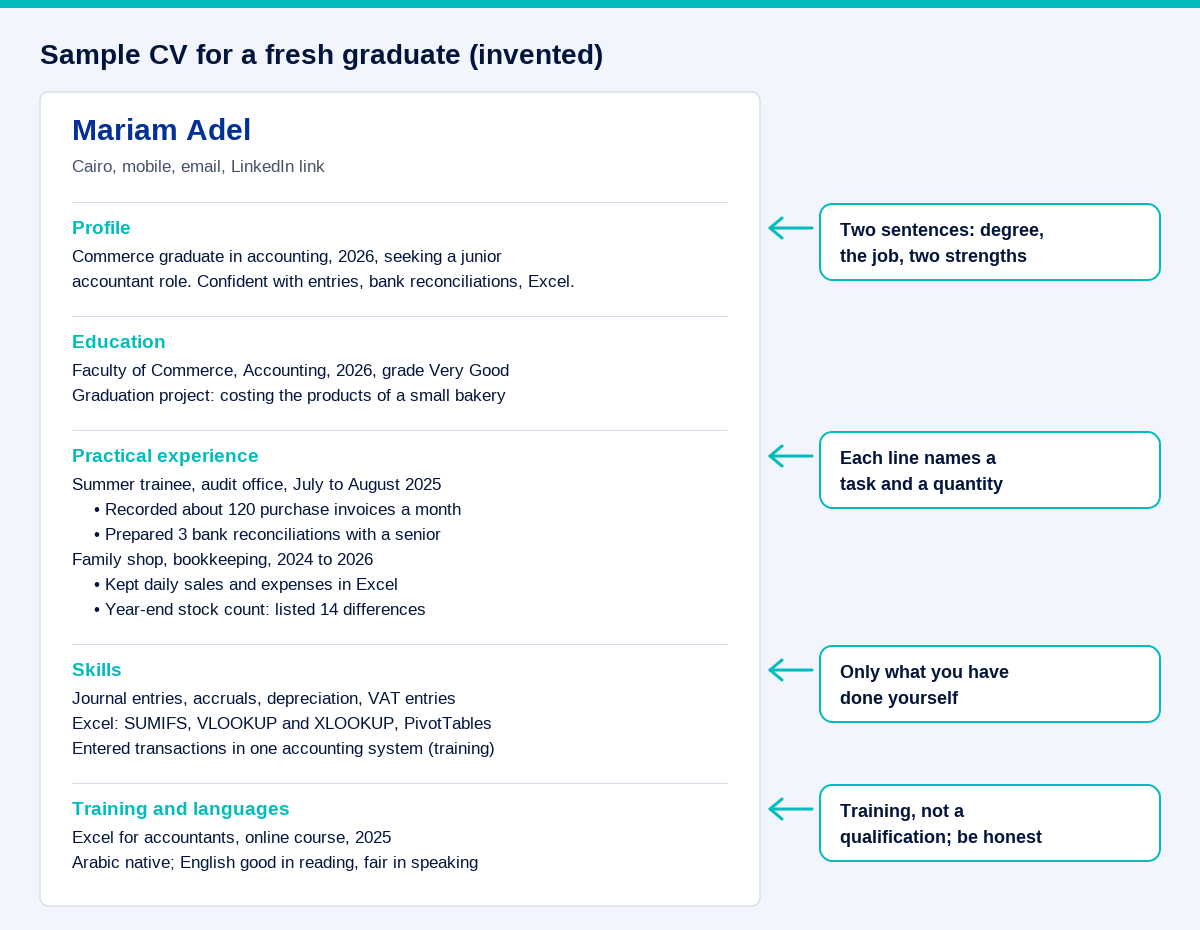
How do you fill the experience section with no job yet?
Count any work where you handled real accounting tasks, paid or not: summer training at an audit office, a part-time job, keeping the books of a family shop, a volunteering role that involved money, or a graduation project with real numbers. Describe each by the tasks you did and their size. One honest line with a number is worth more than three general ones.
| Weak | Stronger |
|---|---|
| Responsible for invoices | Recorded about 120 purchase invoices a month in the accounting system during a two-month training |
| Good at Excel | Built a monthly sales summary with SUMIFS and a PivotTable for a shop with three product lines |
| Helped with the stock count | Counted and recorded one of four store sections in a year-end stock count and listed 14 differences for review |
| Team player, hard-working | Leave it out; show it through the lines above, or in the interview |
Which CV mistakes should a graduate avoid?
Most mistakes fall into three groups: length and layout, vague wording, and claims you cannot back up in an interview. The last group is the most costly, because an accounting manager will test anything you list, and one failed answer makes the rest of the page doubtful. The ten below are the ones to check before sending.
- Two or three pages. A graduate’s CV fits on one.
- An "objective" paragraph about wanting a challenging role in a reputable company. Replace it with two sentences on what you can do.
- Listing course subjects (Financial Accounting 1, Cost Accounting 2). The degree already says that; use the space for practical work.
- Skills with no evidence, such as "excellent in Excel" with nothing that shows it.
- An accounting system named as a skill when you only saw it in a lecture. Name a system only if you entered transactions in it.
- A certificate listed as if complete when you have only enrolled. Write the stage: "CMA Part 1, studying" or "one part passed".
- Short courses listed under professional qualifications. A CFI or similar course goes under training.
- Spelling mistakes in accounting terms, such as "reconcilation" or "accural". An accountant reading the CV notices.
- An email address that is not your name, or a phone number with a missing digit. Check both twice.
- A Word file with odd formatting on the reader’s screen. Send a PDF named with your name.
Should the CV be in Arabic or English?
Follow the job advert: if it is written in English, send an English CV; if in Arabic, send Arabic. Keep both versions ready if you can. Whichever you send, write accounting terms correctly in that language, and state your English level honestly, because an interviewer may switch languages to check it.
How should you list courses and certificates?
Separate training from qualifications. Short online courses, including the CFI certifications, go under training with the provider and the year. Professional qualifications that also require experience and membership of a body, such as the CMA, go in their own line once complete, and with the stage reached while you are still studying. Our article on CFI certifications explains the difference in detail.
What should you check before sending?
Read the CV aloud once, slowly, then ask someone else to check every name and number. Adapt the profile and the order of skills to each advert, which takes ten minutes and makes the CV answer what that company asked for. Save it as a PDF with your name and the job title in the file name.
Common questions
- Should I put my grade on the CV?
- Yes, if it helps you; a reader who does not see it may assume it is low. If it is modest, put it plainly and let the experience section carry the page.
- Do I need a photo?
- Only if the advert asks for one. If you add it, use a plain, recent, professional photo.
- Can I use a CV template from the internet?
- Yes, a simple one with one column and clear headings. Avoid designs with skill bars and graphics: a bar that says "Excel 80%" tells the reader nothing they can check.
- Should I include references?
- Not on the page. Write nothing, or "available on request", and have two names ready, such as your training supervisor and a professor, after asking their permission.
Sources
The pages the figures and rules in this article were checked against, read in November 2026.
- imaglobal.org/certifications/cma/how-to
- support.microsoft.com/en-us/office/xlookup-function-b7fd680e-6d10-4...