
Key points
- General accounting is the usual first job: entries, bank reconciliations, the trial balance and the month-end close. Every other path builds on it.
- Cost accounting suits someone who likes operations: stock, production, and what each product really costs.
- External audit means working in an audit office. In Egypt the ESAA qualification requires three years of training in one, so the choice is made early.
- Finance manager is rarely a first step. It usually comes after years in general accounting or audit, plus budgeting, cash planning and dealing with banks.
- Choose your first move by the work you enjoy on an ordinary day, and change direction early if it is wrong.
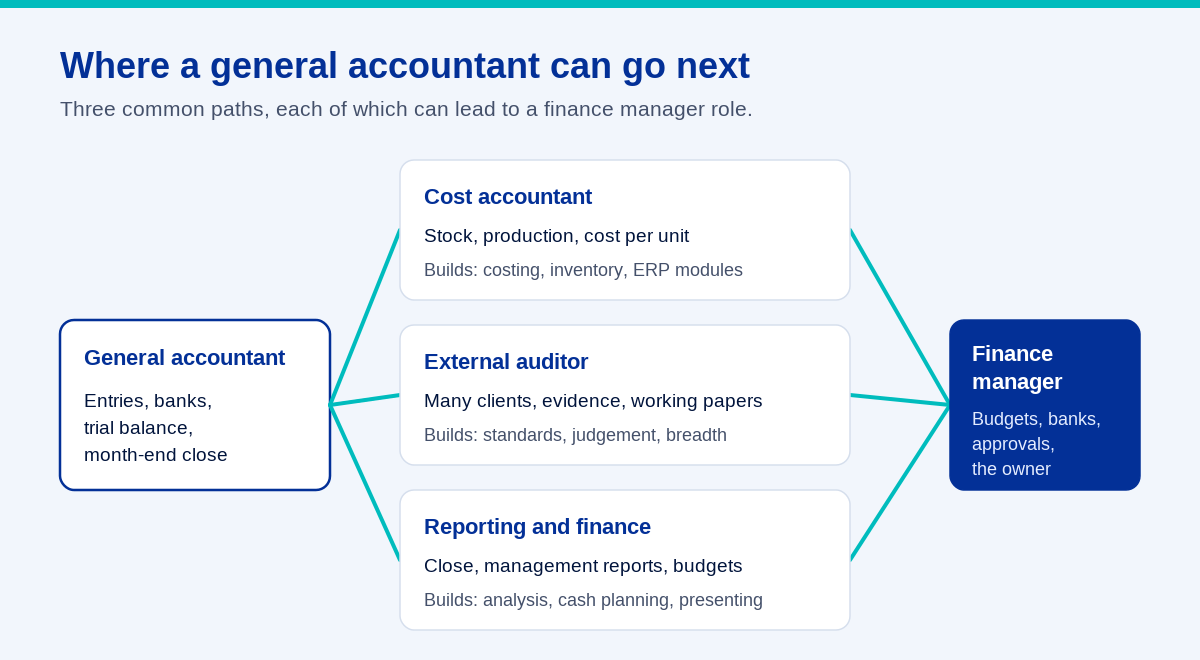
A fresh accounting graduate in Egypt usually starts as a general accountant and, within two or three years, moves towards one of three paths: cost accounting inside a company, external audit in an audit office, or reporting and finance work that leads to a finance manager role. Choose by the work you enjoy on an ordinary day, because each path is a different daily routine. The audit path needs the earliest decision, since it starts with training in an audit office.
What does a general accountant do, and why start there?
A general accountant records the company’s transactions and keeps the books in order: journal entries from invoices and receipts, bank reconciliations, customer and supplier balances, the trial balance, and the month-end close. It is the best first job because every other path assumes you can do it. A cost accountant who cannot reconcile a ledger, or an auditor who has never closed a month, is working from theory.
In a small company the general accountant often does all of it alone, including payroll entries and tax filings prepared for an outside adviser. In a larger one the work is split: one person on payables, another on receivables, another on banks. The small company teaches breadth faster; the larger one teaches how a documentary cycle and approvals work when many people touch the same transaction.
How do the three paths compare?
The three paths differ in where you work, what a normal week looks like, and which skills grow fastest. Cost accounting keeps you inside one company and close to operations. Audit moves you between clients and teaches you many businesses quickly. Reporting and finance keeps you in one company, close to management and the numbers it decides on.
| Item | Cost accountant | External auditor | Reporting and finance |
|---|---|---|---|
| Where you work | A factory, a contractor, a restaurant group: any company that makes or assembles things | An audit office, visiting clients | Any company with a finance team |
| A normal week | Stock movements, production orders, cost per unit, variance against standard | Testing balances, collecting evidence, writing working papers | Closing the month, preparing management reports, budgets and cash forecasts |
| Skills that grow | Inventory, costing methods, Excel, ERP stock and manufacturing modules | Standards, judgement, reading many businesses, writing clearly | Financial statements, analysis, presenting numbers to owners |
| Matching qualification | CMA (cost management and performance are part of its first exam) | ESAA qualification or ACCA | CMA or ACCA |
Who suits cost accounting?
Cost accounting suits someone who likes to know how things are made and is comfortable on a factory floor or in a warehouse. The work answers one question for management: what does each product or job really cost, and why did it cost more this month? You will spend time with storekeepers and production staff, run stock counts, and build cost sheets that link materials, labour and overheads to output.
The risk is staying too narrow. A cost accountant who never sees the full financial statements can get stuck. Ask to join the month-end close and the budget, so the cost numbers you produce connect to the profit the owner reads.
Who suits external audit, and when must you decide?
Audit suits someone who is curious, careful and happy to move between clients. In one season you may see a trading company, a factory and a clinic, which shows you more kinds of business in two years than one company job can. The cost is pressure around year-end, travel to clients, and a lot of documentation.
Decide early. The Egyptian Society of Accountants and Auditors requires at least three consecutive years of training under a registered contract, in the office of one of its fellows or members, an office registered with the society, or the Central Auditing Organization. Years spent in a company’s accounts department do not count towards it, so a graduate who wants to become an auditor in Egypt should look for an audit office from the start.
How do you get to finance manager?
A finance manager decides what the numbers mean and what the company does about them. The role adds budgets, cash planning, dealing with banks and the tax adviser, setting approval limits, and explaining results to the owner in plain words. People usually reach it from general accounting or from audit, after several years, once they can run a full close without help and have prepared at least one budget.
- From general accounting: ask to own a piece of the close each year, then the whole close, then the budget.
- From audit: after two or three years, move to a client-side role such as chief accountant, where your knowledge of standards and controls is used every day.
- From cost accounting: move towards planning and budgeting, where your knowledge of operations is rare and valued.
- In every case, learn to present: one page of numbers and three sentences of explanation is what an owner reads.
How do you choose your first move?
Use your first year to find out what you enjoy, then commit. These steps make that year count.
- Decide on audit first, because it is the only path with a timing rule. If you want it, apply to audit offices now.
- If you take a company job, ask in the interview which parts of the close you would handle, and prefer the job that gives you the trial balance, not just one ledger.
- Keep a weekly note of the tasks you did and which ones you enjoyed. After six months the pattern is usually clear.
- Learn Excel properly in the first year: lookups, pivot tables and a clean reconciliation. Every path uses it.
- Pick a qualification only after the path. The CMA fits cost and finance work; the ESAA qualification and ACCA fit audit.
- Review your direction at the end of year two. Moving then costs little; moving after five years costs more.
Any first job that teaches you to close a month is a good start. What holds a career back is five years in one narrow task without asking for more.
Common questions
- Can I move from a company job into audit later?
- Yes, but in Egypt the ESAA training clock only starts when you register a training contract in an audit office or the Central Auditing Organization. Earlier company years do not count towards those three years.
- Is cost accounting only for factories?
- No. Contractors cost each project, restaurants cost each dish, clinics and schools cost each service. Any business that wants to price correctly needs someone who knows its costs.
- Do I need a qualification to become a finance manager?
- No law requires one for a finance manager in a private company, as far as we know, but employers often ask for one, and the CMA and ACCA both cover planning and financial management. Experience of running a close and a budget matters more.
- What if I do not enjoy any of these?
- Accounting also leads to tax, internal audit, treasury and systems work such as ERP implementation. Your first years in general accounting are useful in all of them.
Sources
The pages the figures and rules in this article were checked against, read in November 2026.
- esaa.org.eg/المؤهل-المهني/التقديم-لشهادة-عضوية-الجمعية
- imaglobal.org/assets/static/cma-content-specification-outlines-2024...
- imaglobal.org/certifications/cma/how-to
- accaglobal.com/gb/en/qualifications/glance/acca/how.html